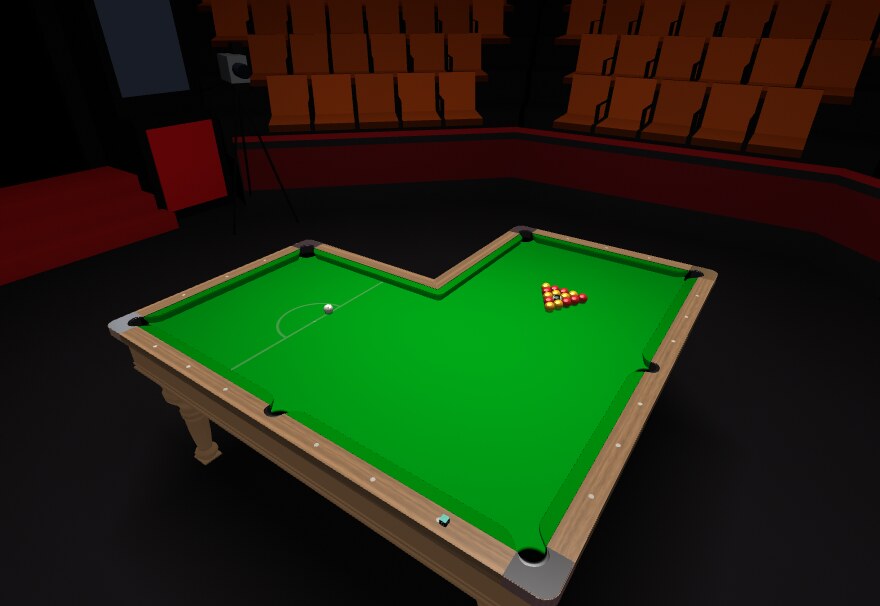
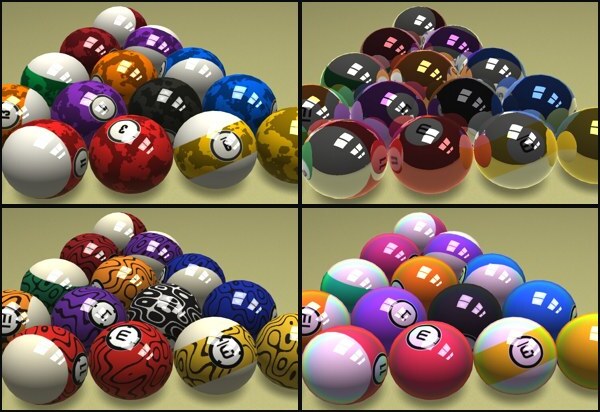
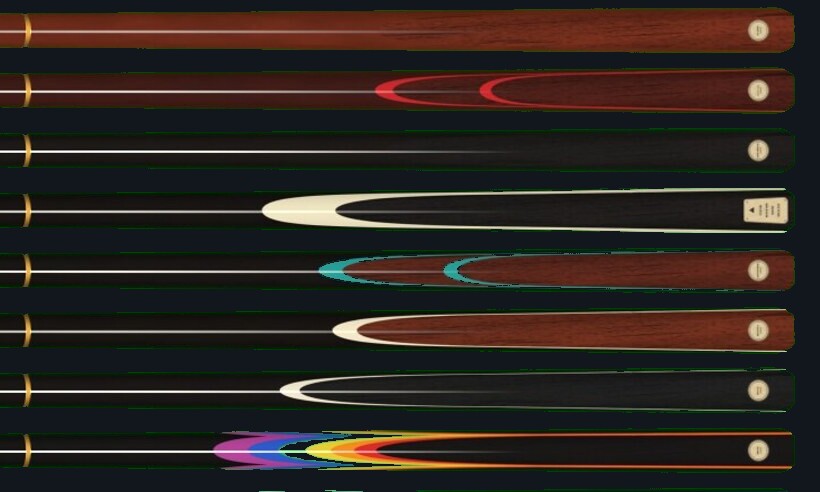
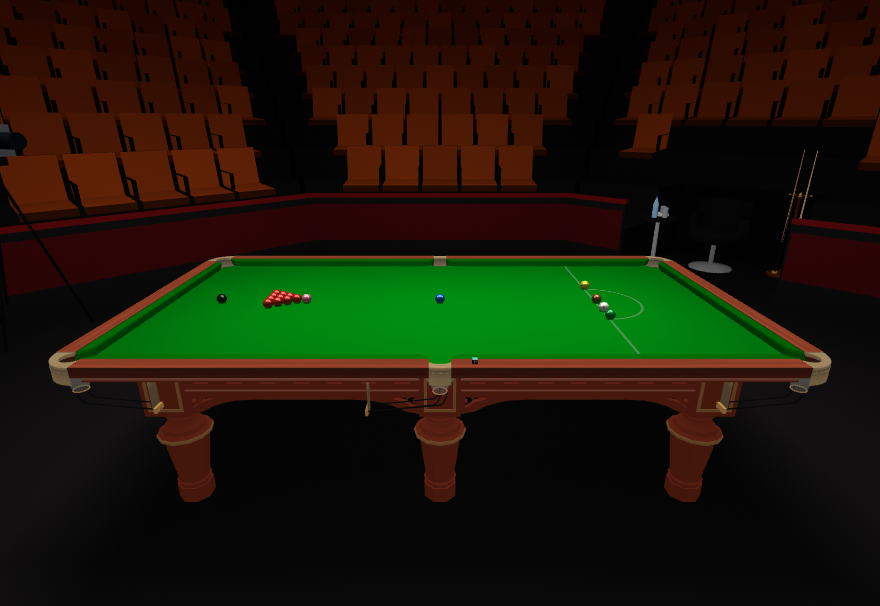
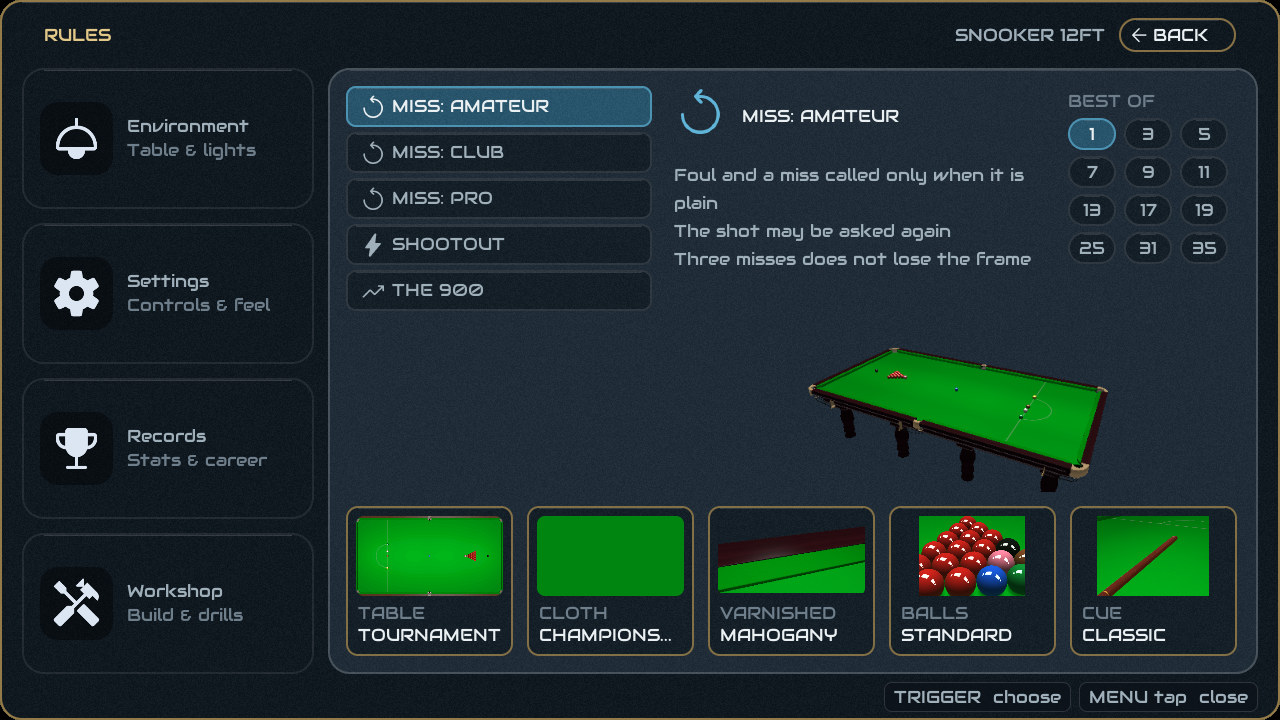
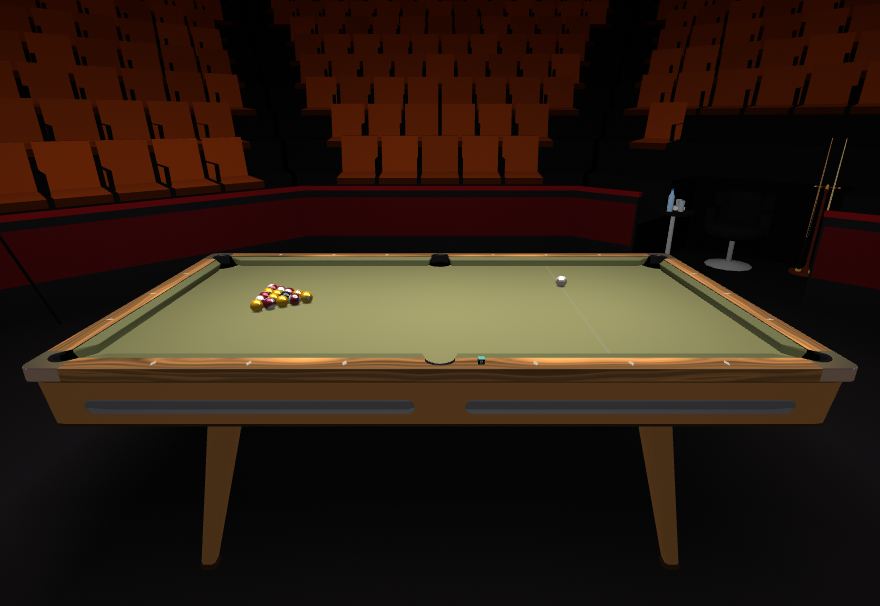
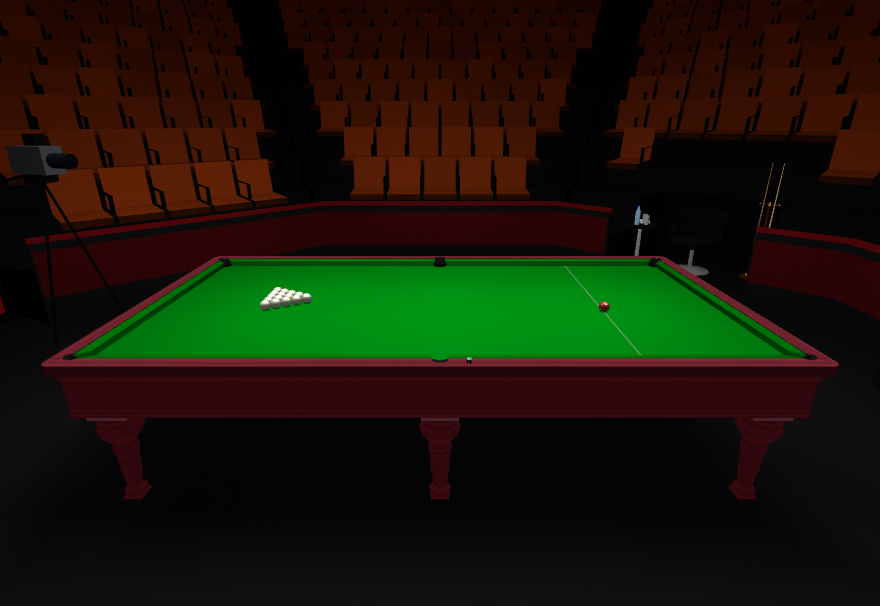
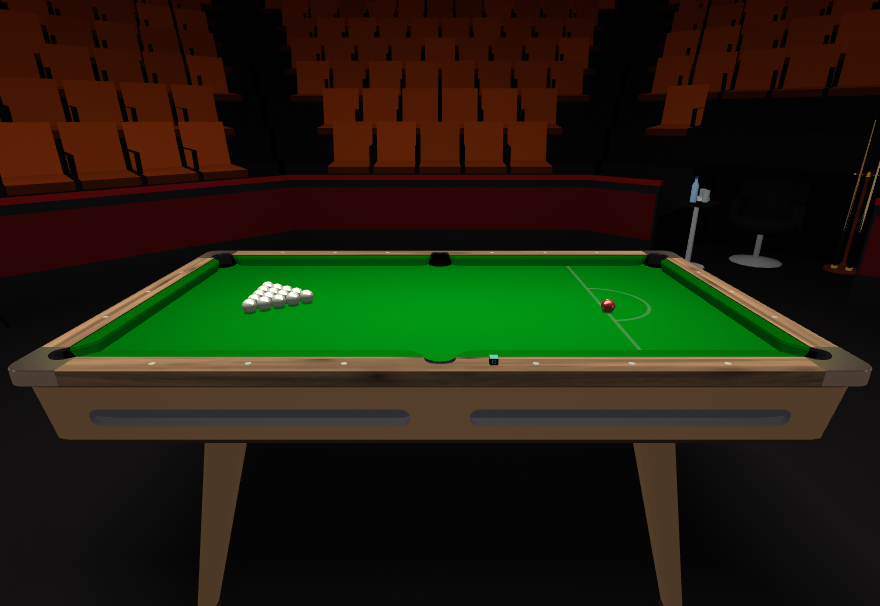
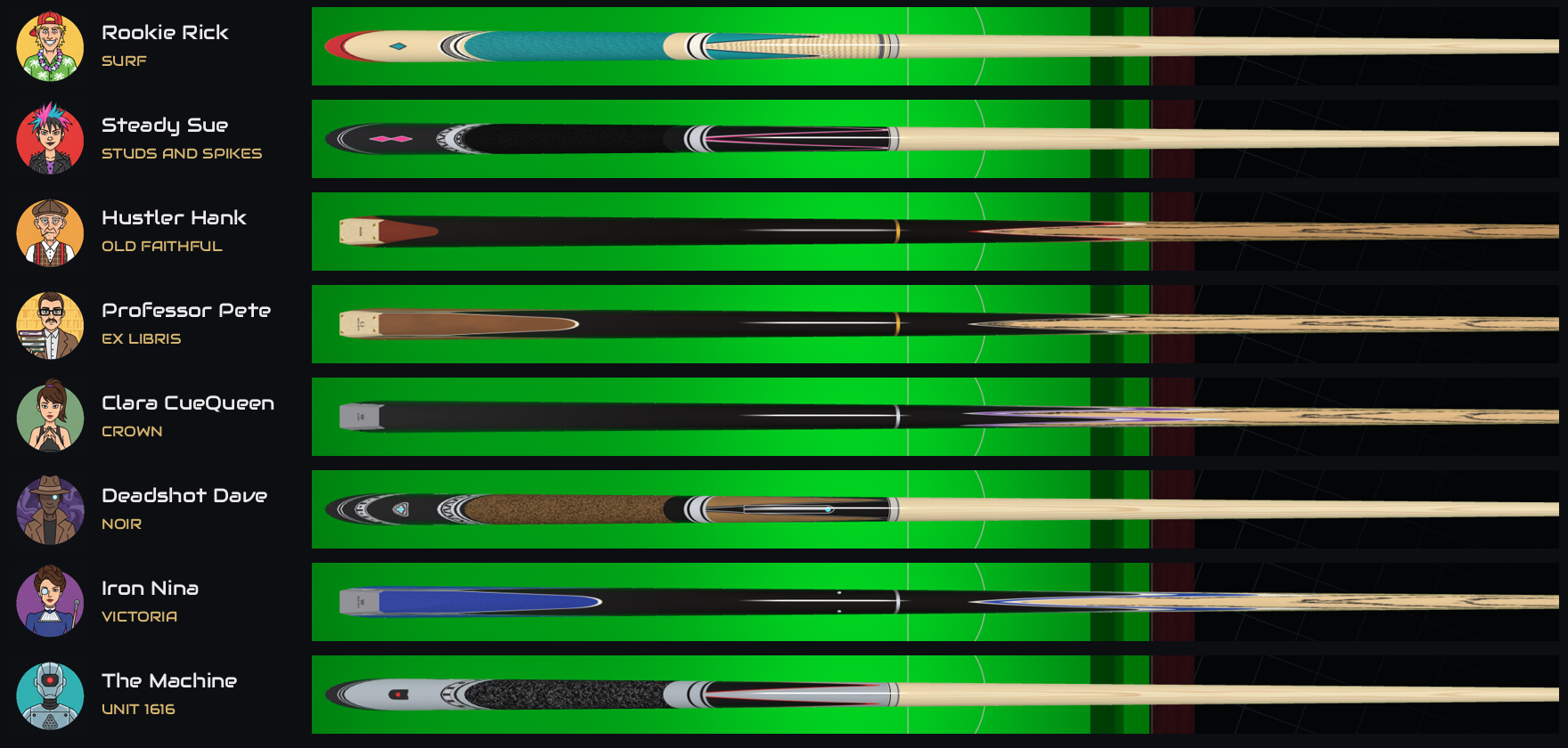
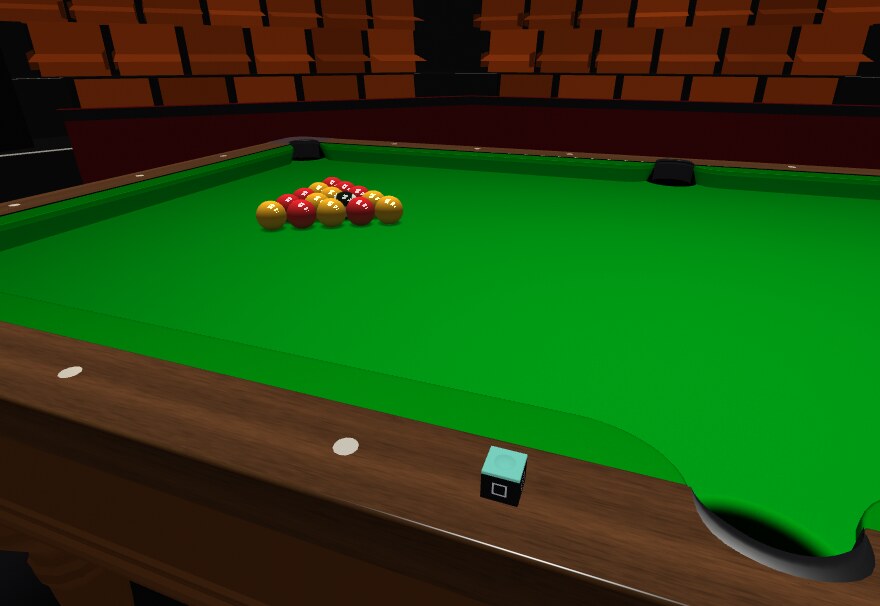
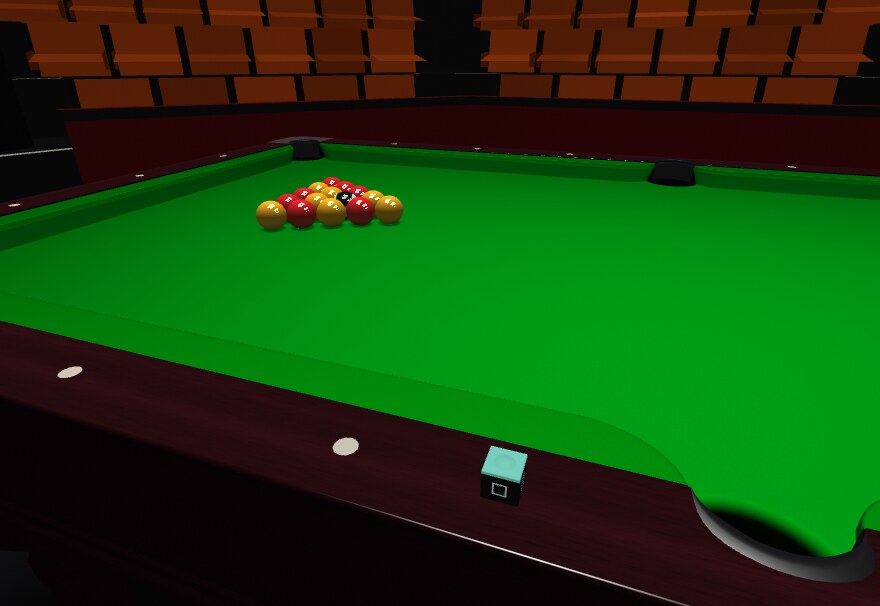
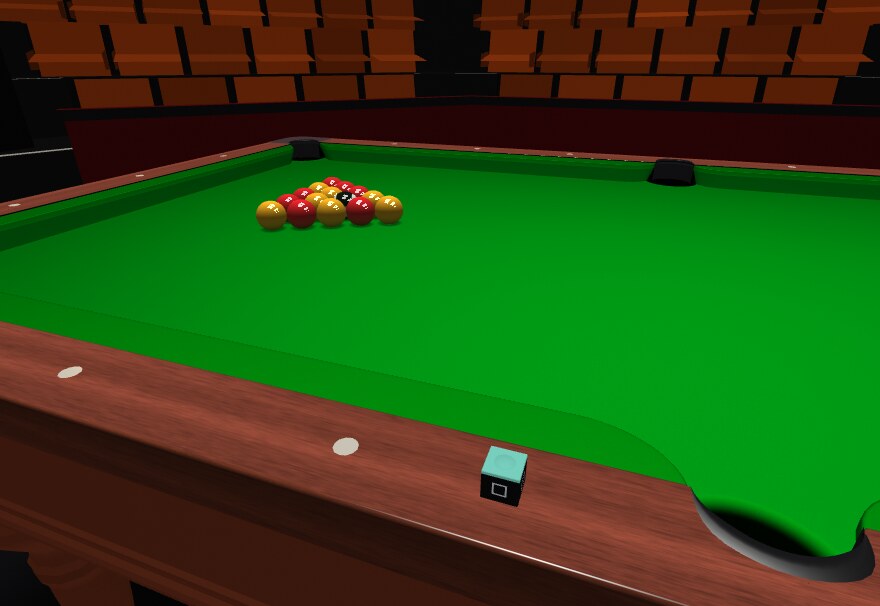
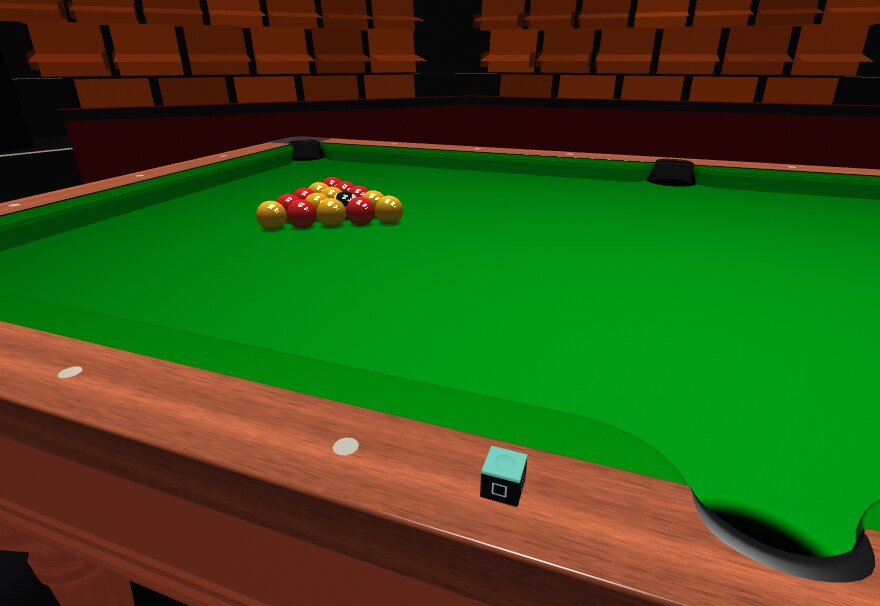
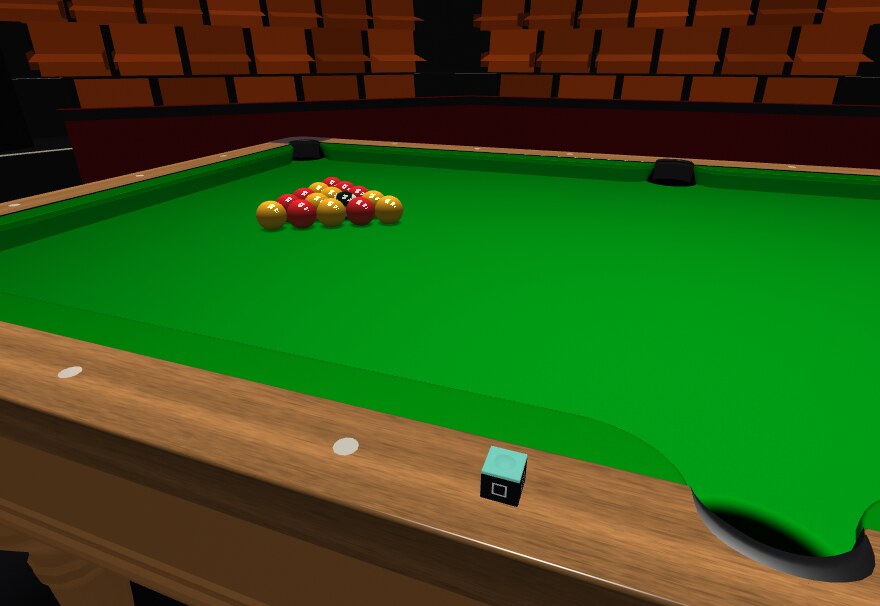
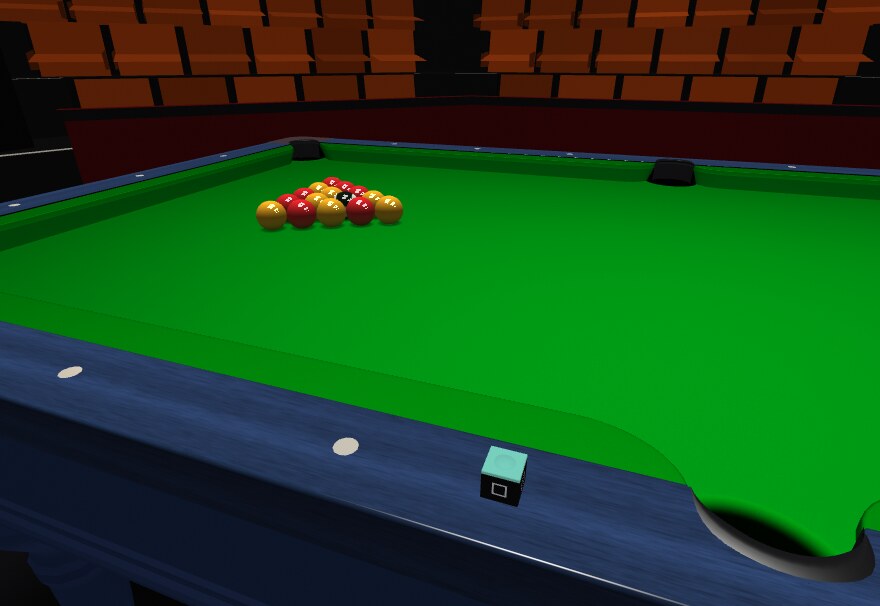
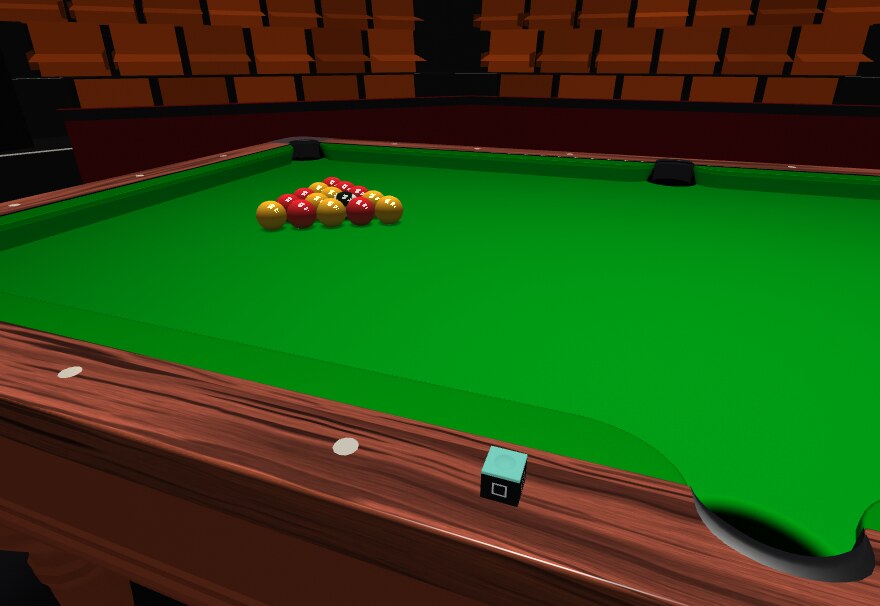
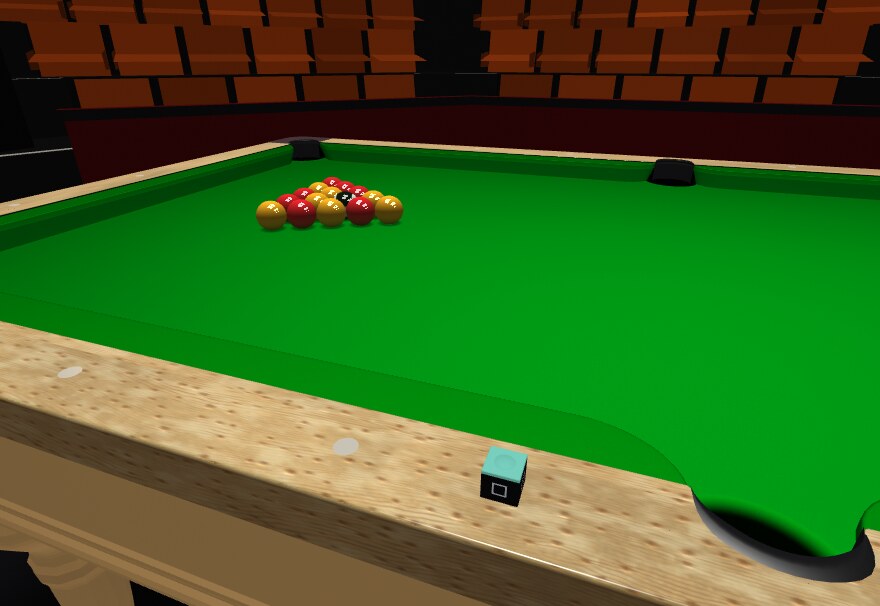
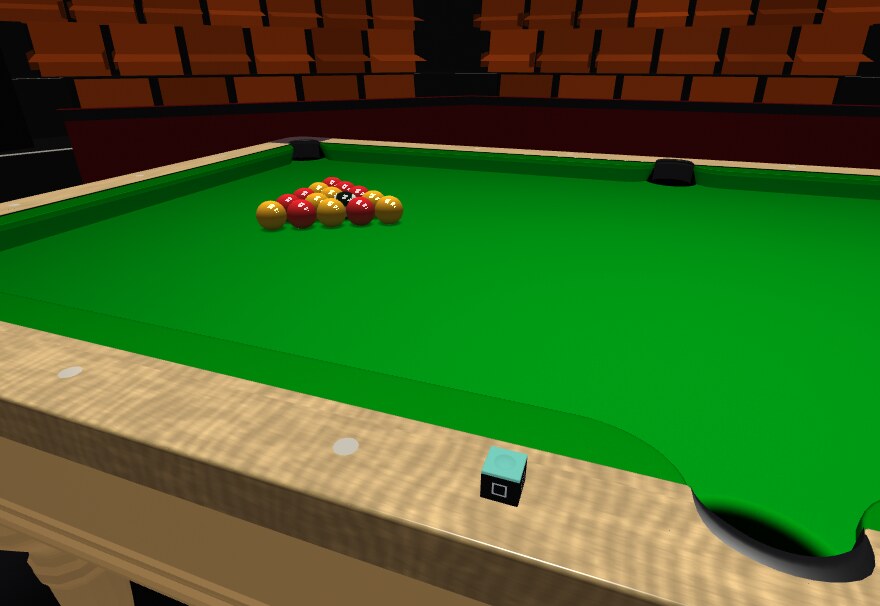
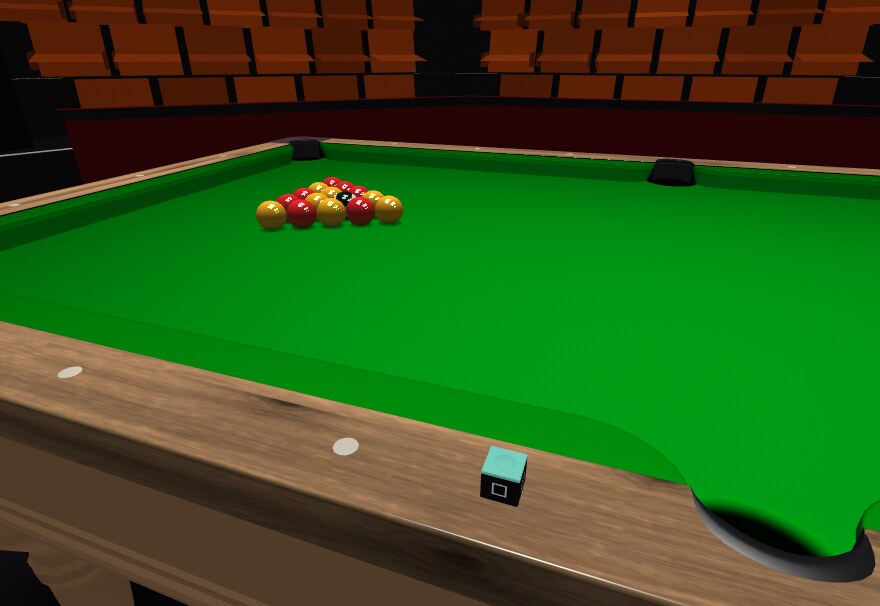
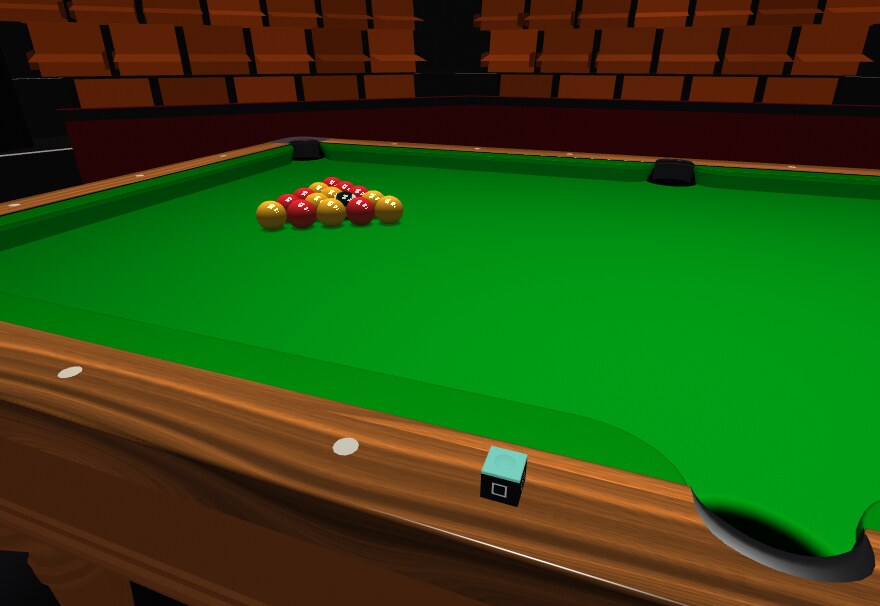
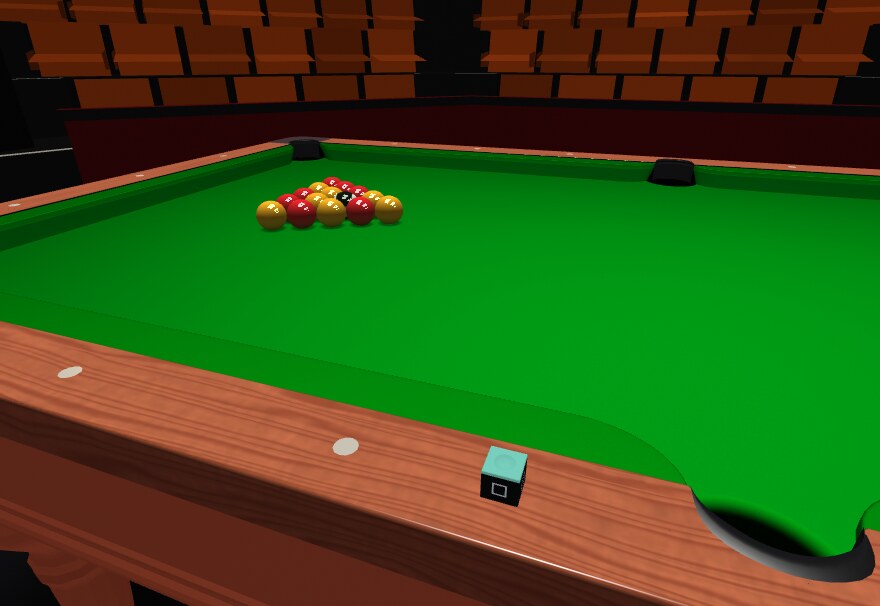
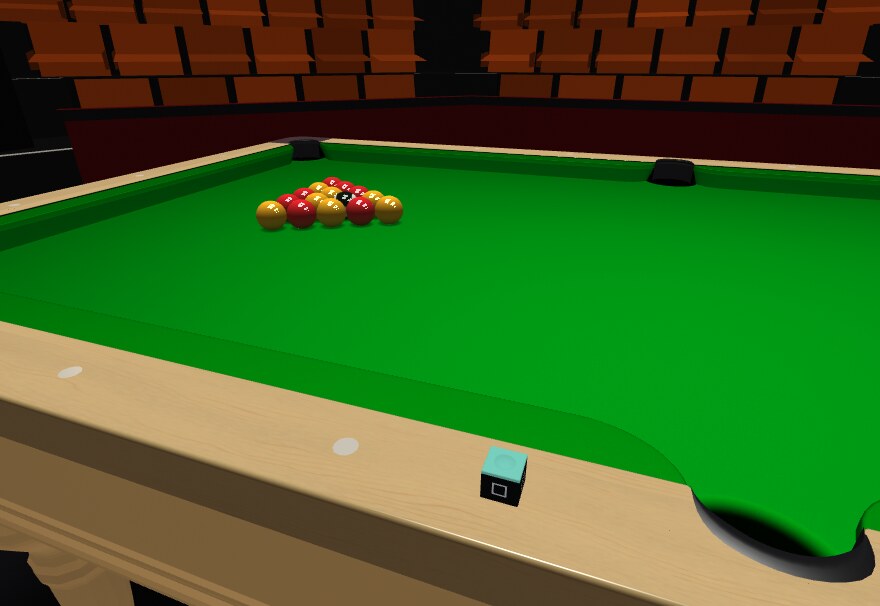
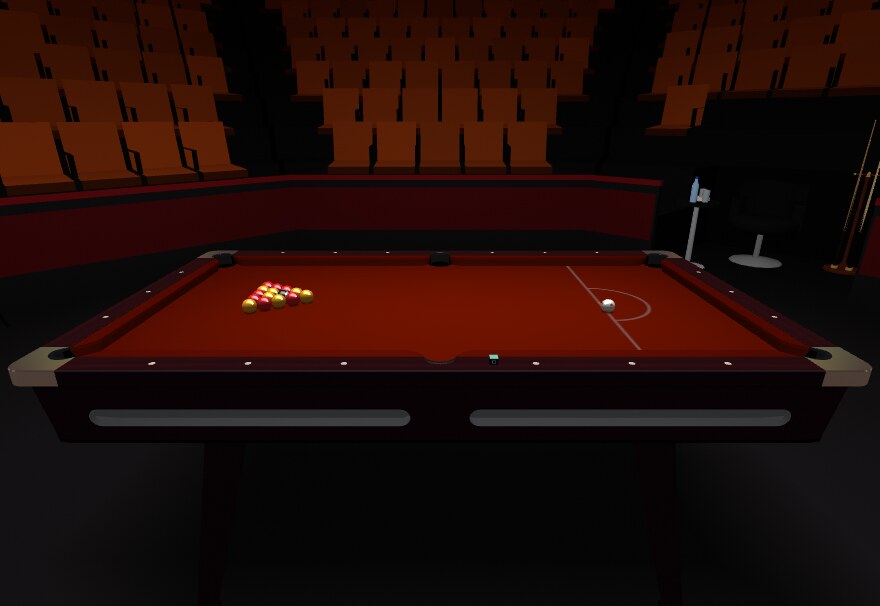
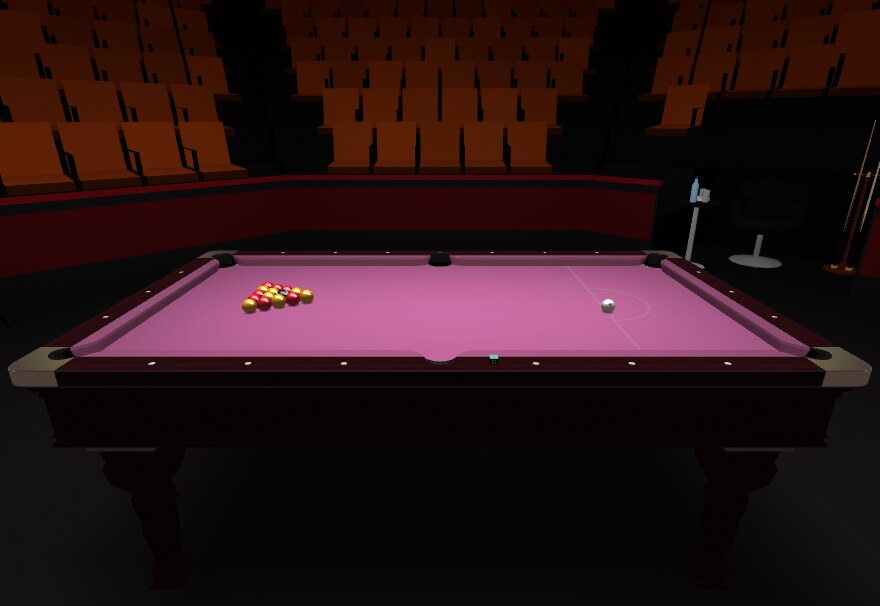
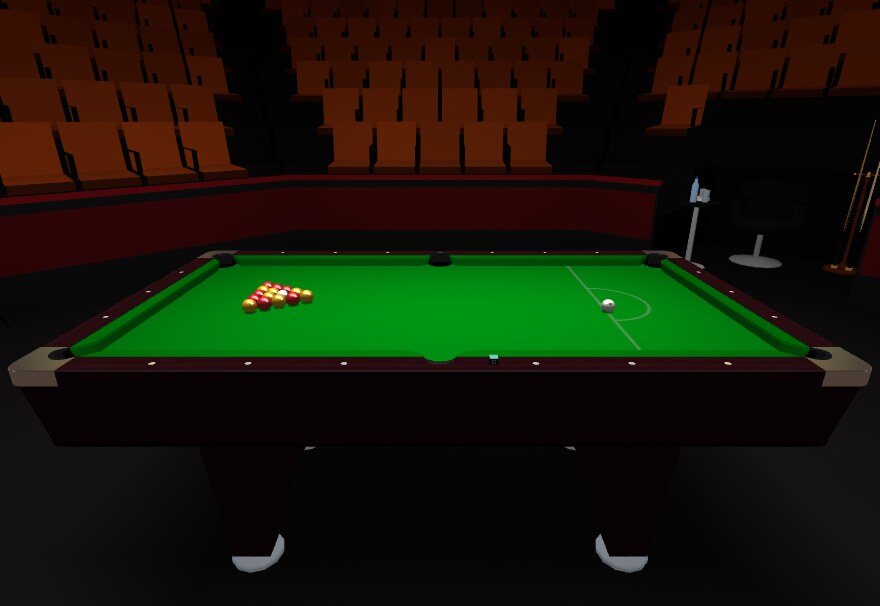
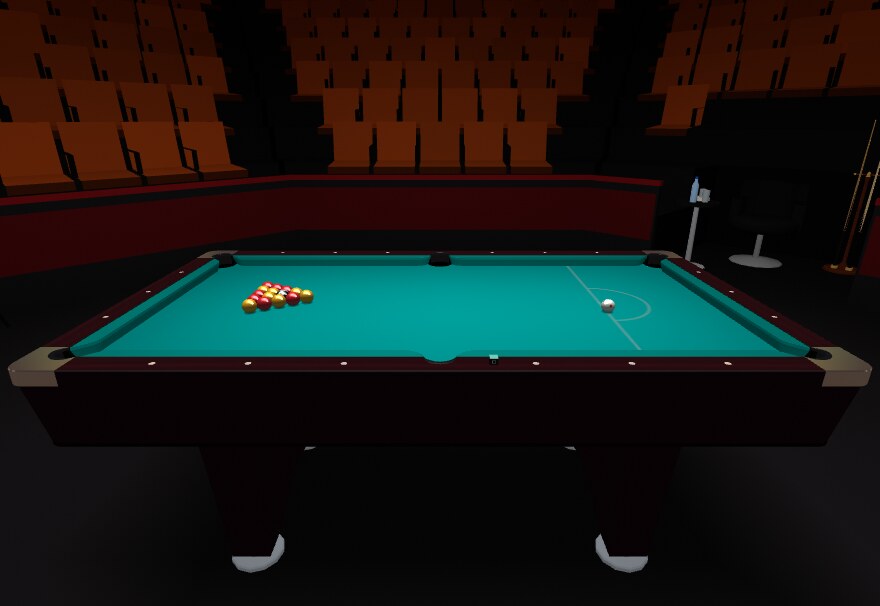
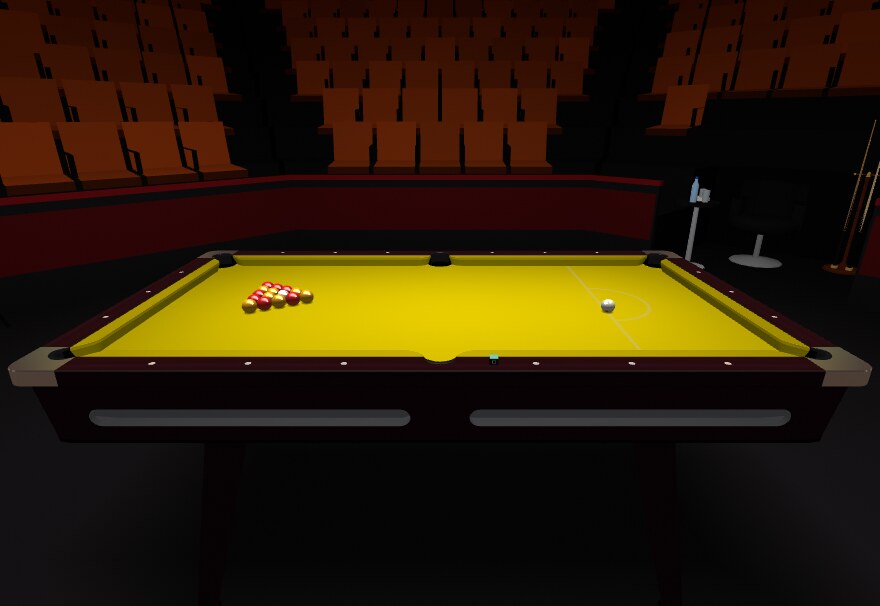
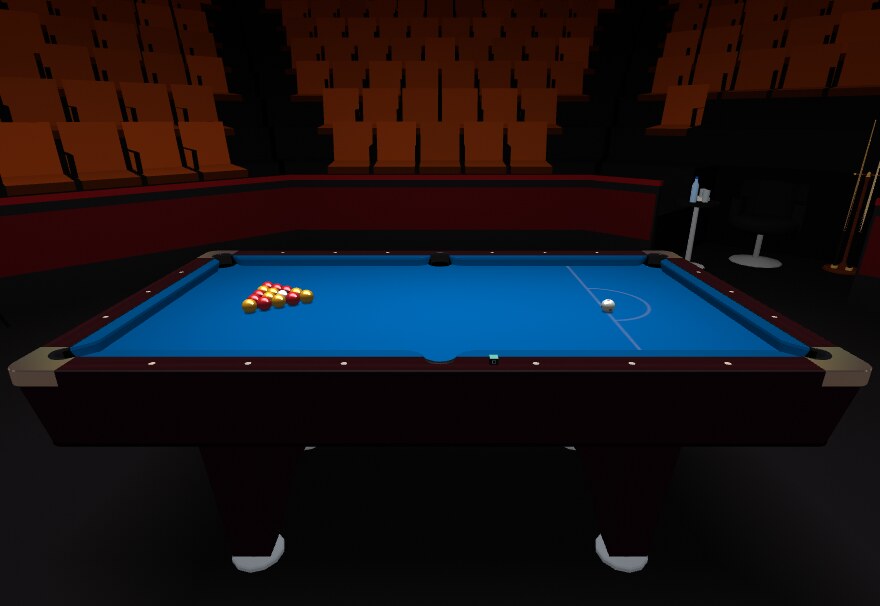
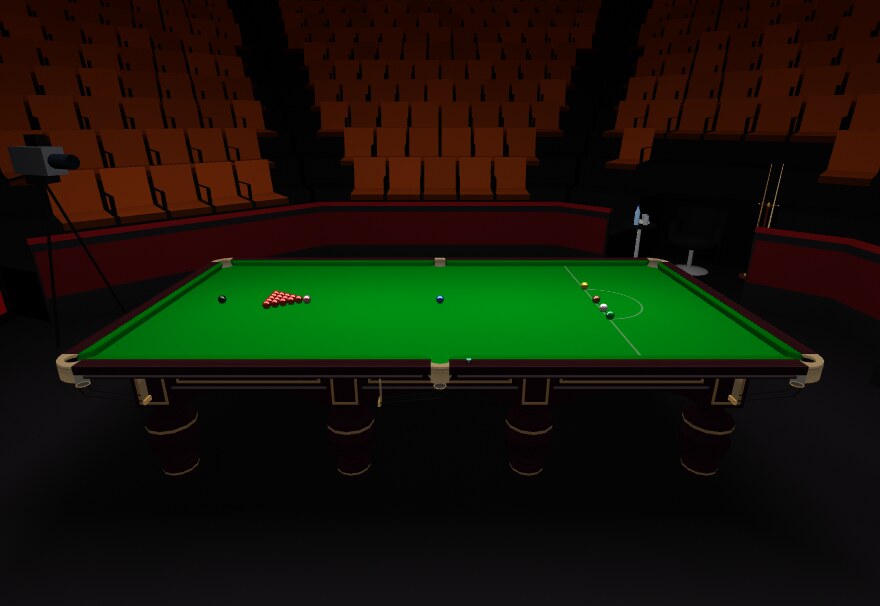
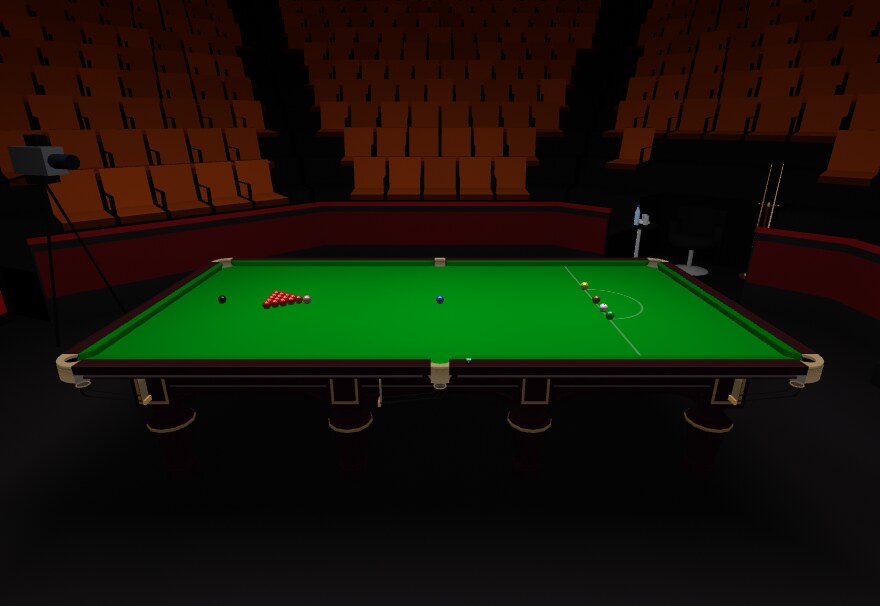
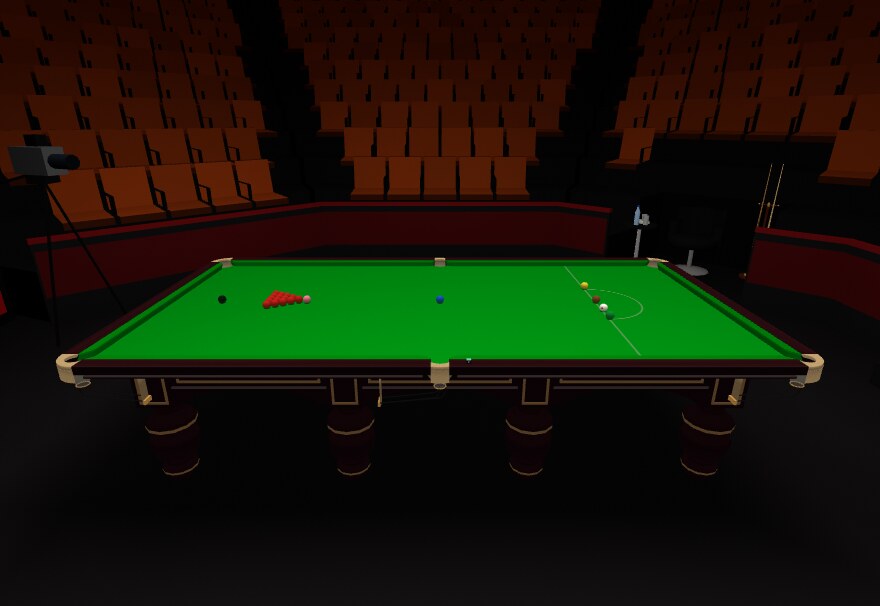
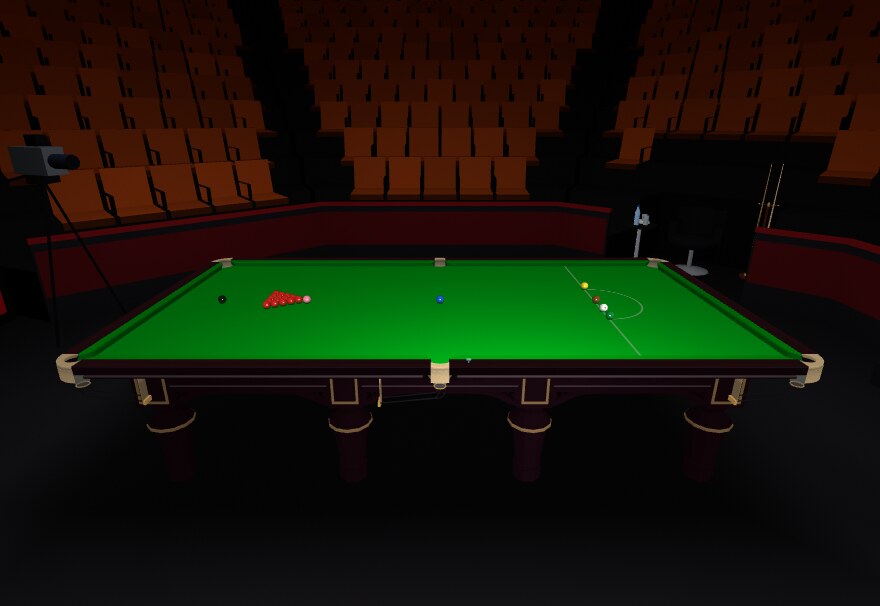
MIXED AND VIRTUAL REALITY32 GAMESTRUE-TO-LIFE PHYSICS8 COMPUTER PLAYERSPLAY ONLINETHE CLUB30 CUESBUILD YOUR OWN CUES, BALLS AND TABLESREAL CUE ATTACHMENT
Getting started
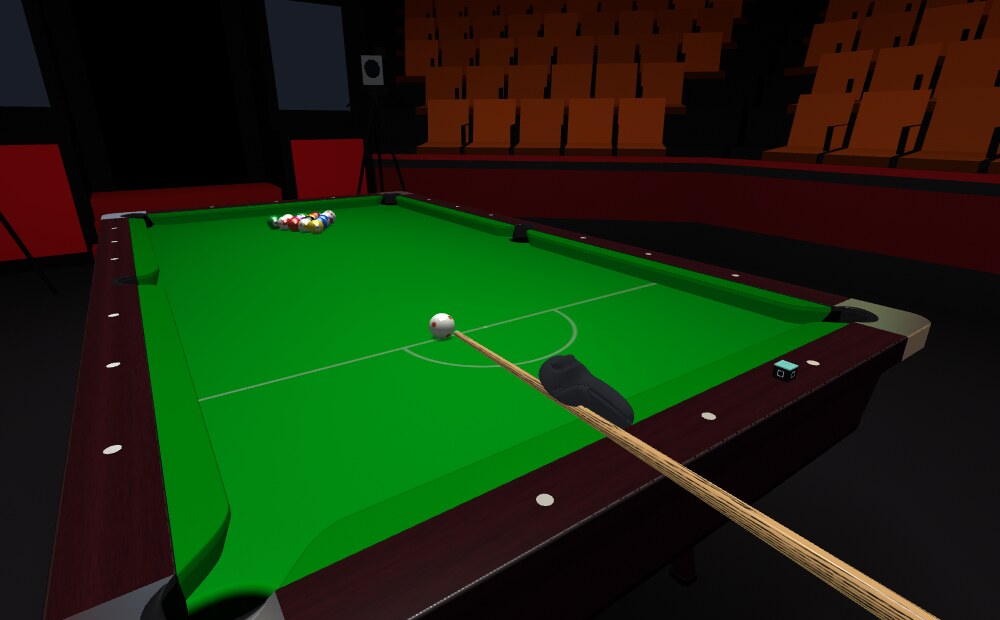
Play any cue sport, any way you like: snooker, pool, billiards and 29 more
games, in your room through mixed reality or in a packed arena in virtual reality, with
true-to-life physics, computer players from beginner to world-class, and online play with
friends or in a club full of players. Build your own cue down to the inlays and name plate, your
own ball sets and your own tables, any size and pocket, and play with controllers, your bare
hands or your real cue.
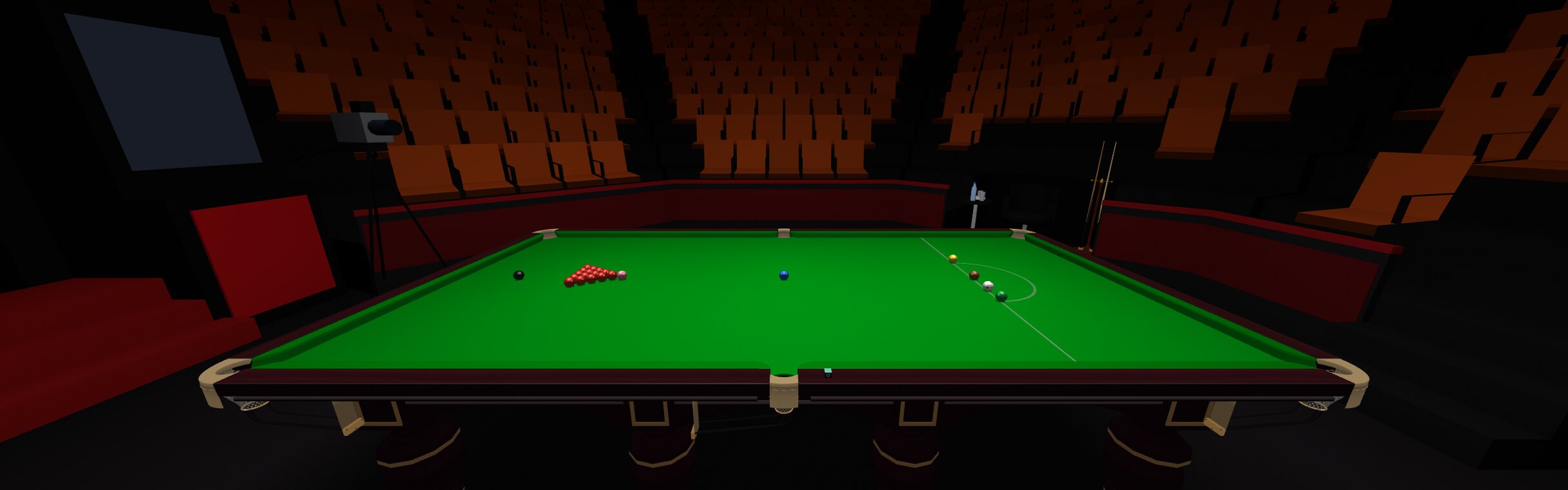
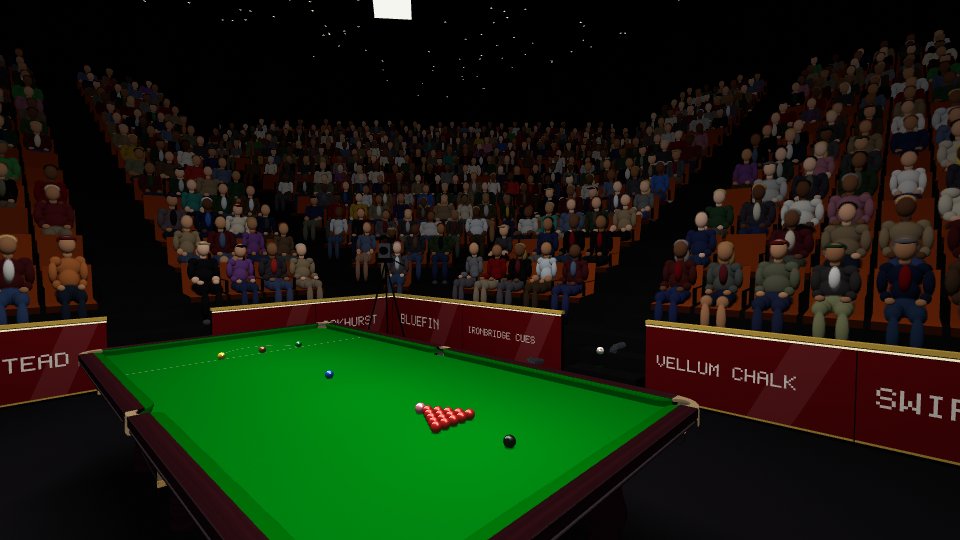
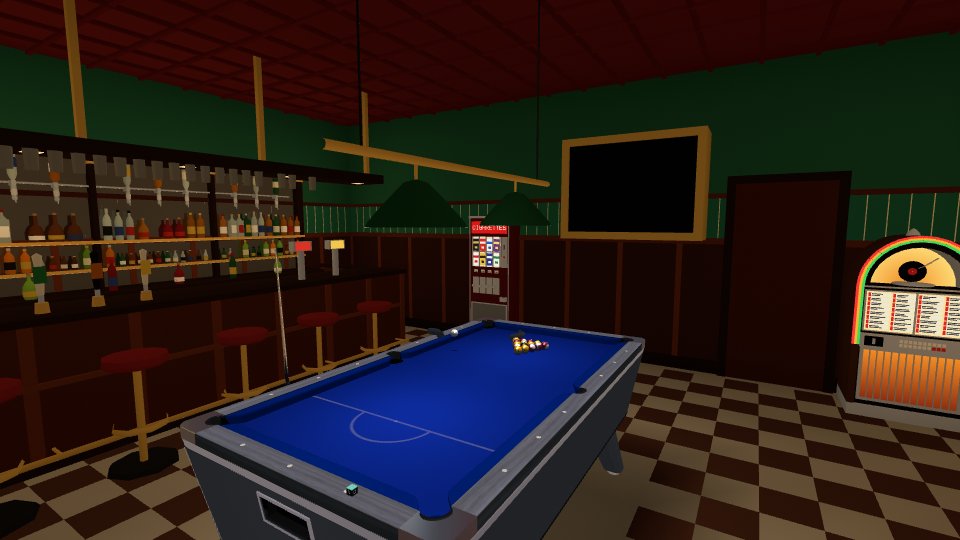
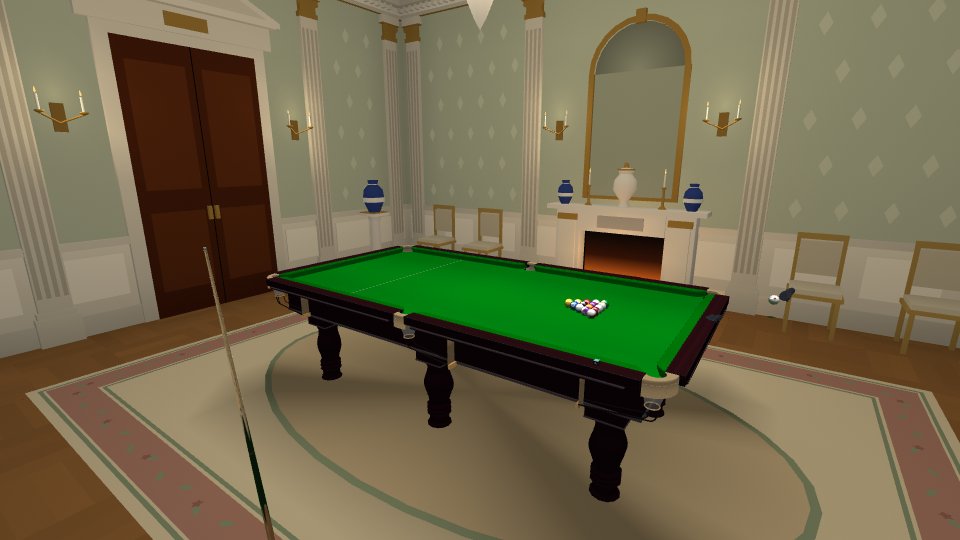
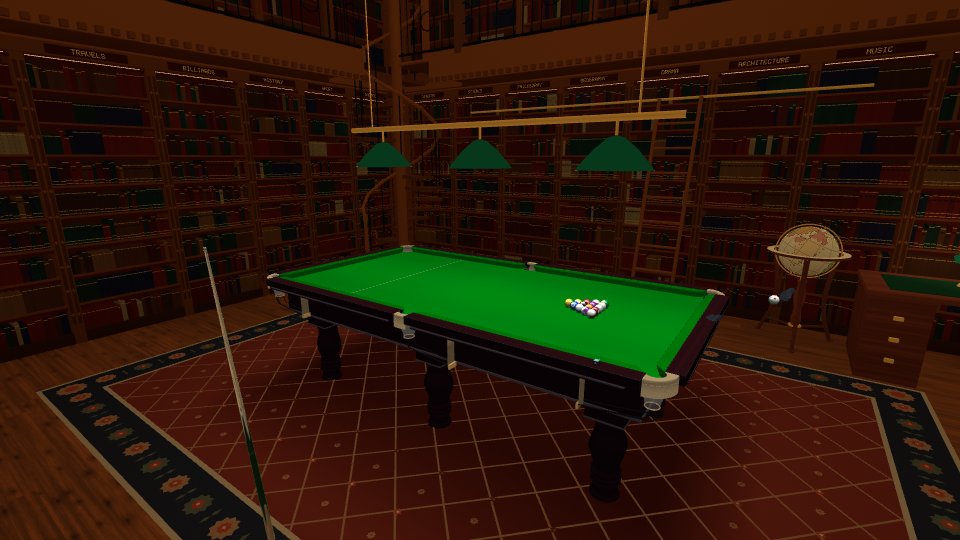
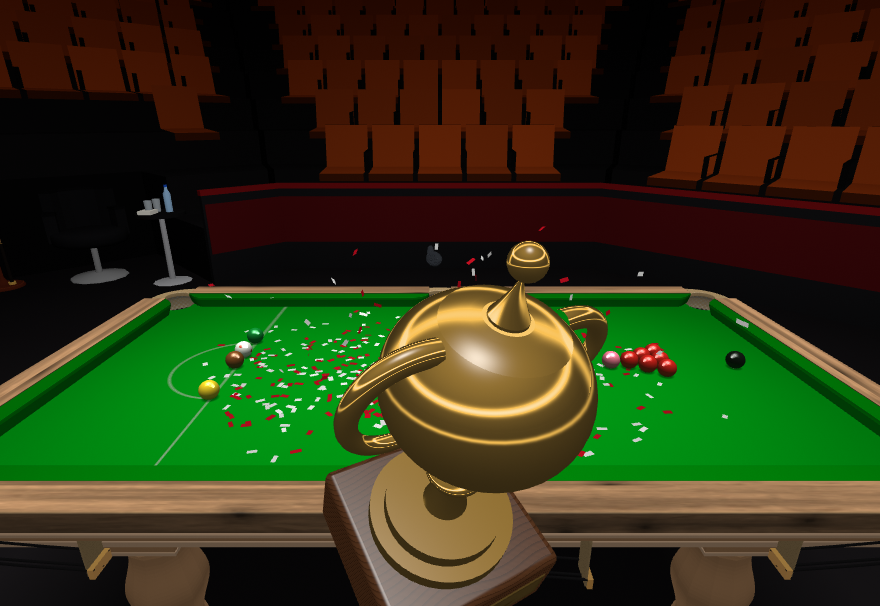
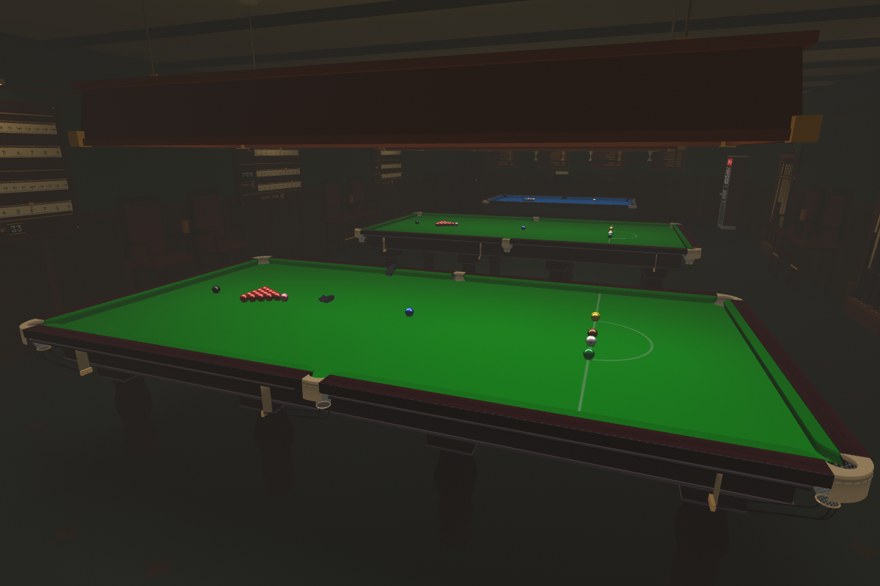
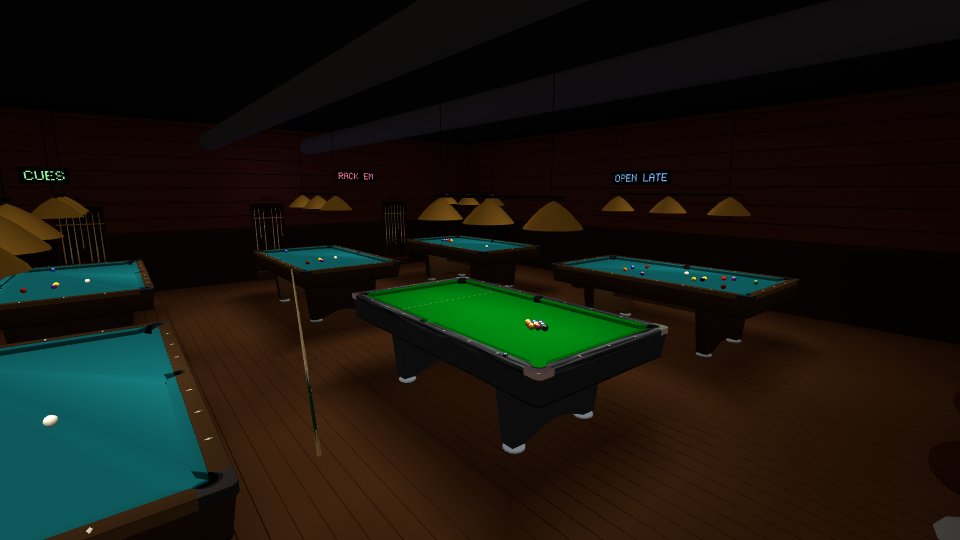
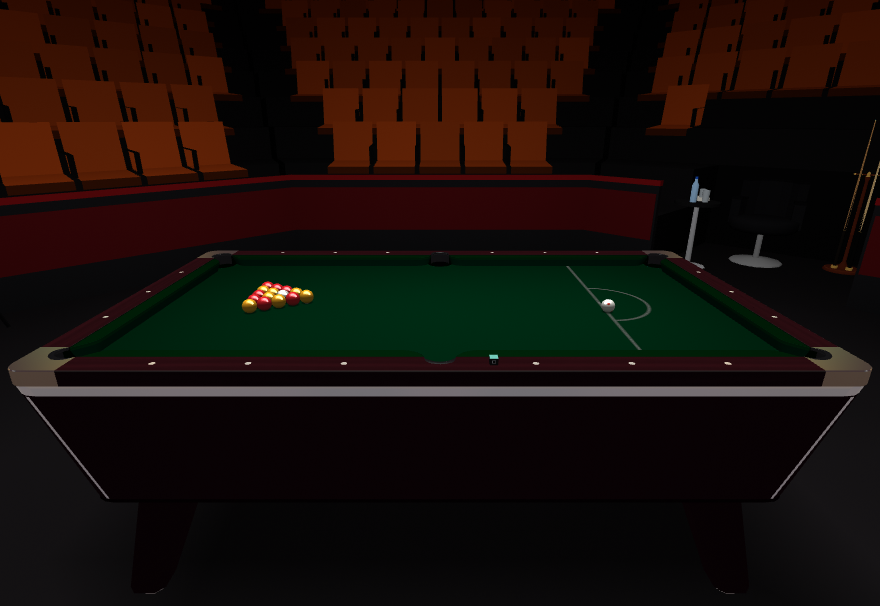
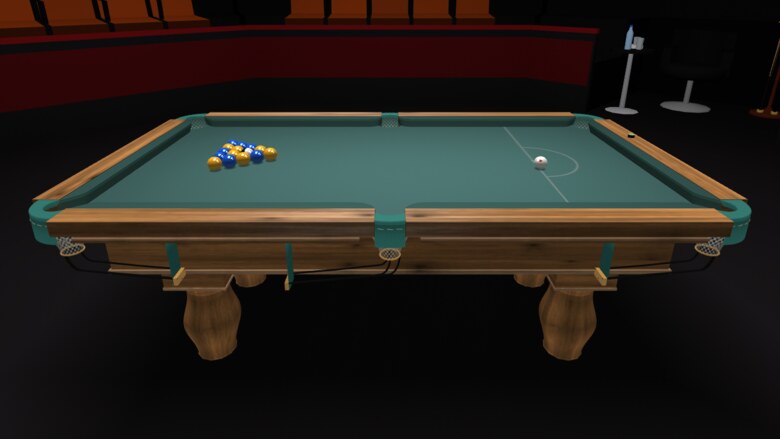
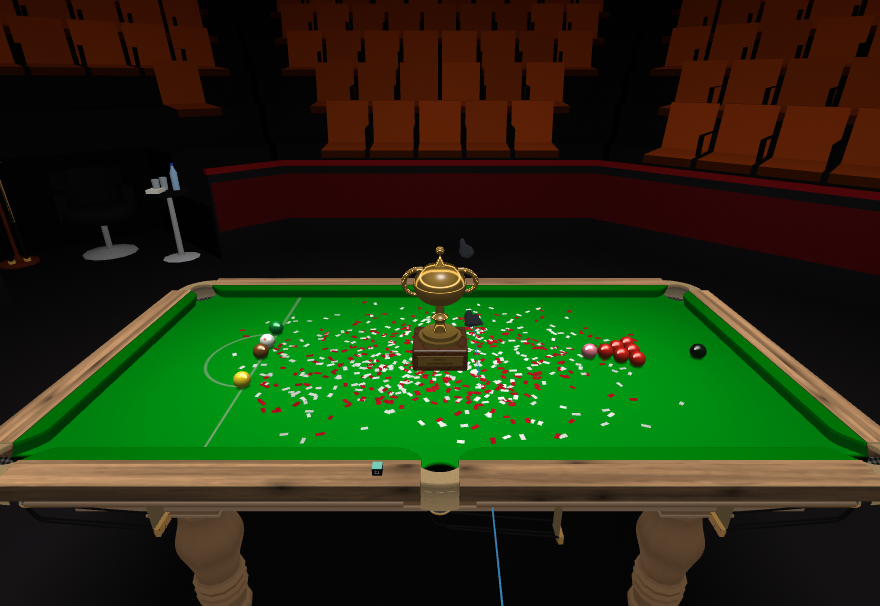
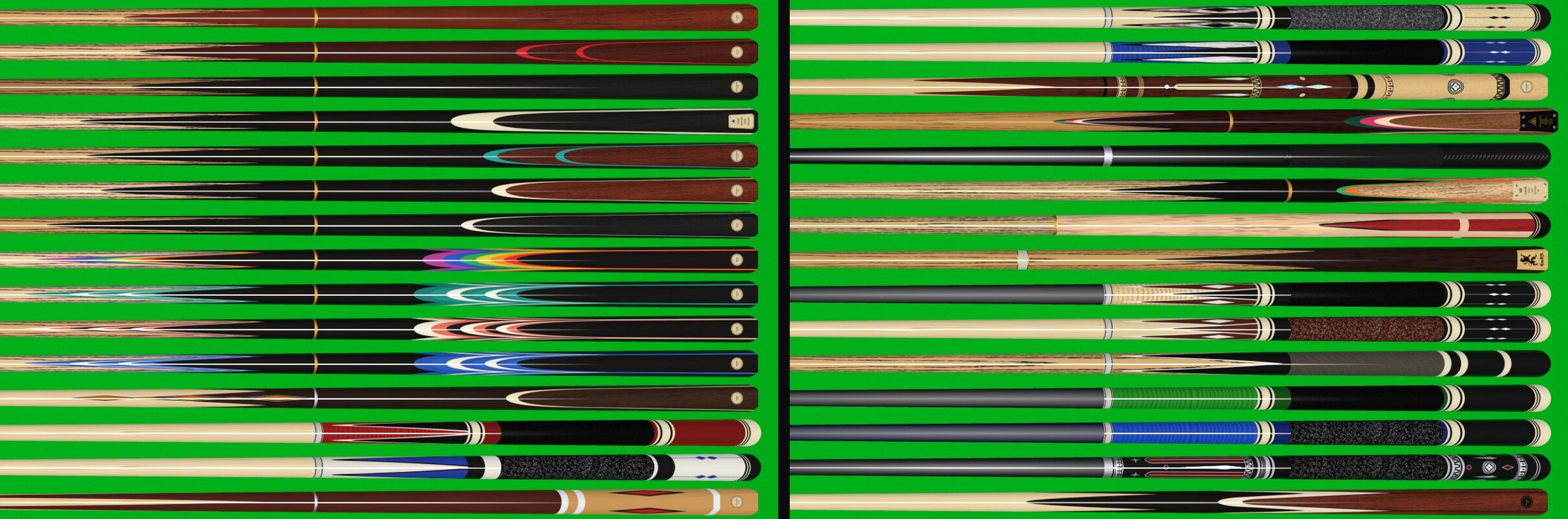
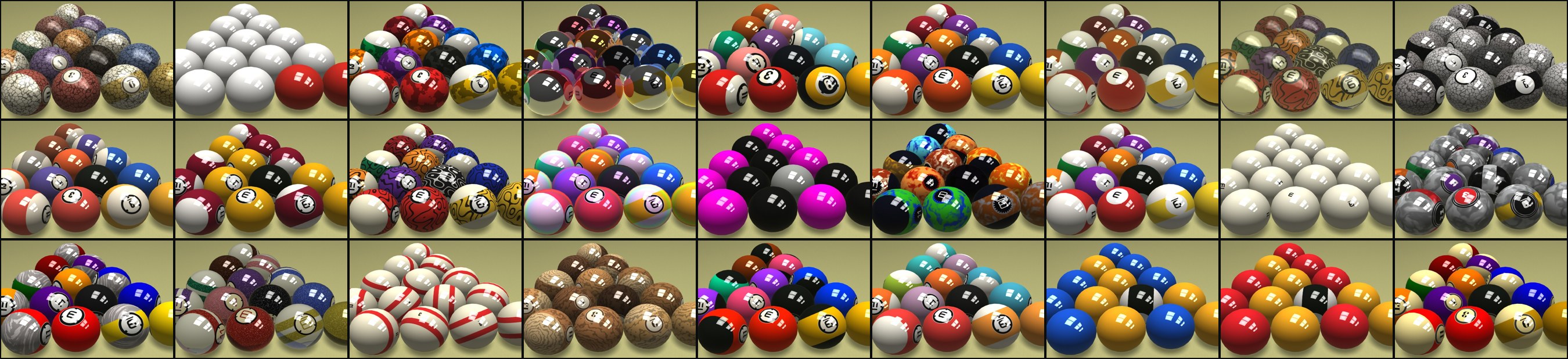
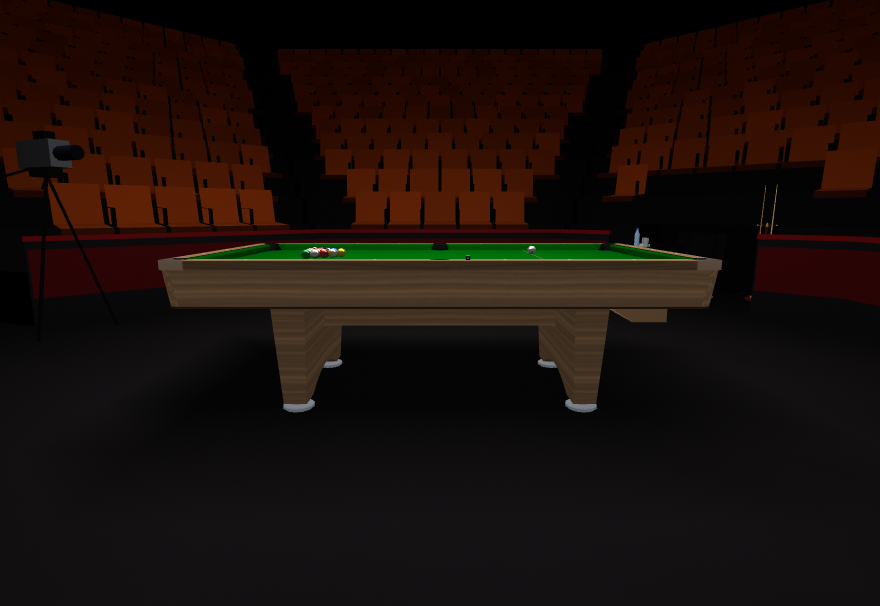
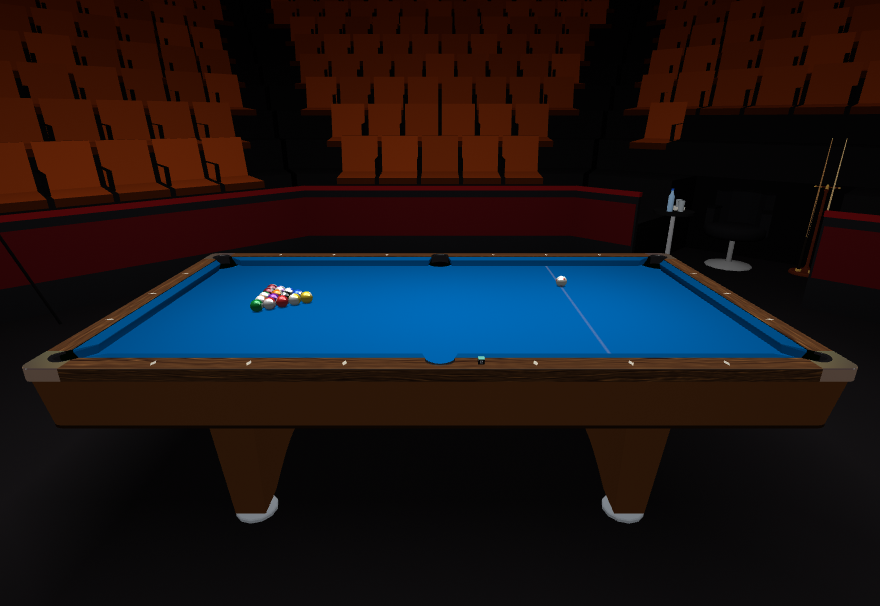
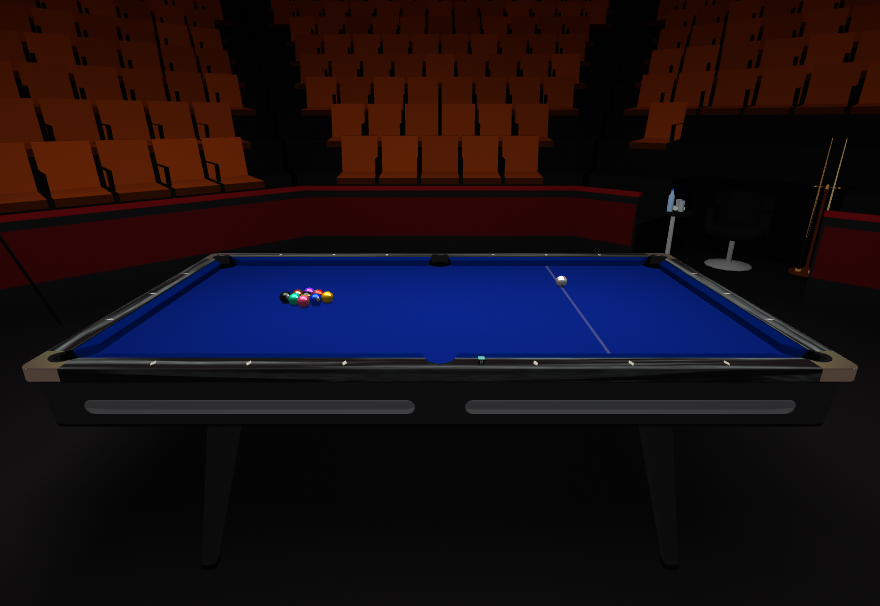
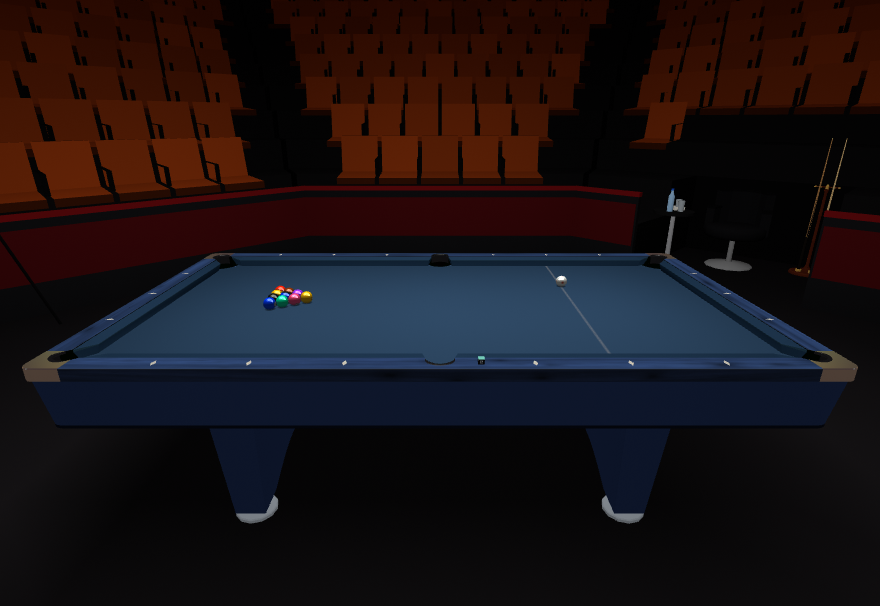
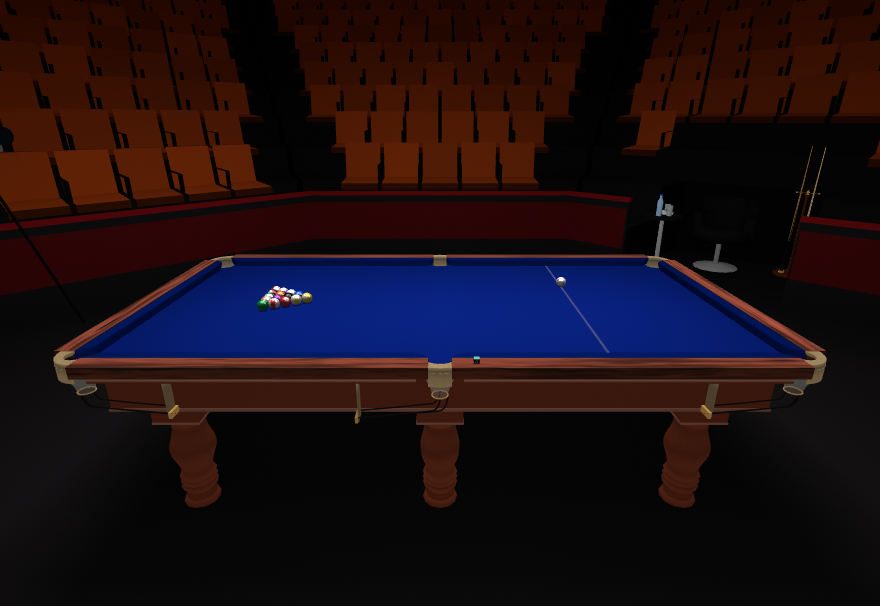
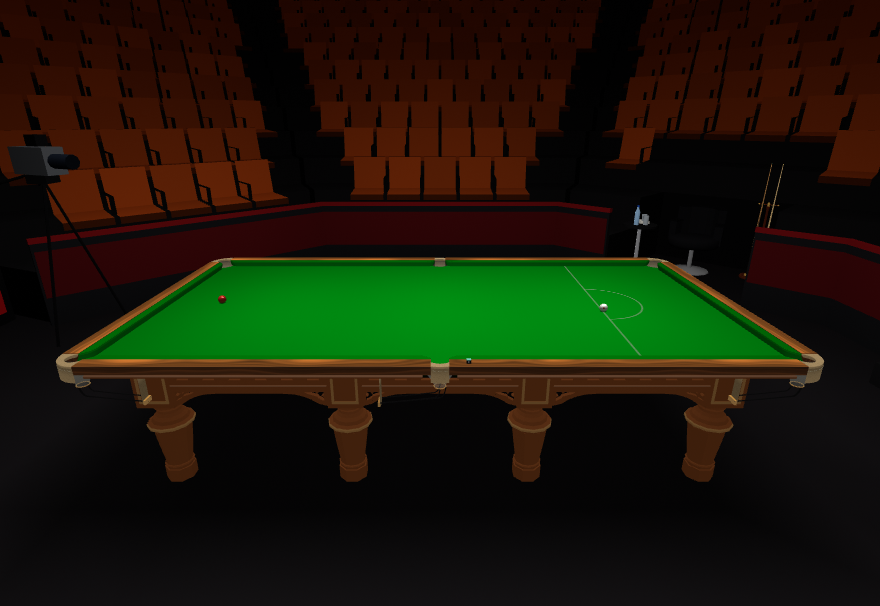
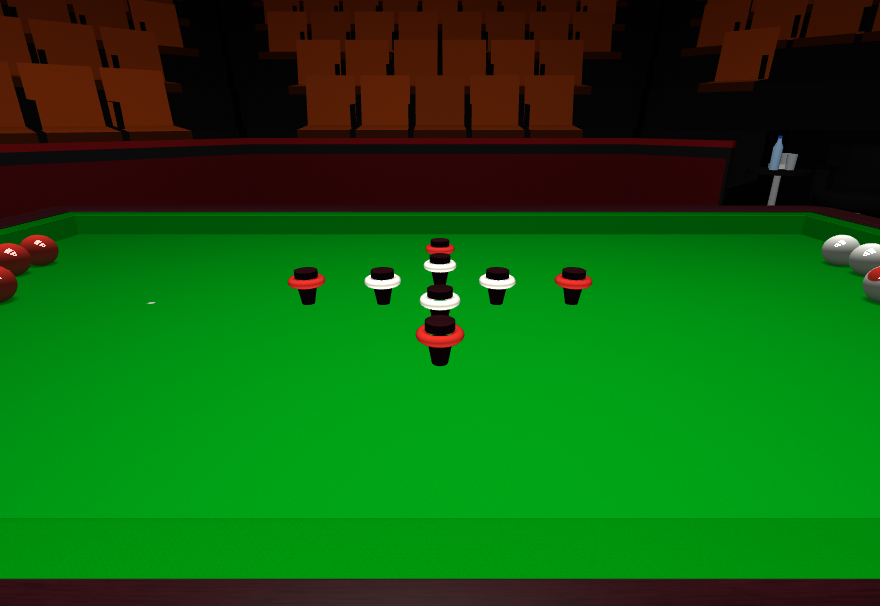
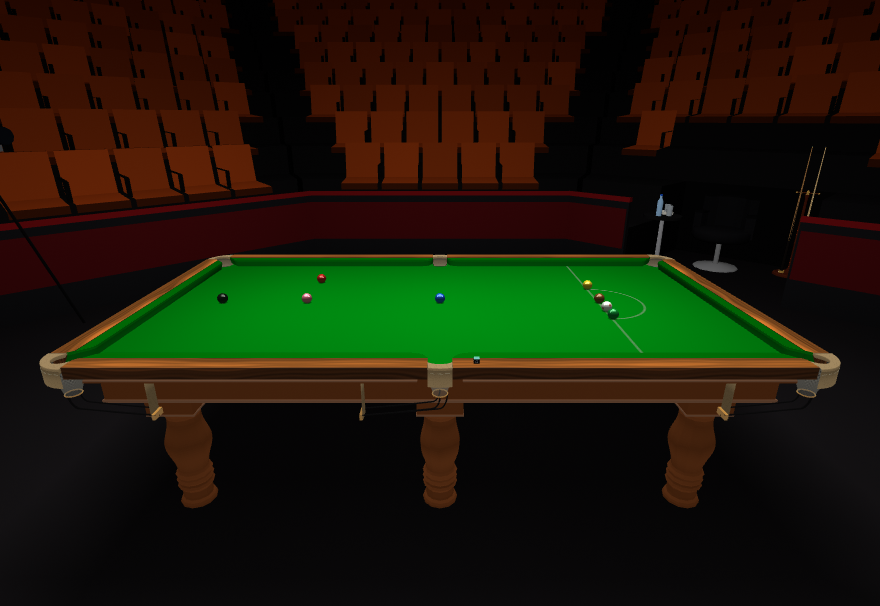
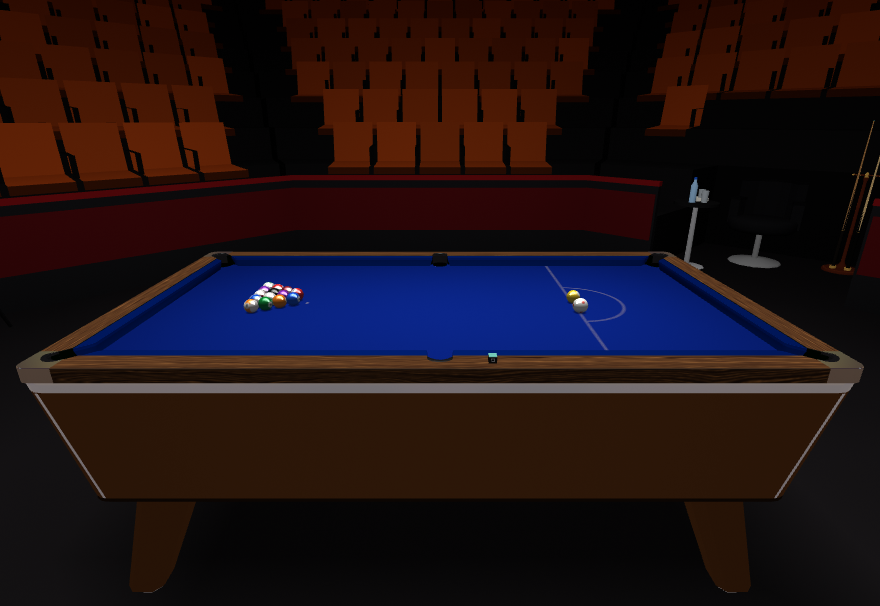
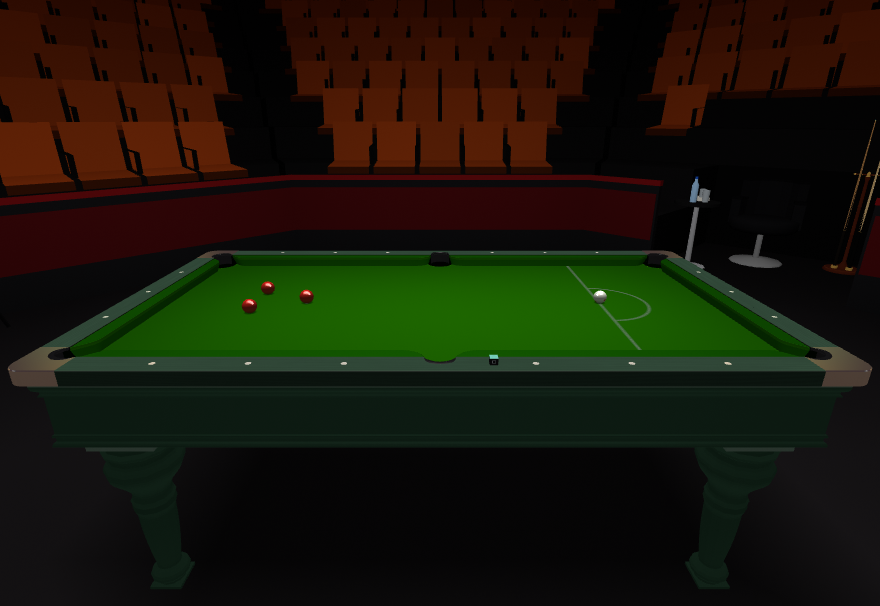
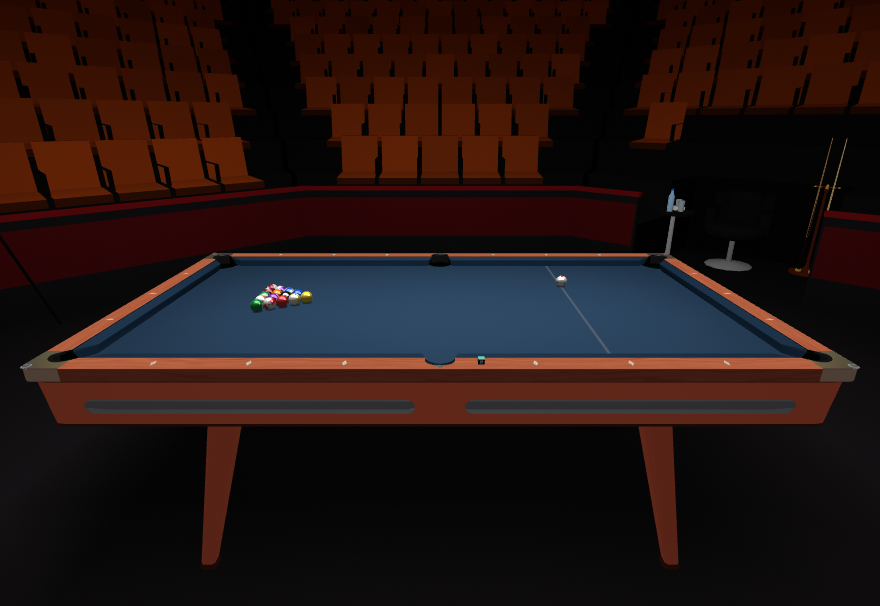
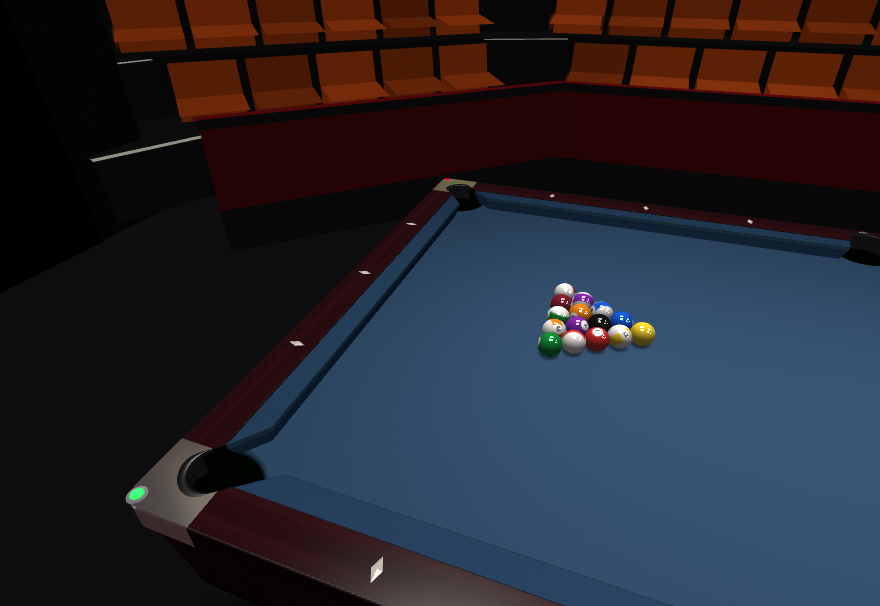
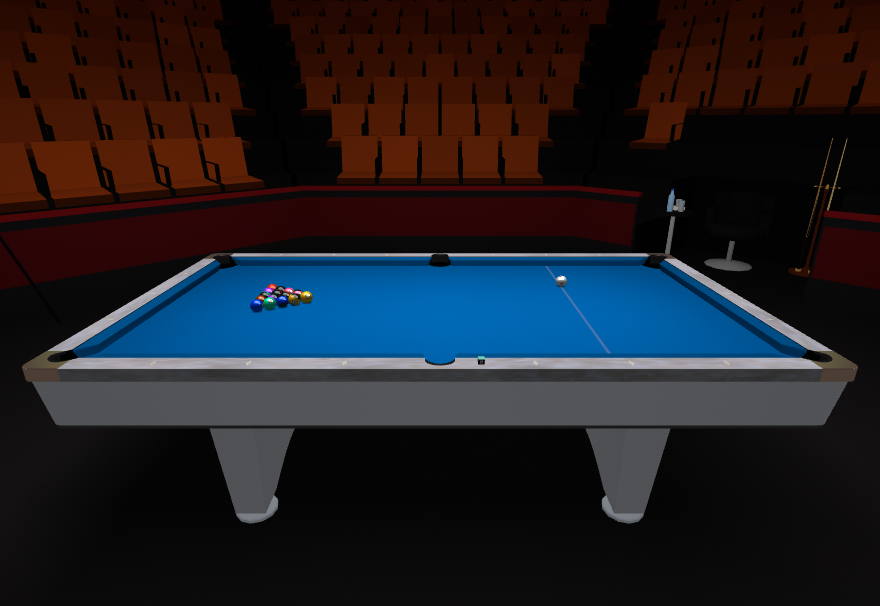
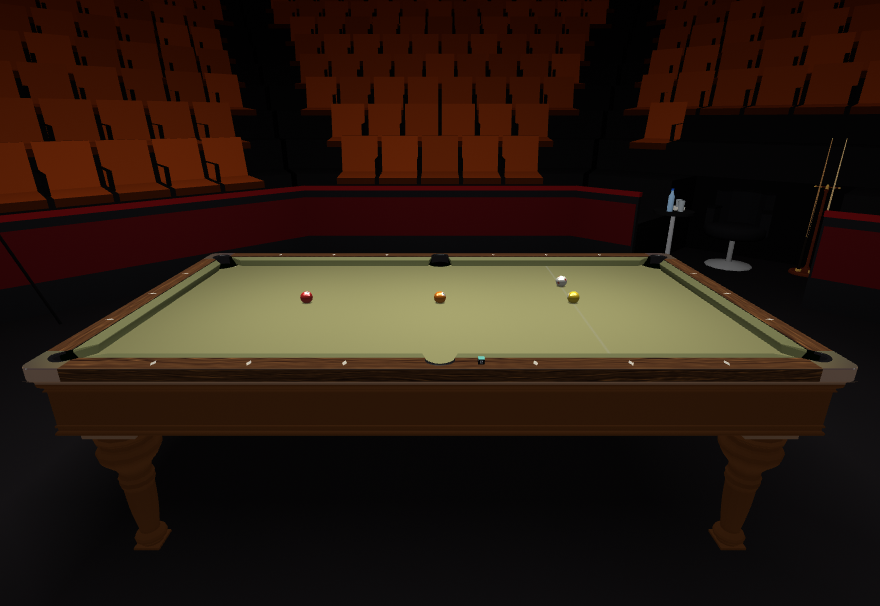
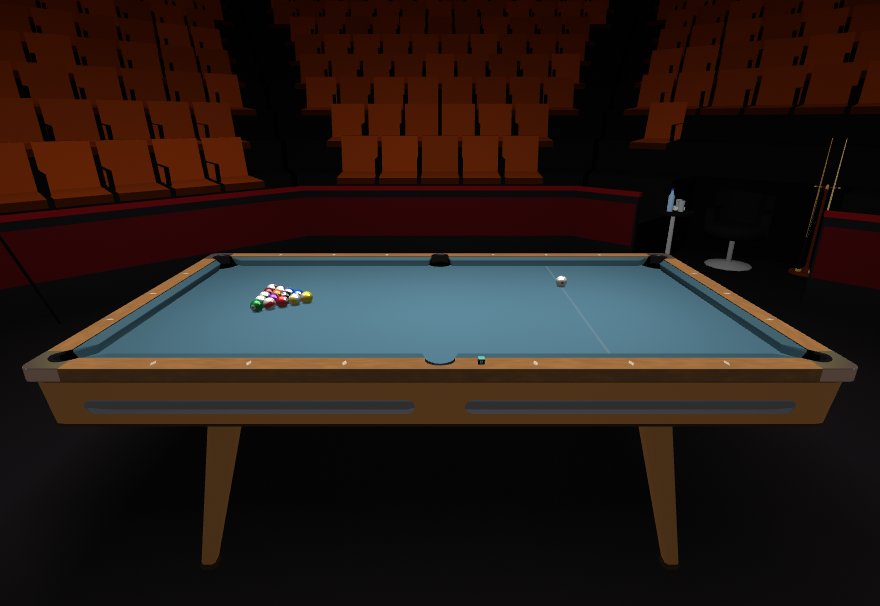
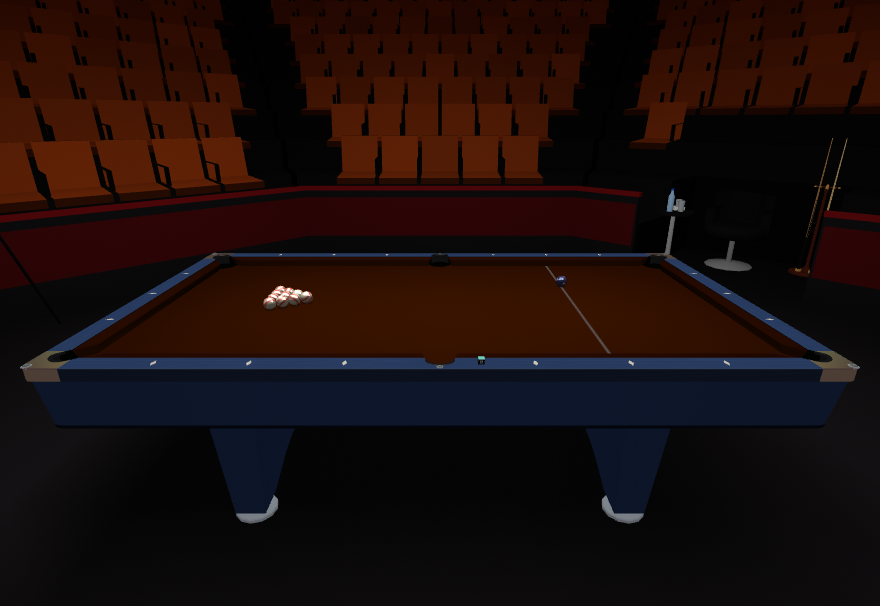
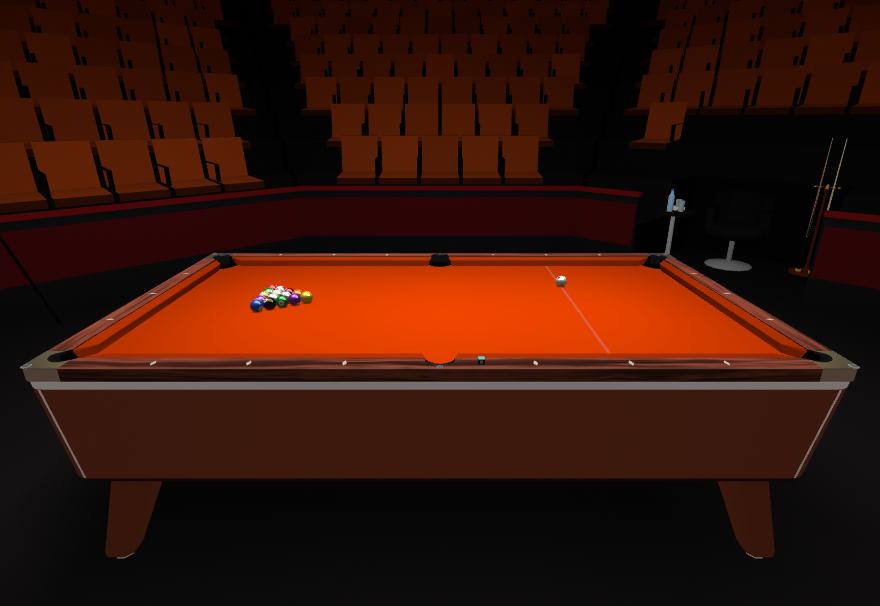
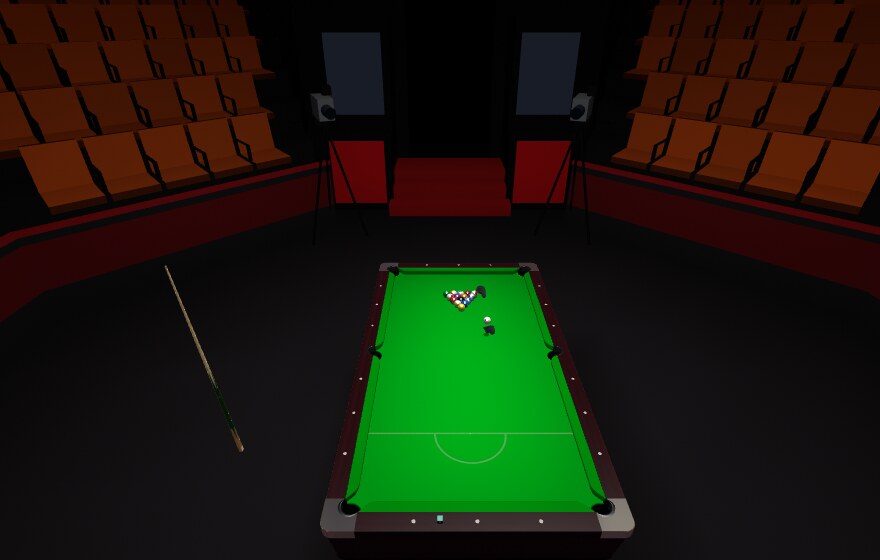
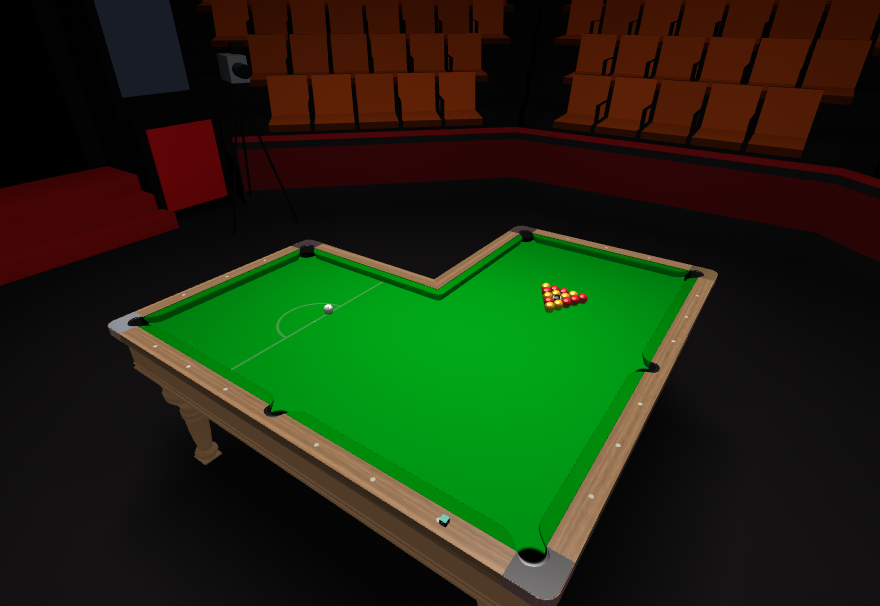
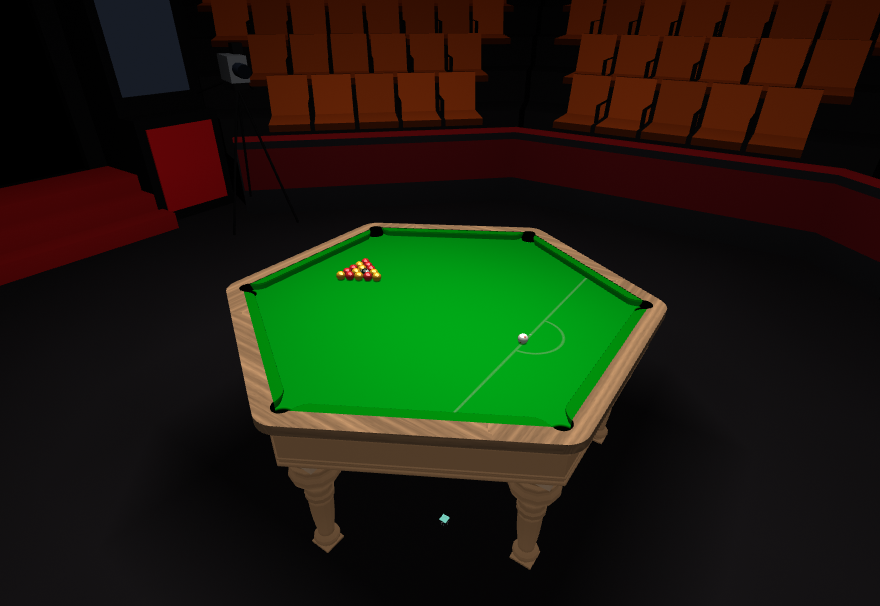
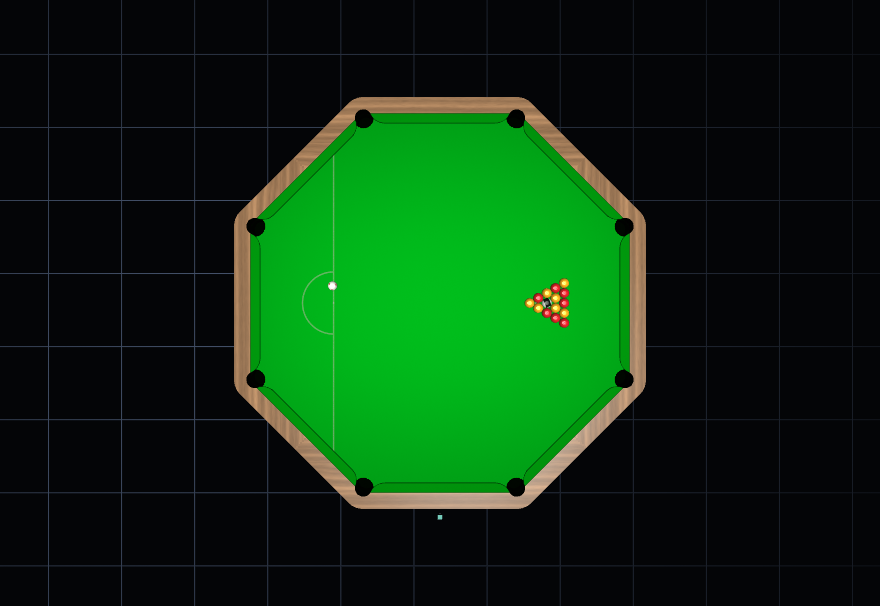
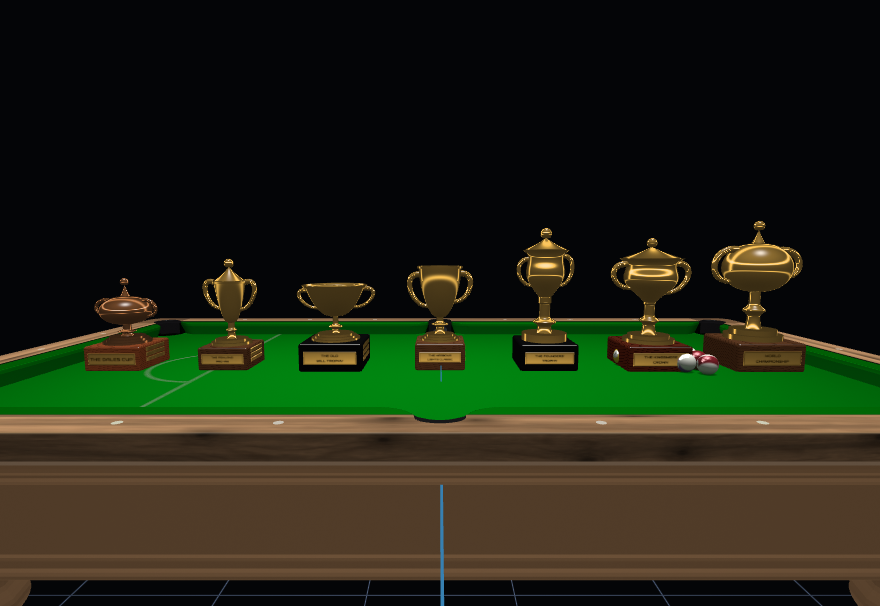
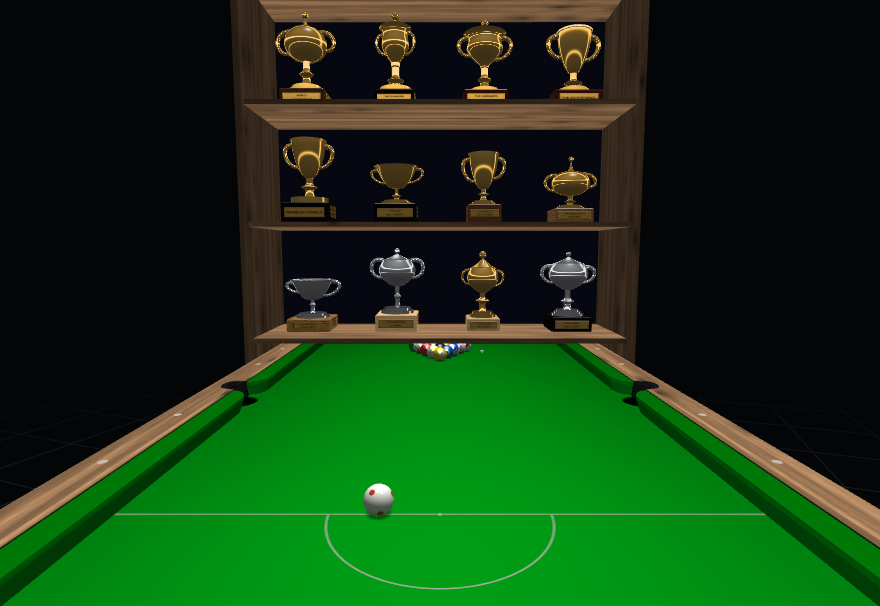
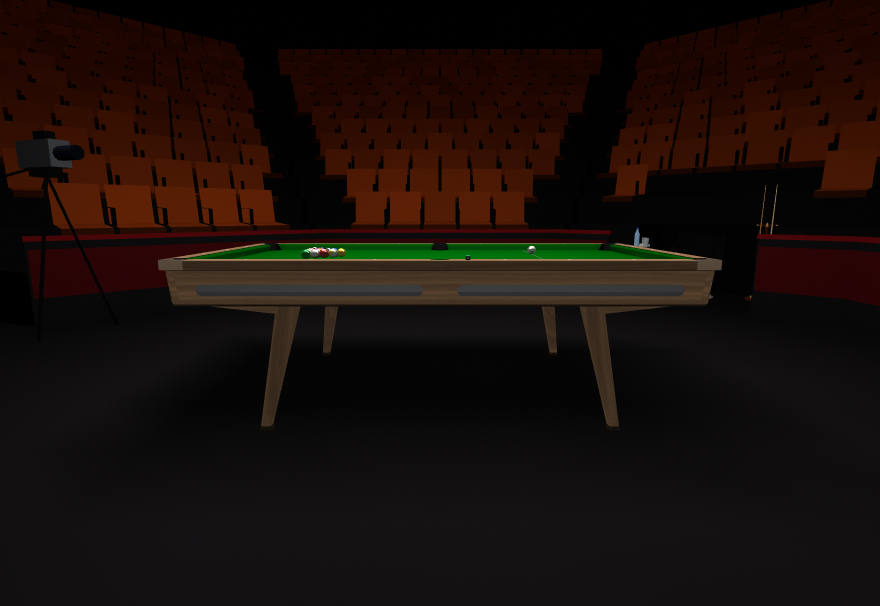
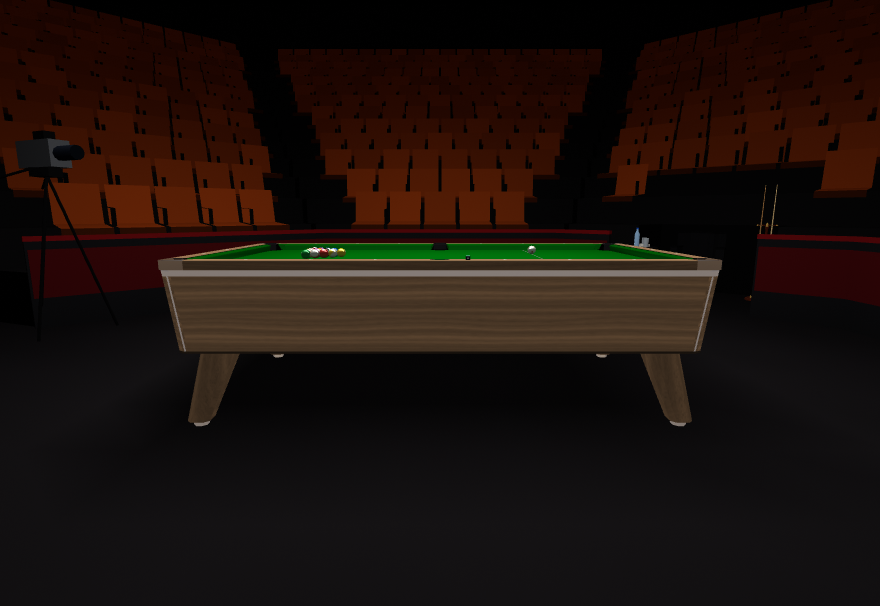
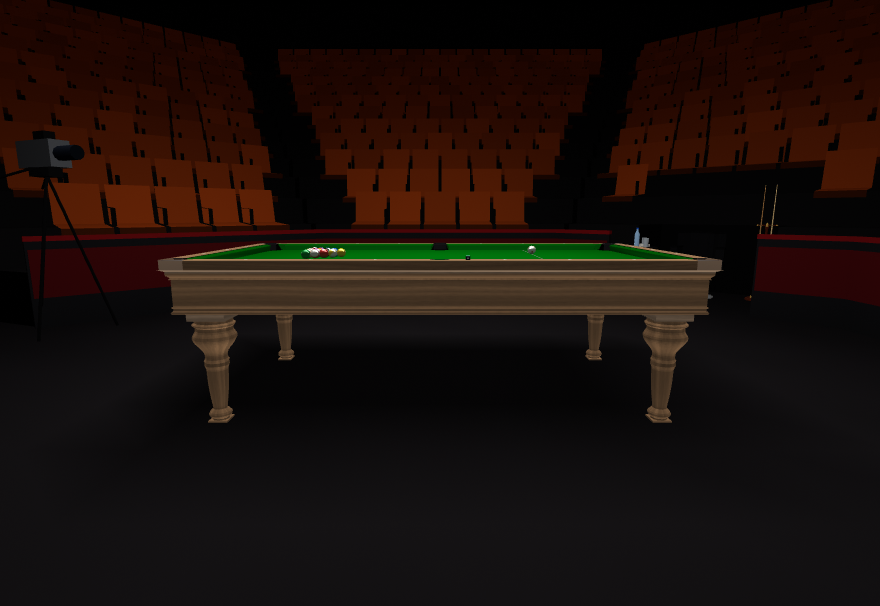
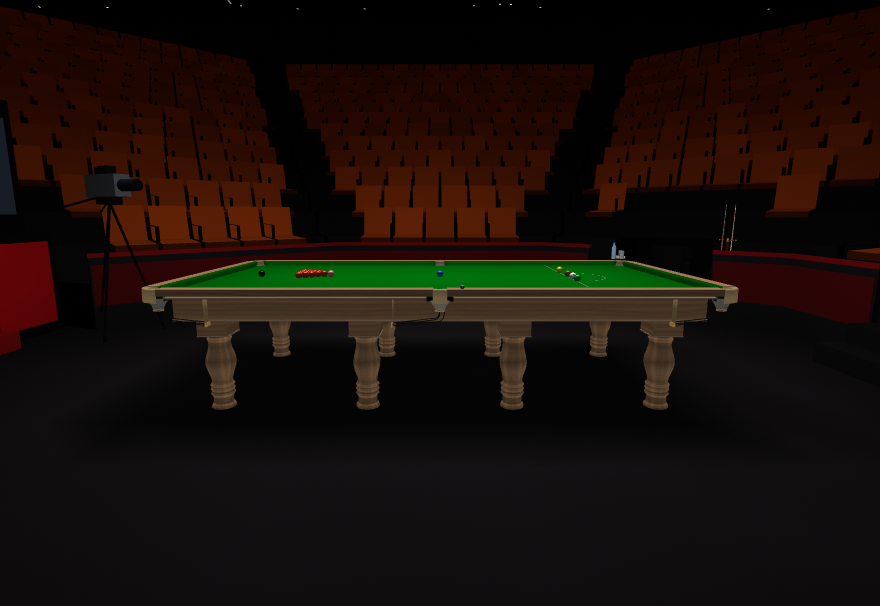
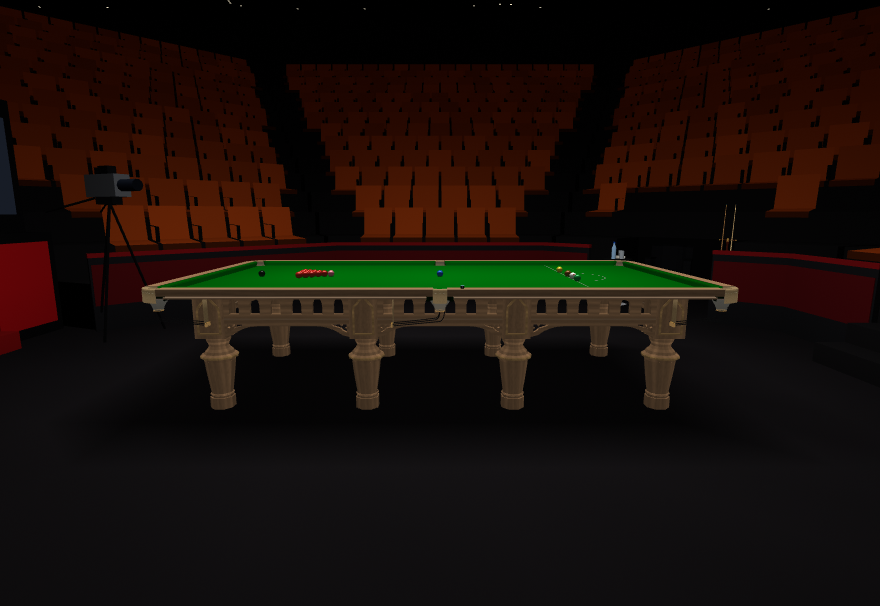
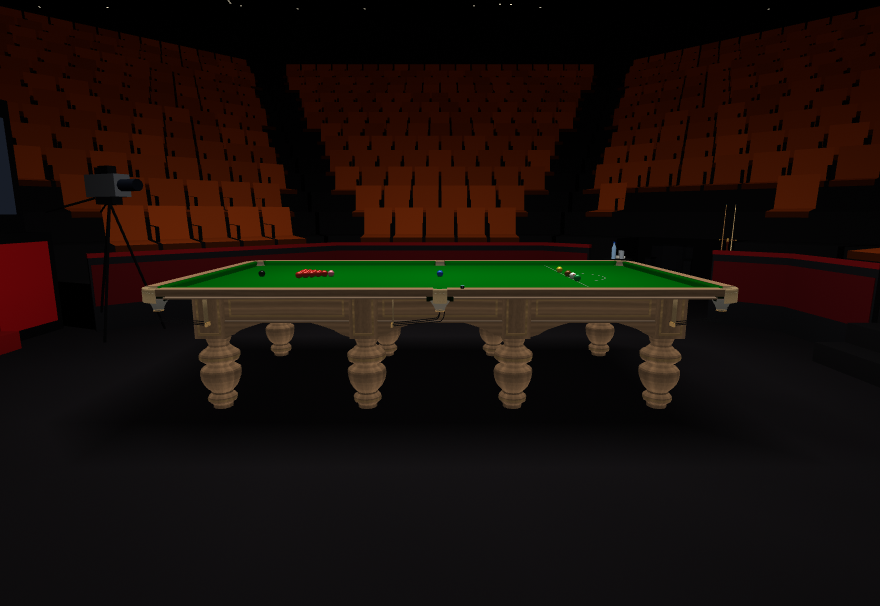
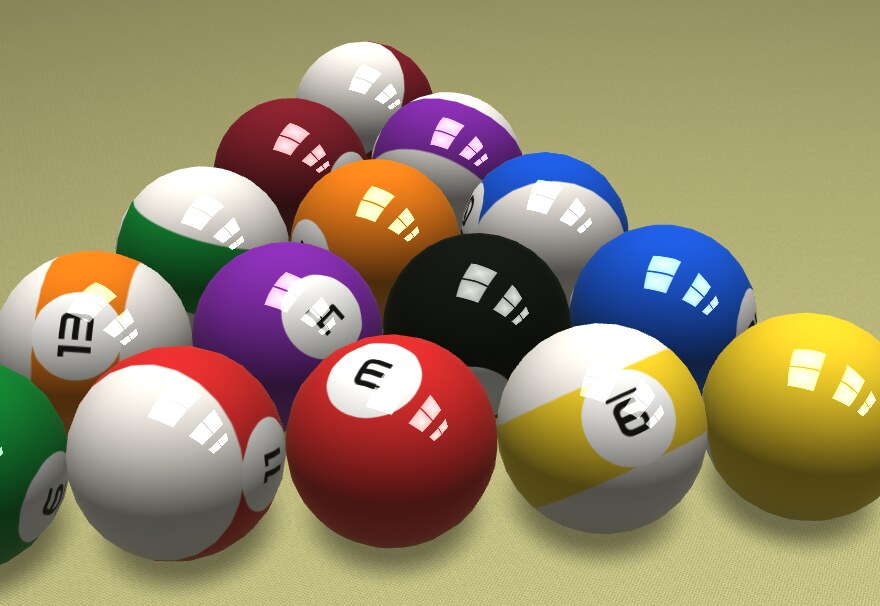
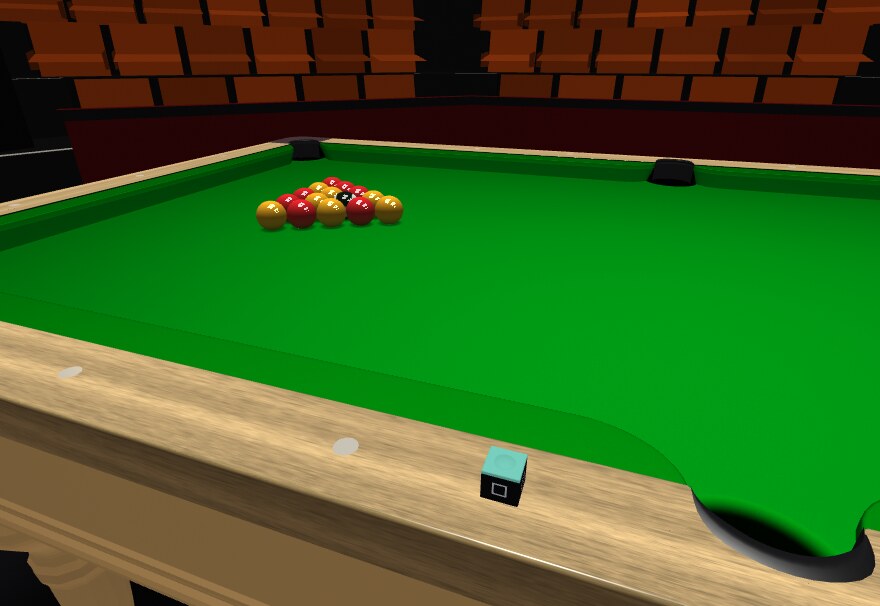
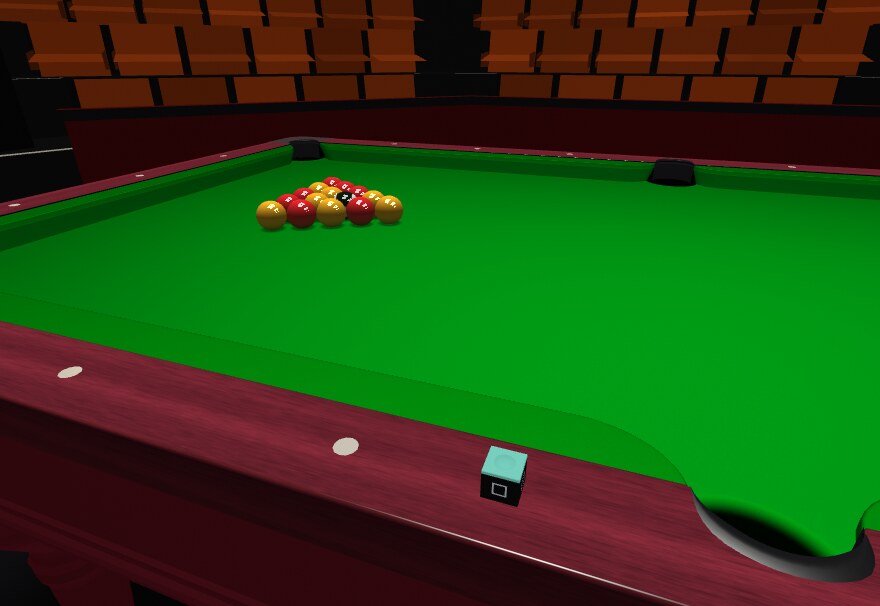
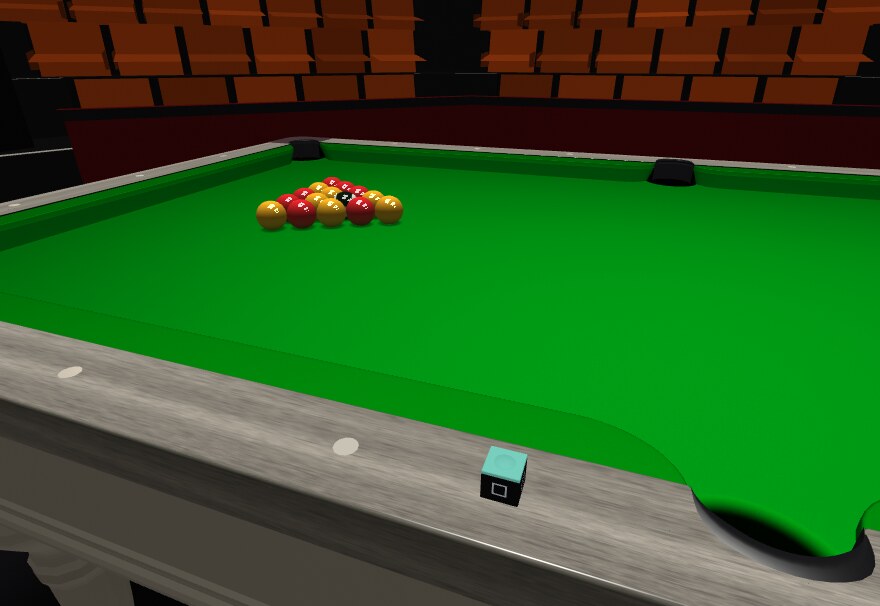
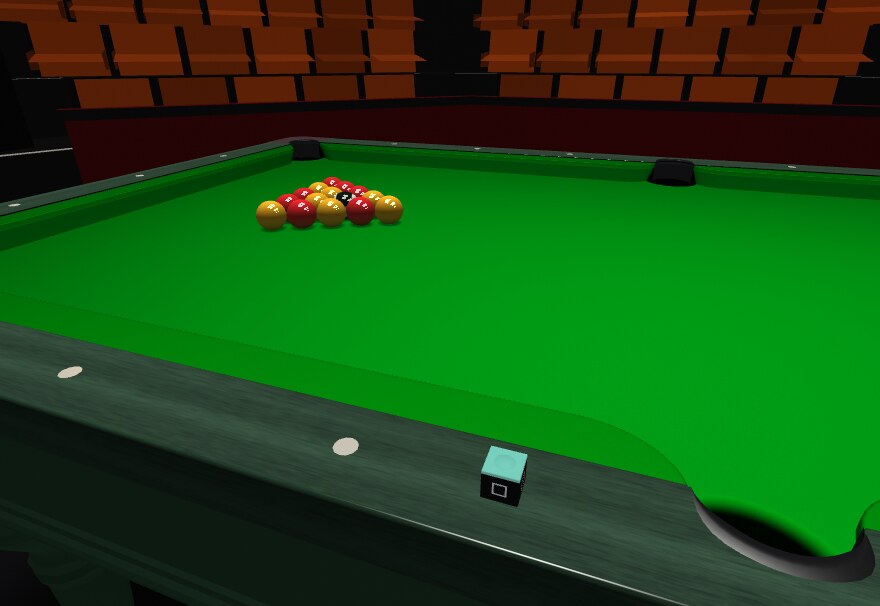
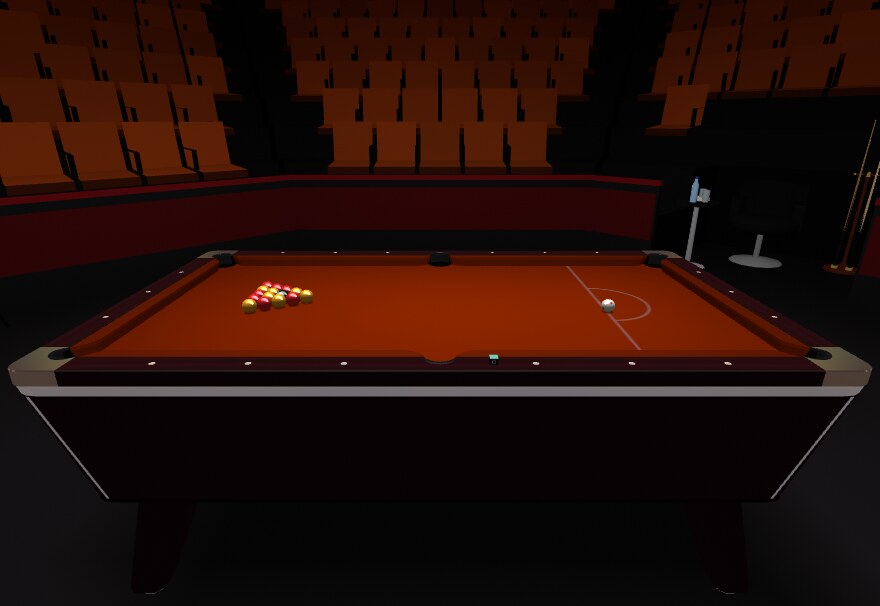
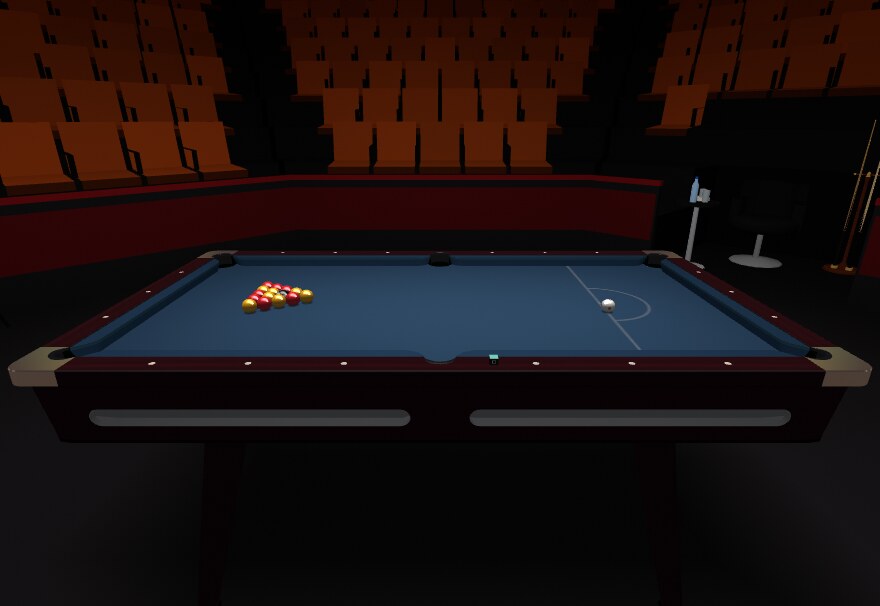
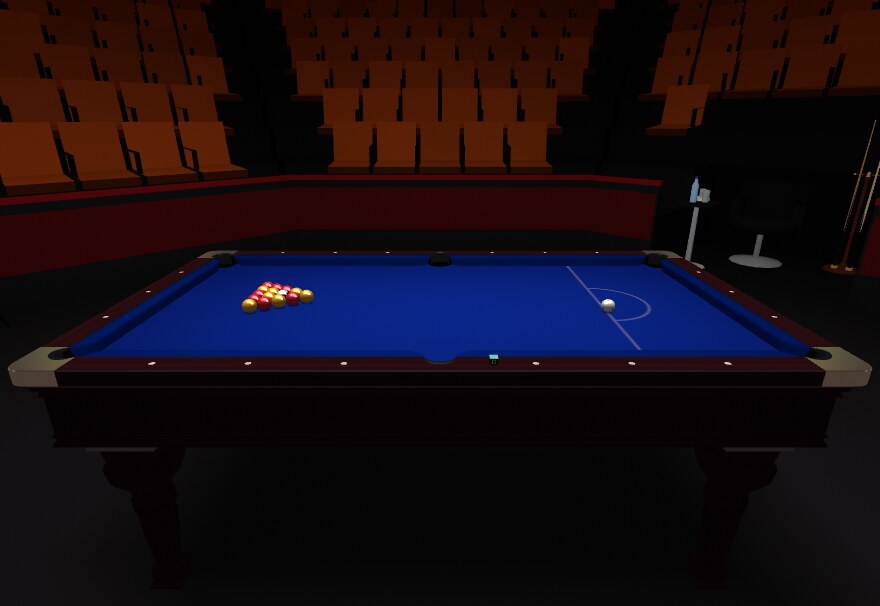
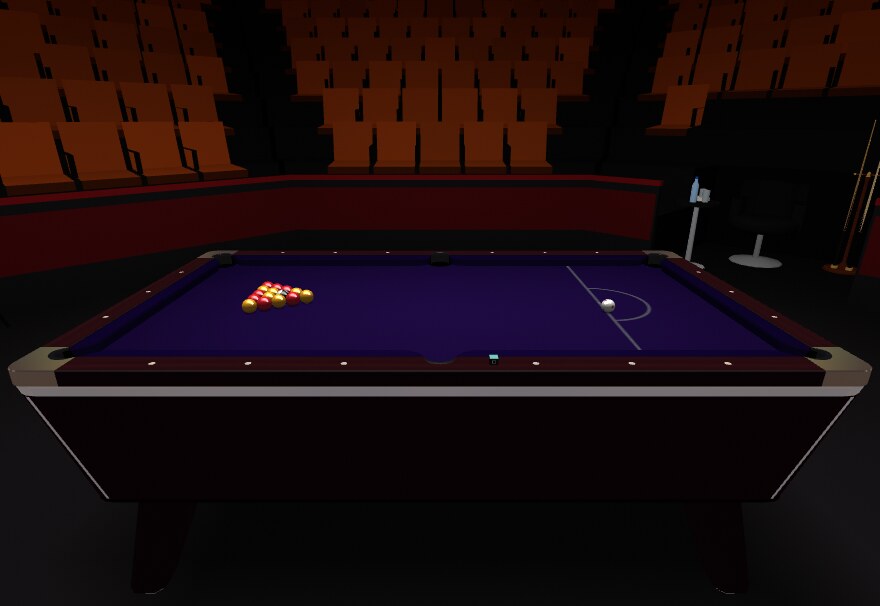
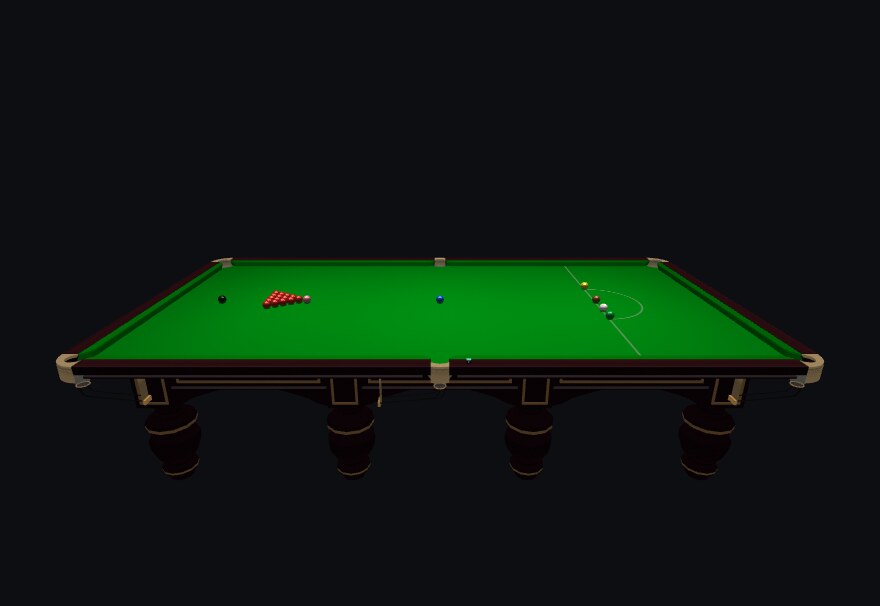
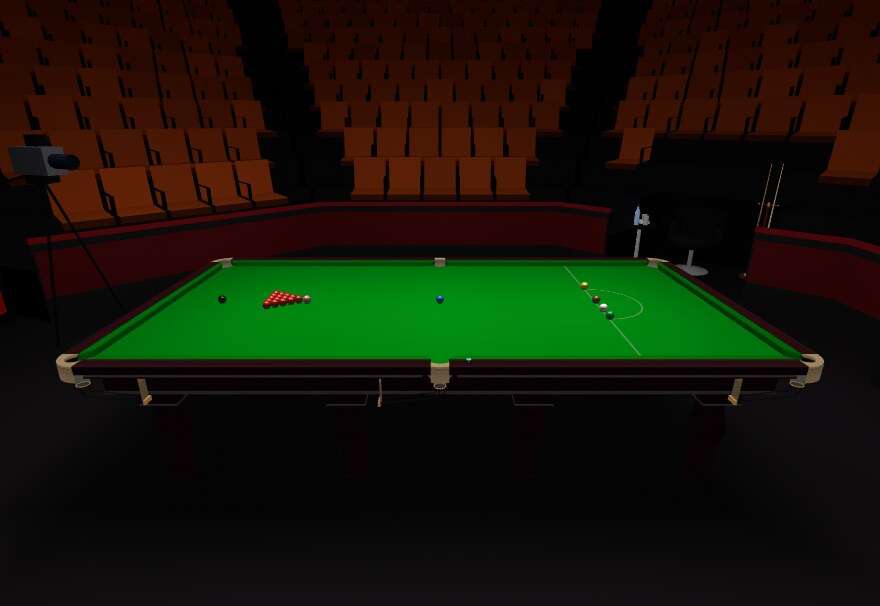
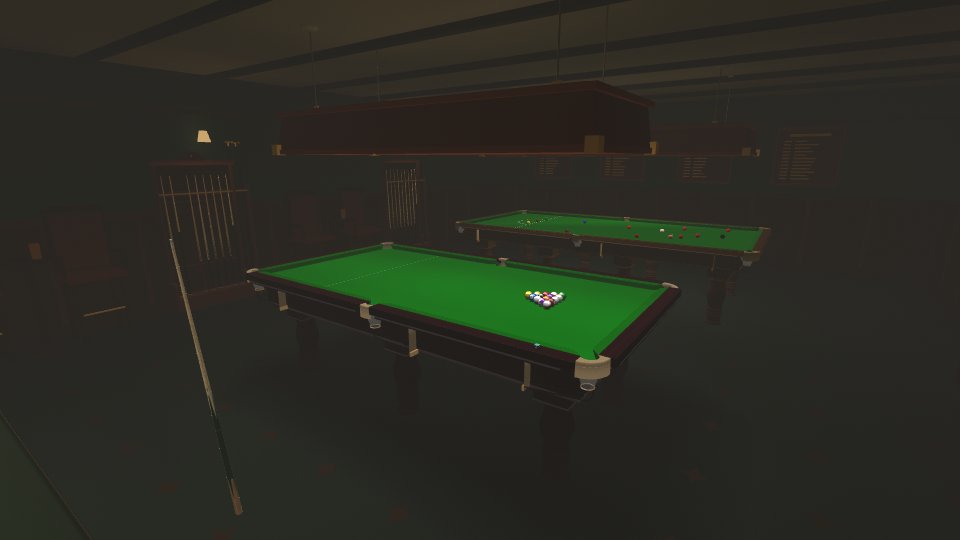
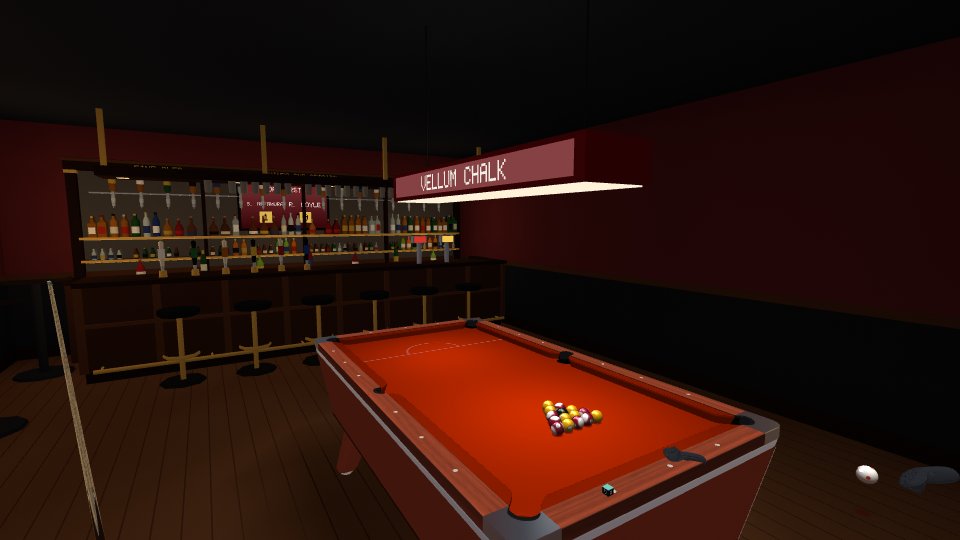
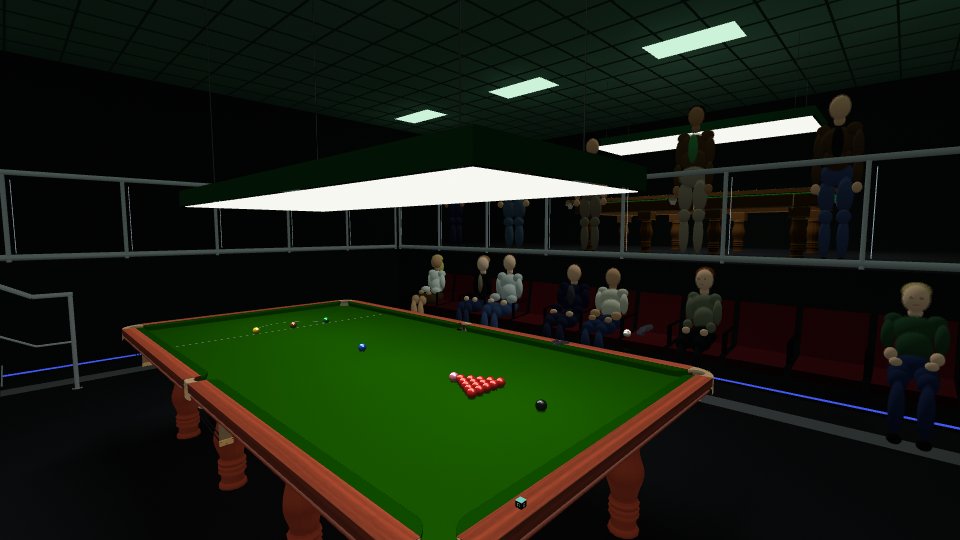
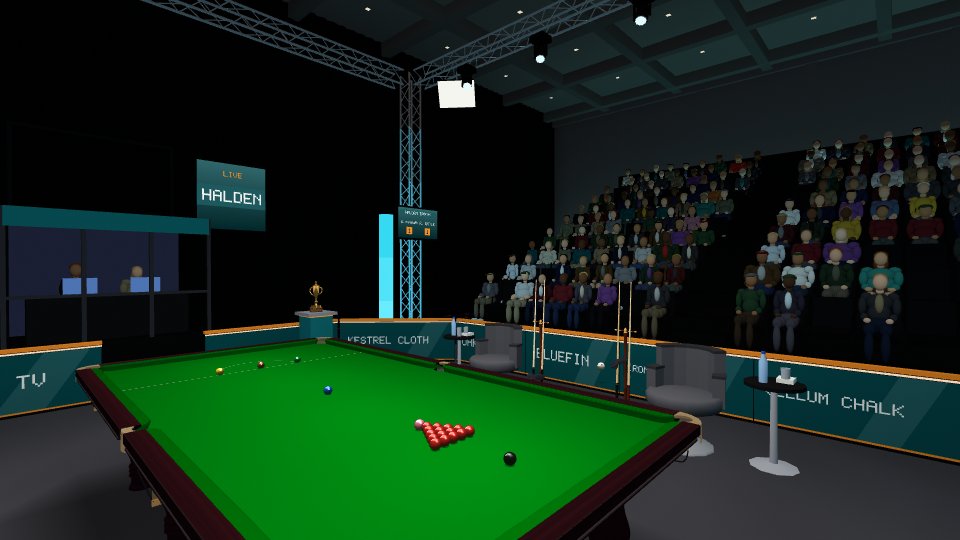
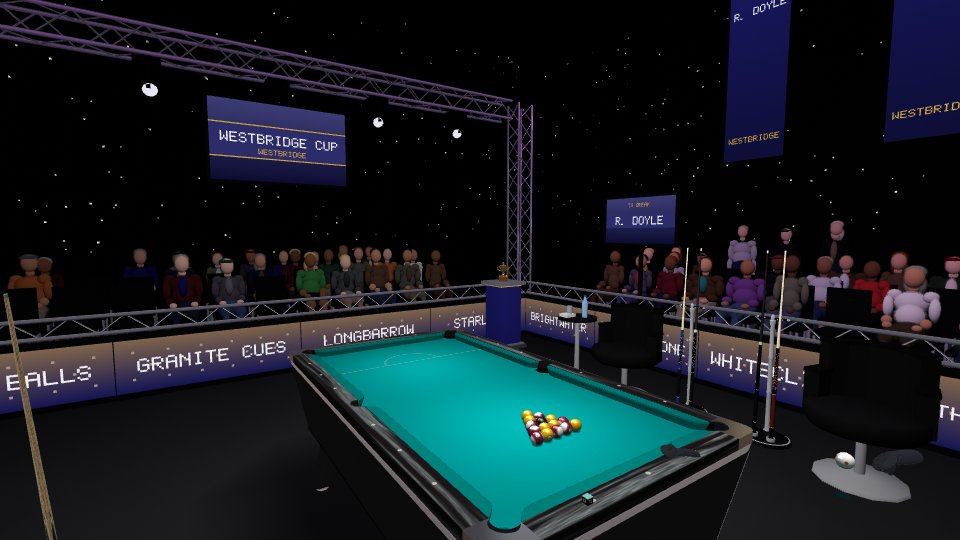
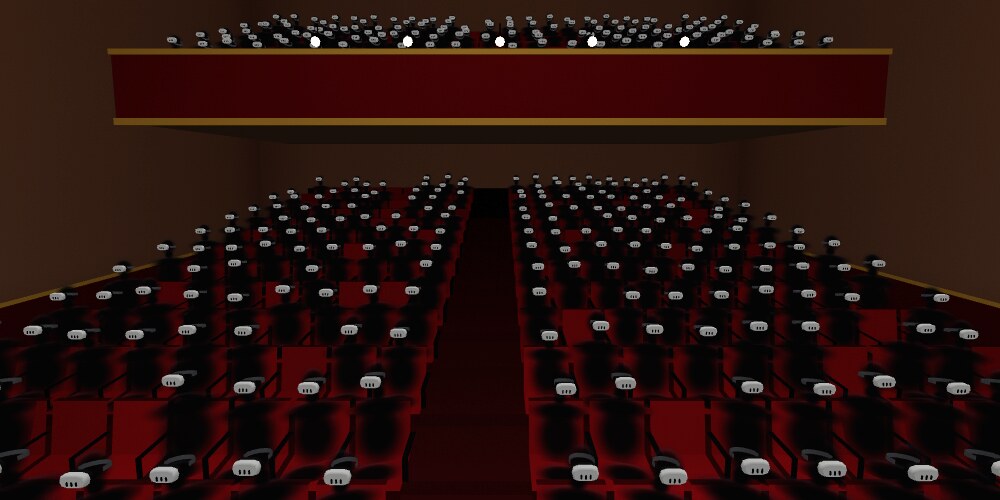
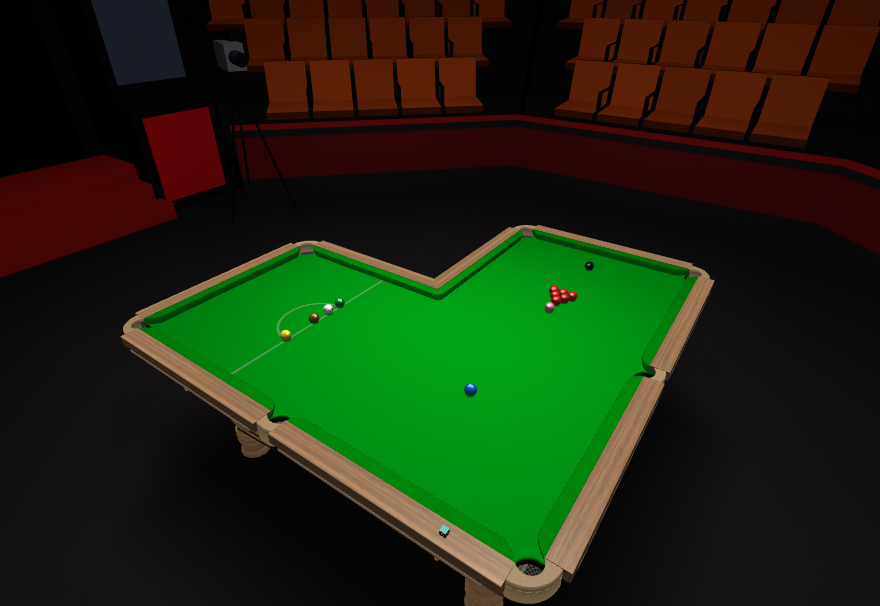
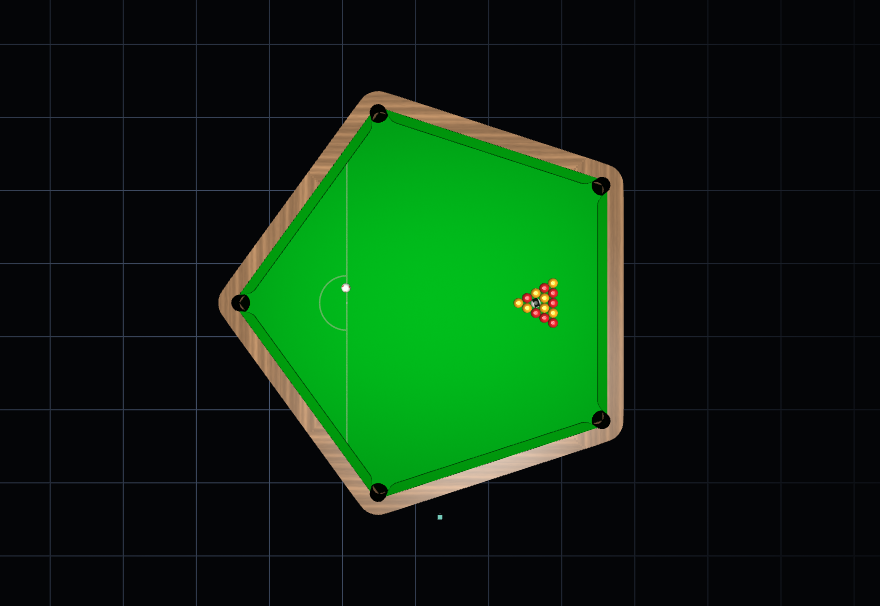
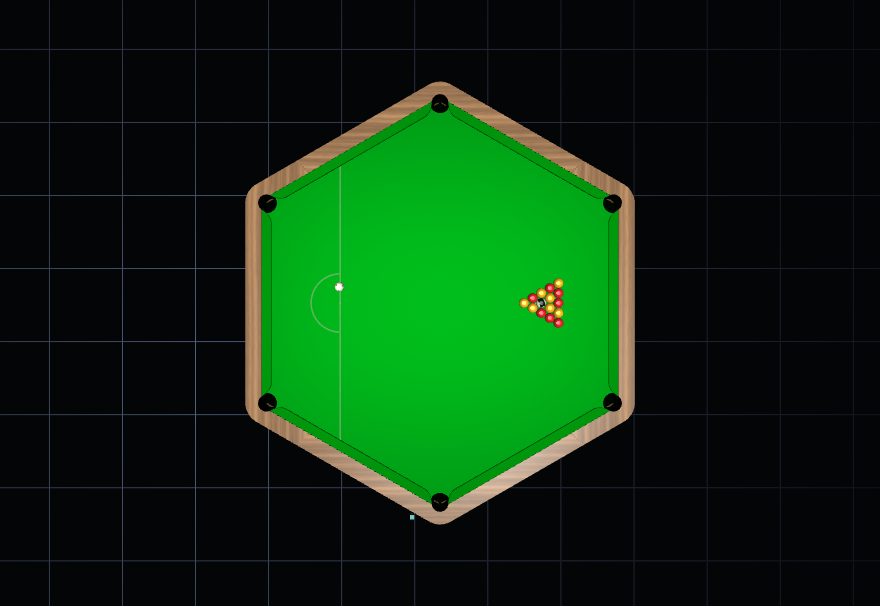
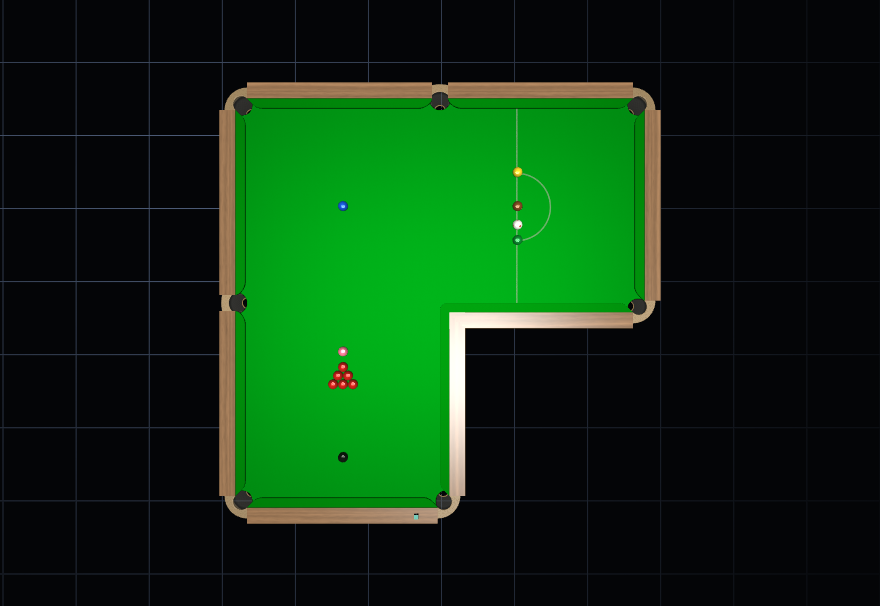
Play a tour final in front of a full houseA Victorian gin palaceA stately home's dining roomThe libraryWin a title, lift the trophyDown the club, with other playersA pool hallSeven table bodies, and beds of every shape27 ball sets30 cues, and a workshop to build more
All you need is a Quest 3 or 3S. This section takes you from putting the headset on to
your first frame, the way the game starts: in mixed reality, with your own room around
the table, and two controllers as the cue. Everything else (a real cue, your bare hands, playing in a virtual room) is further on,
once you have played a frame.
1. Put the table in your room
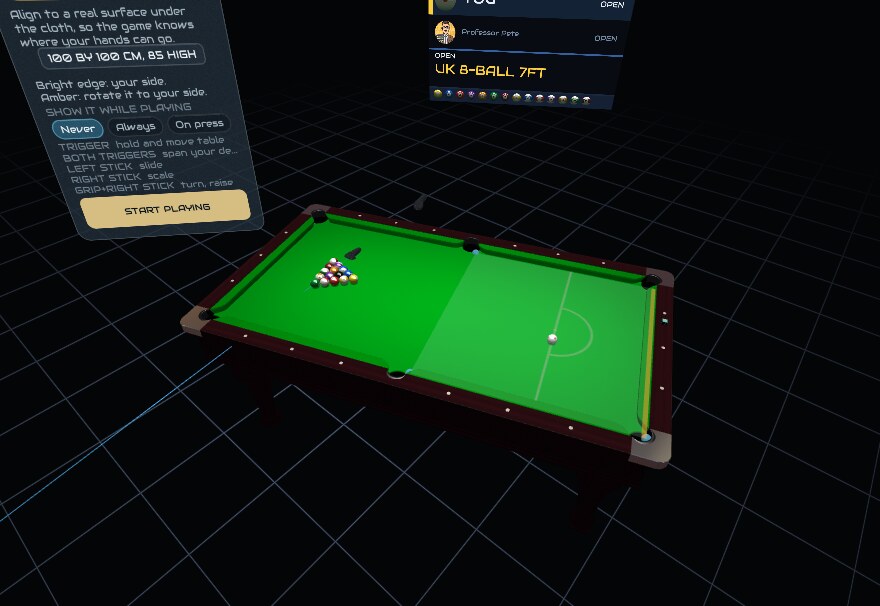
The table panel opens first.
The first time you start CueVR, the table panel opens before anything else. You are looking
at your own room, and the game wants to know where the table should stand.
Stand where you want to play, ideally beside a real desk or table: resting your
bridge hand on something solid makes it far easier.
Hold the trigger and move your hand until the outline sits on your desk, then let
go. The bright edge of the outline is the side you play from.
Point at START PLAYING and pull the trigger.
The table stands about 85 cm high, like a real one, and you do not need a room as big as the
table: you move the table, not yourself (step 4). Setting up the table
has the rest, including the scoreboard.
2. Pick a game and press PLAY
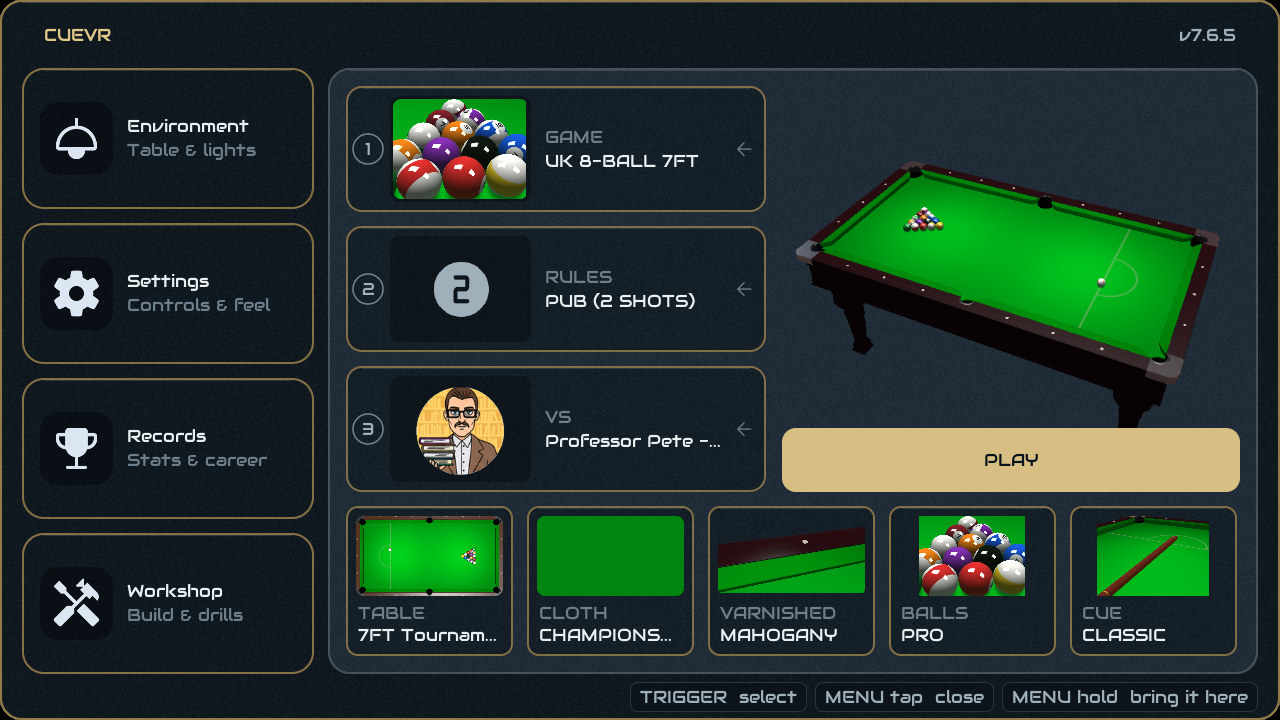
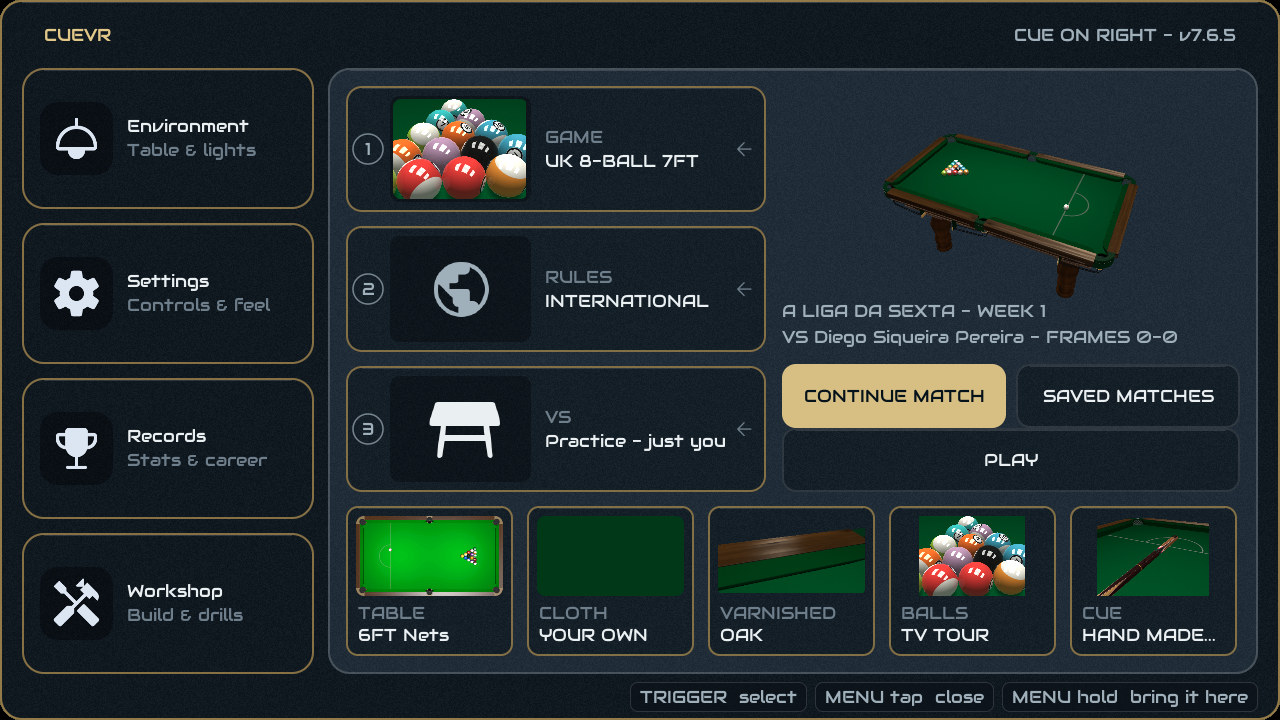
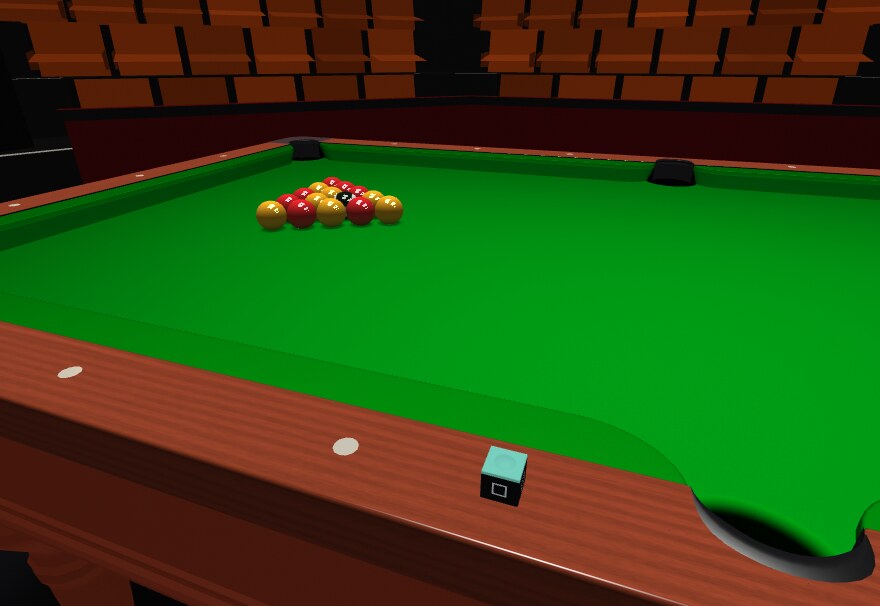
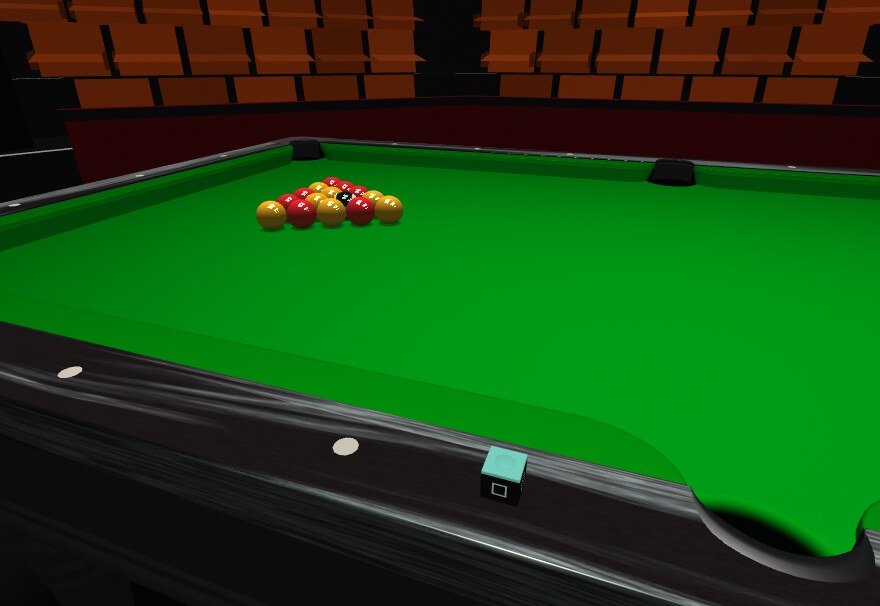
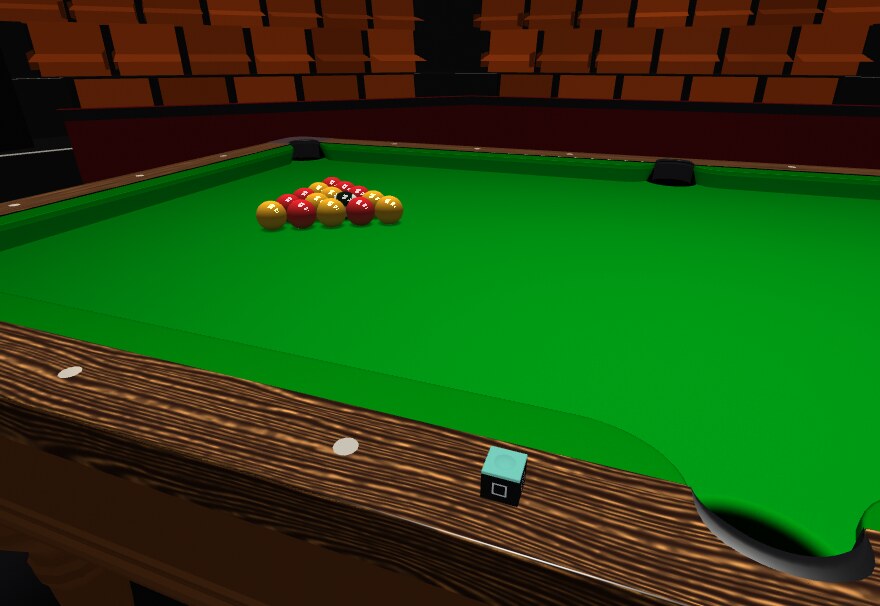
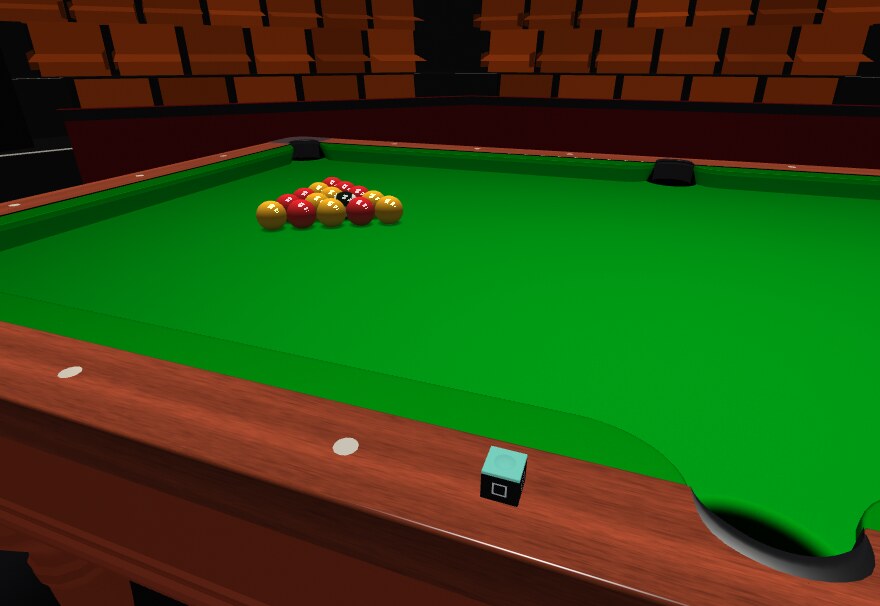
Home. The three numbered steps set the frame, the picture is the table you are
about to play on, and PLAY starts it.
Home opens in front of you on a sheet of glass. Point at things with either controller and
pull the trigger. Three numbered steps set up the frame: 1 GAME (UK 8-ball to start
with), 2 RULES and 3 VS, your opponent, a computer player to start with. Leave
them as they are for your first frame, point at PLAY and pull the trigger.
3. Hold the cue and play a shot
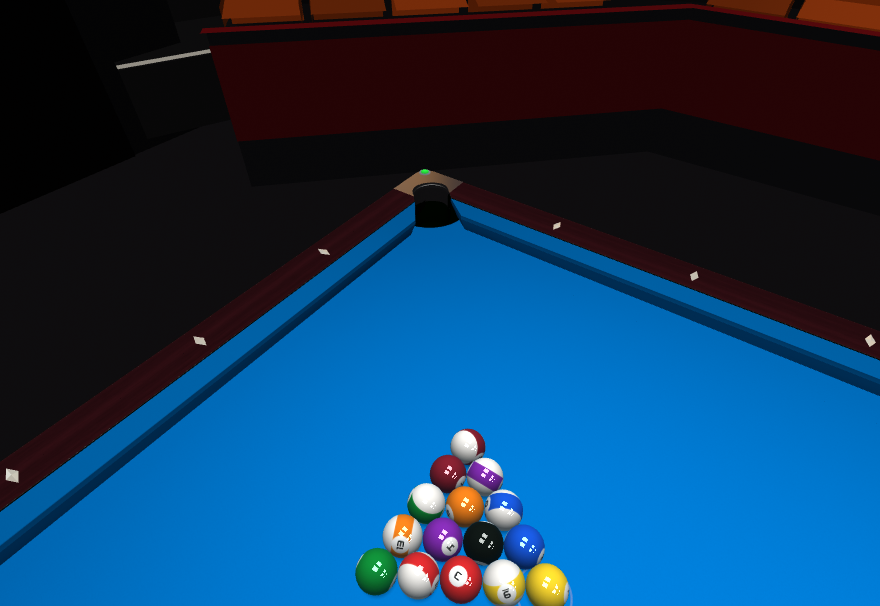
UK 8-ball, racked and waiting.
The cue lies between your two controllers. Your right hand holds the butt and plays
the stroke; your left hand is the bridge, where the front of the cue rests. The line
between your hands is the line of the shot. (Left-handed? Settings → Controls → CUE
HAND.)
Put the tip on the cue ball and line up the shot. Rest your left hand on your real
desk if you can.
Choose where to hit the ball by where the tip is: higher for top, lower for screw,
left or right for side.
Pull the trigger on your right hand. That locks the line, so your aim cannot drift
while you deliver.
Keep it held and move your right hand forward through the ball. How fast you move
it is how hard you hit: a slow push for a gentle shot, a real swing to break. Let go
afterwards.
When the cue ball is in your hand after a foul, it sits in front of your right controller:
carry it where you want it and pull the trigger to put it down. Playing a
shot has the rest: shortening the cue, the rest, and more.
4. Move the table, not yourself
You do not need to walk round a twelve-foot table. The left stick slides the table
around your room and the right stick turns it, at any time, even in the middle of a
frame, so any shot can be brought in front of you. Walking round it works too.
5. The menus during a frame
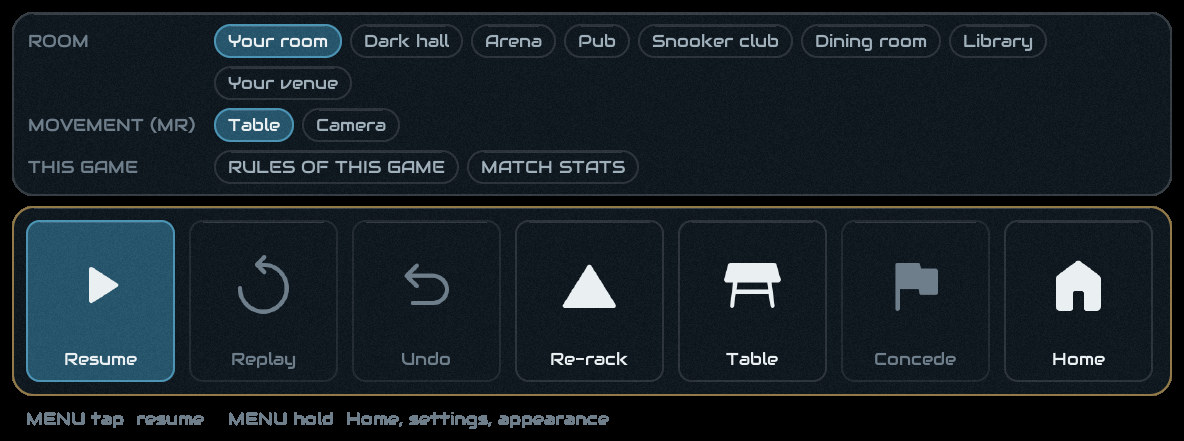
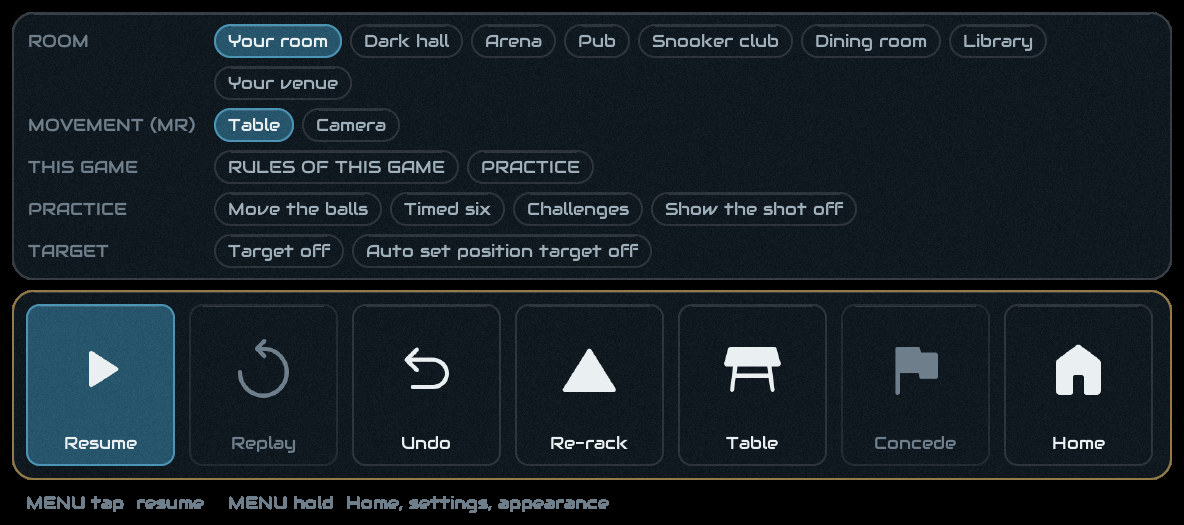
Tap MENU for the pause menu: resume, replay the last shot, re-rack, move the
table, concede the frame, or go Home. Hold MENU to bring Home to where you are
standing, from anywhere; your frame waits for you.
There are two menus. Home is where you set up a game. The pause
menu is what you get when you press MENU during a frame. Both open in front of
you, wherever you are standing.
Home
ABCDEFGHIJ
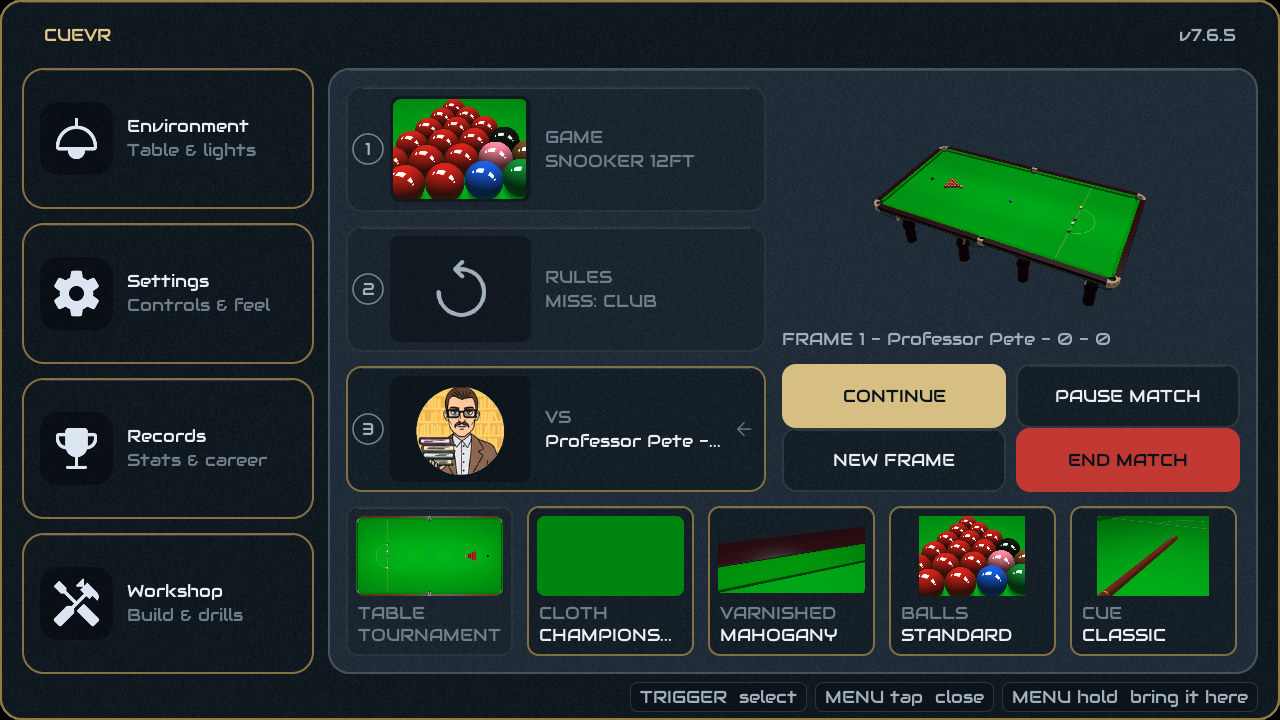
GAME — Which game: snooker, the pools, billiards, carom and the rest. Opens a page of cards, one per game.
RULES — Which version of that game, such as pub rules or the official ones.
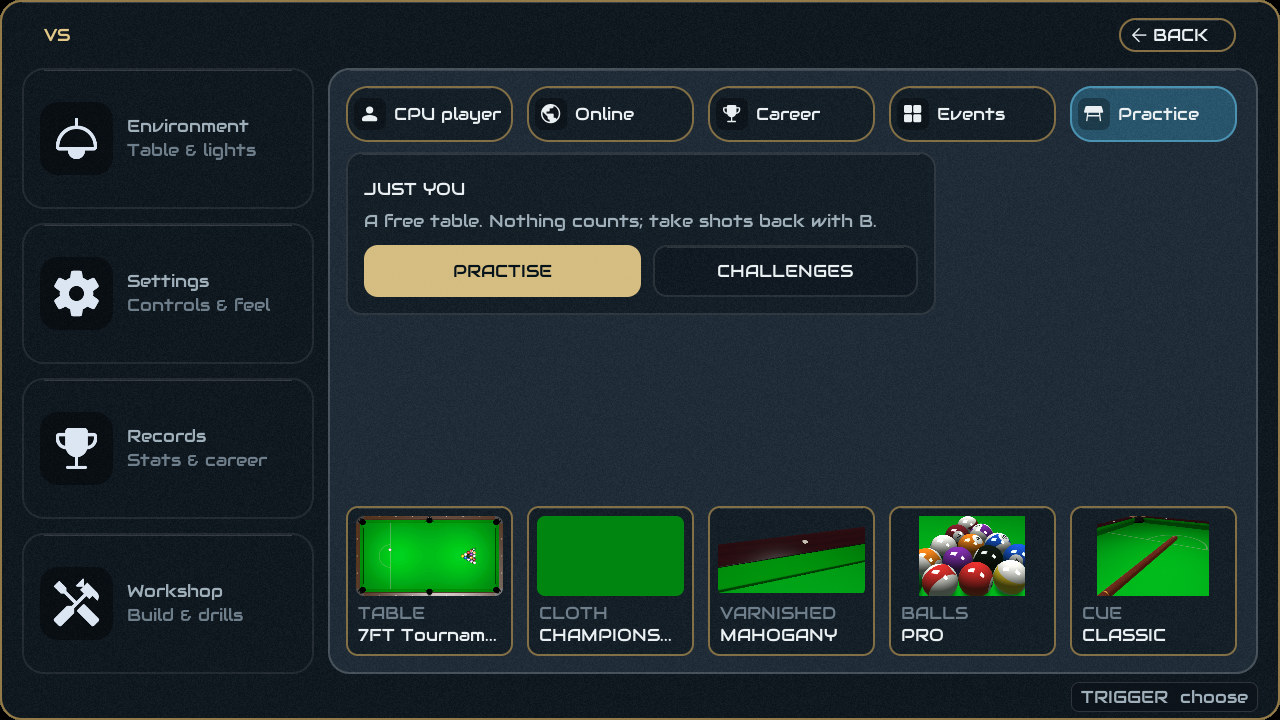
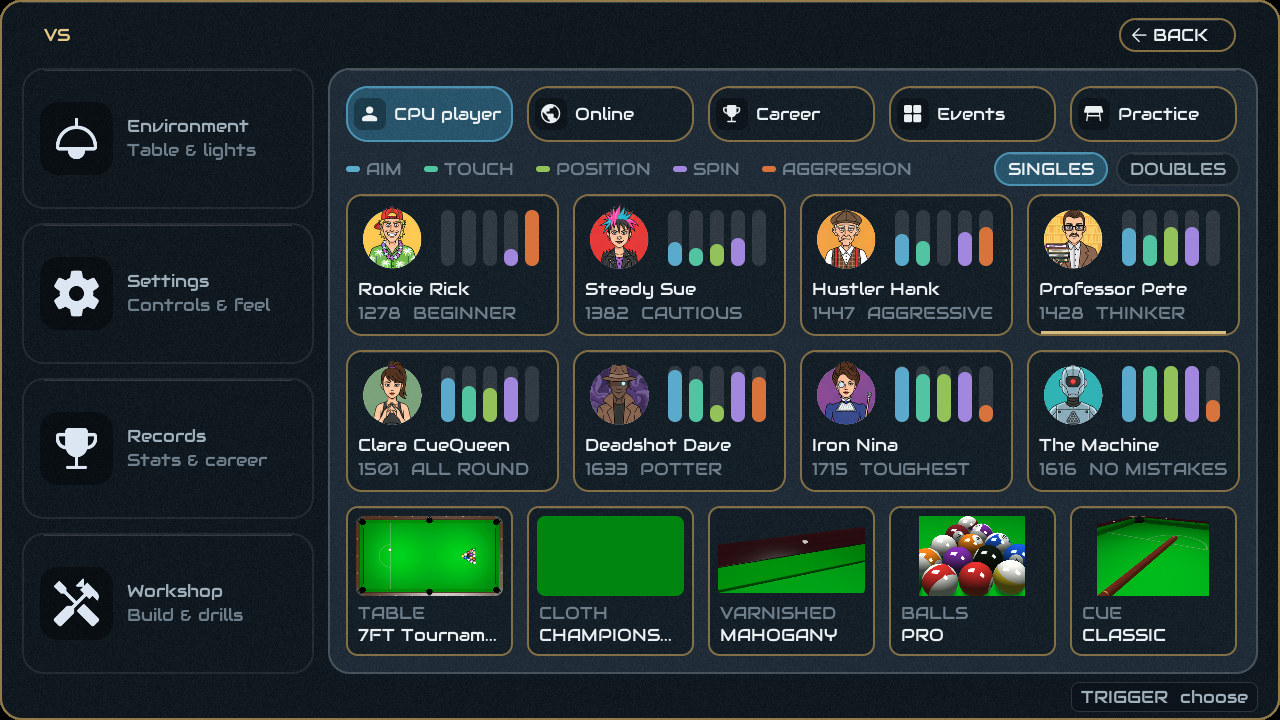
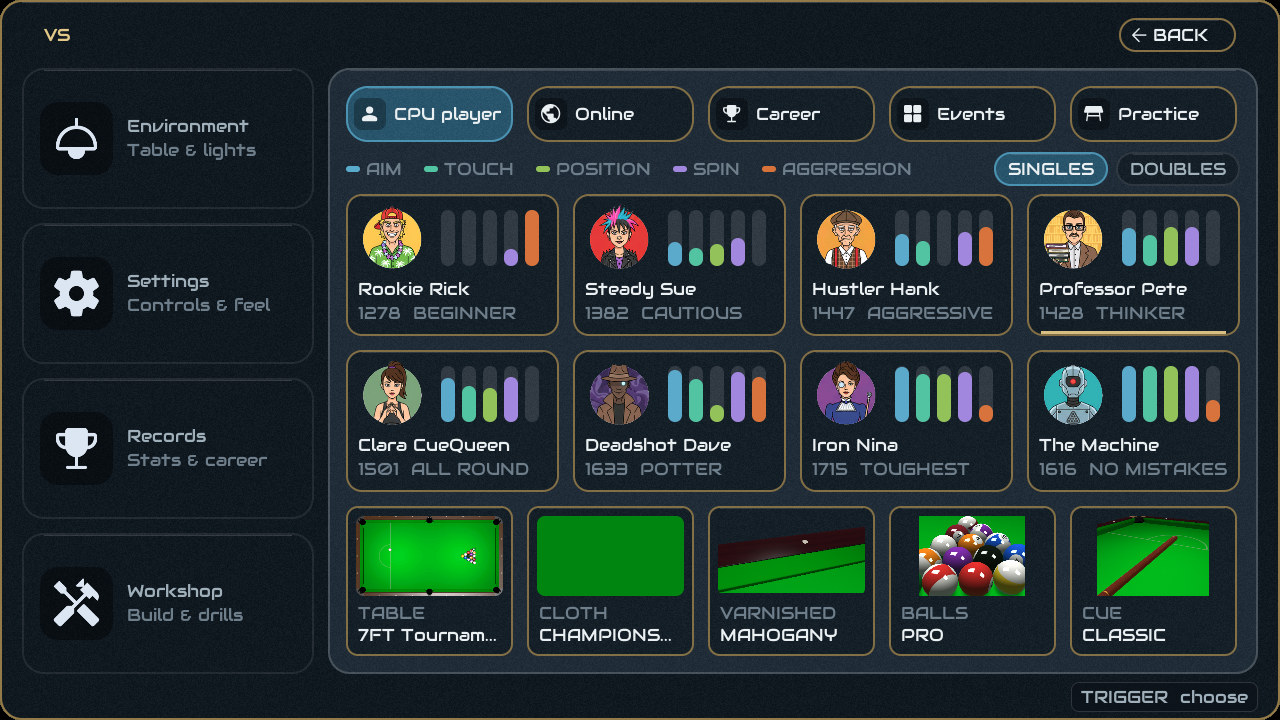
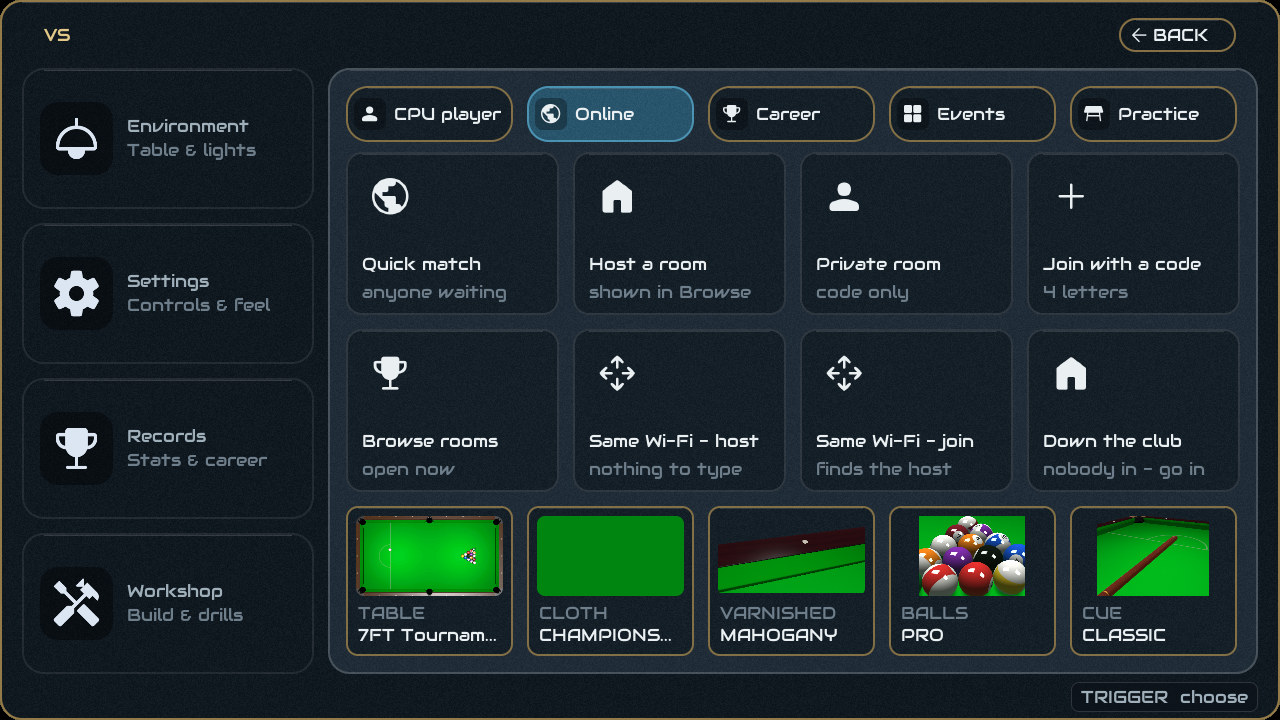
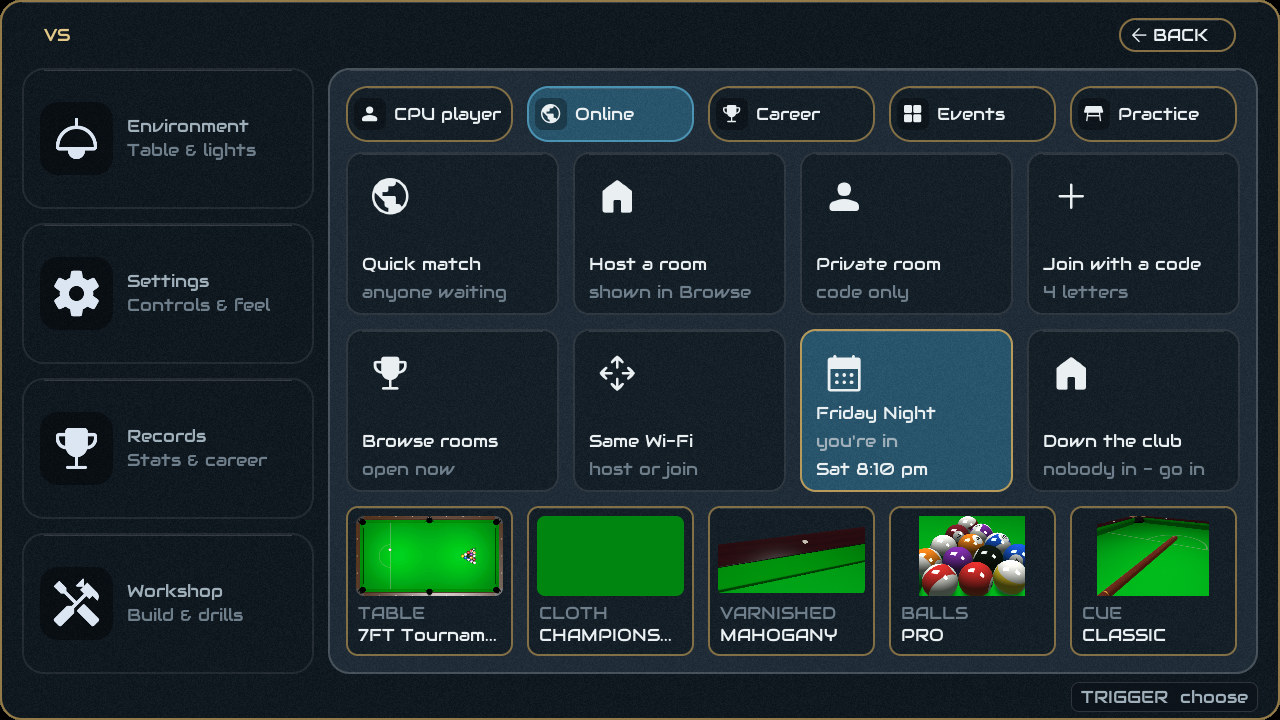
VS — Who you play: a computer player, someone online, a career or event match, or practice on your own.
PLAY — Starts the frame. The picture above it is the table you will play on.
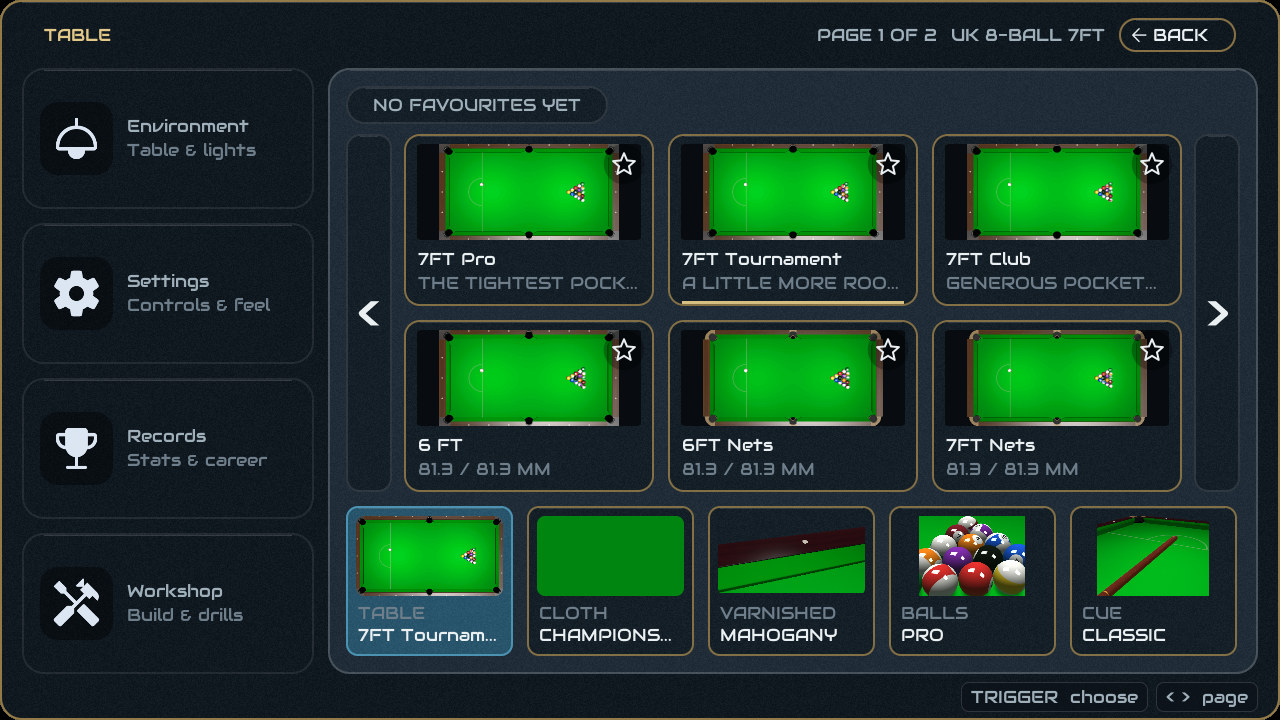
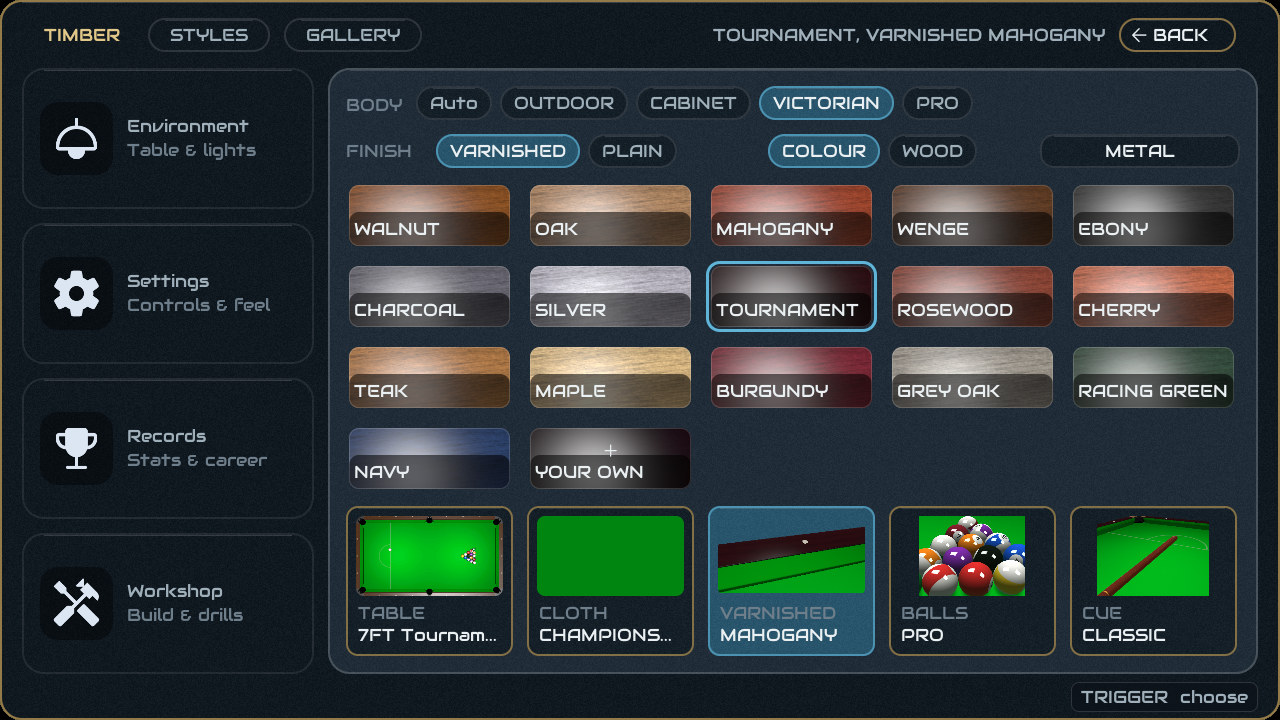
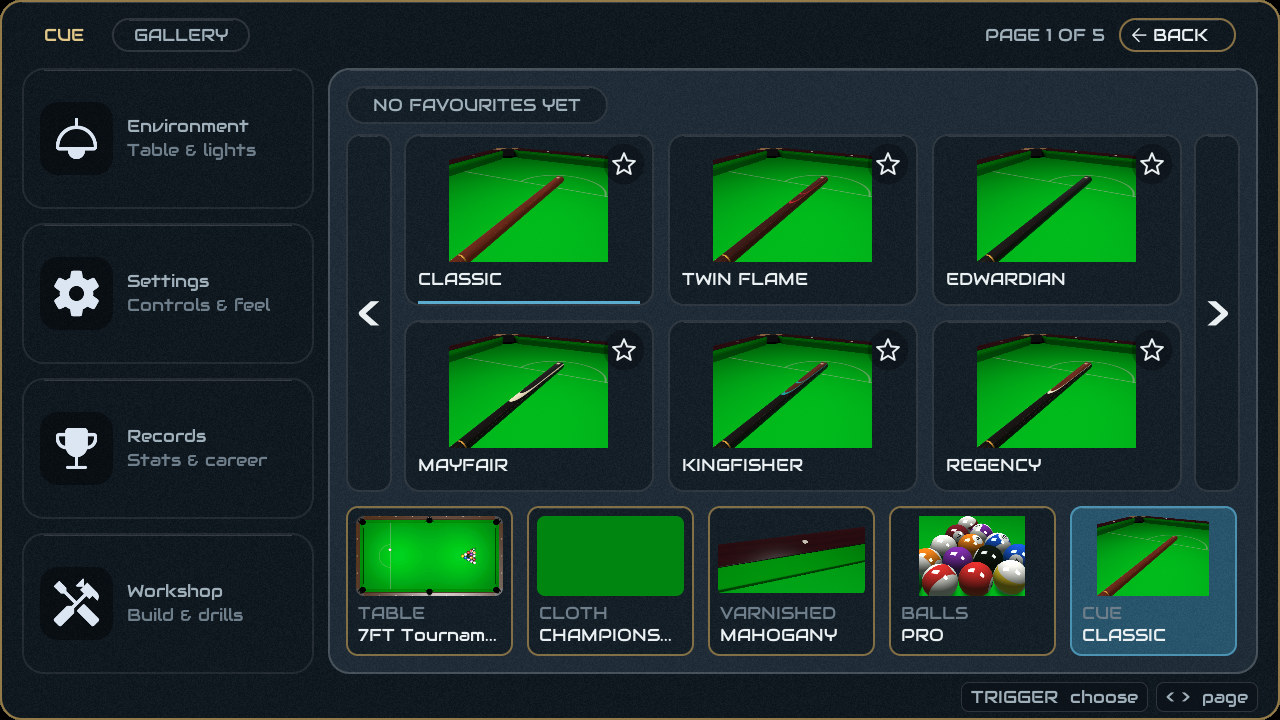
The table's look — The table, the cloth, the wood, the balls and your cue. Each opens a page of pictures to choose from.
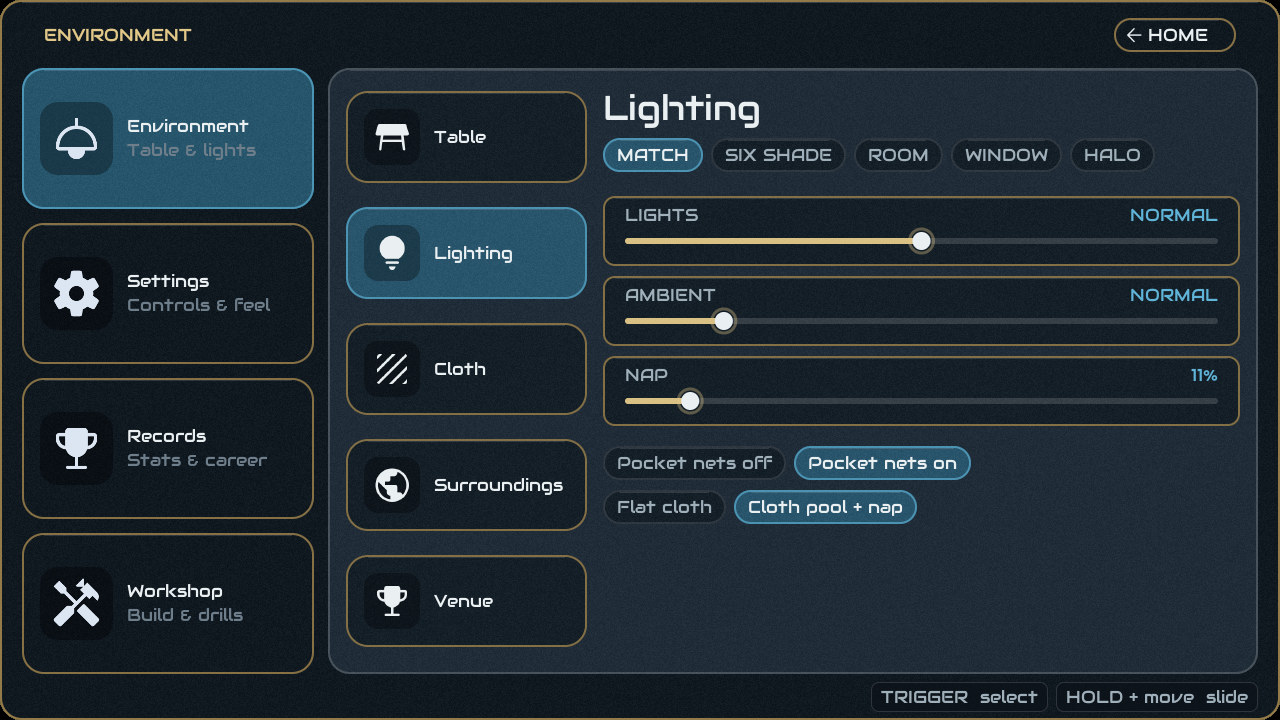
Environment — Where the table stands, the scoreboard, the lights and the room around you.
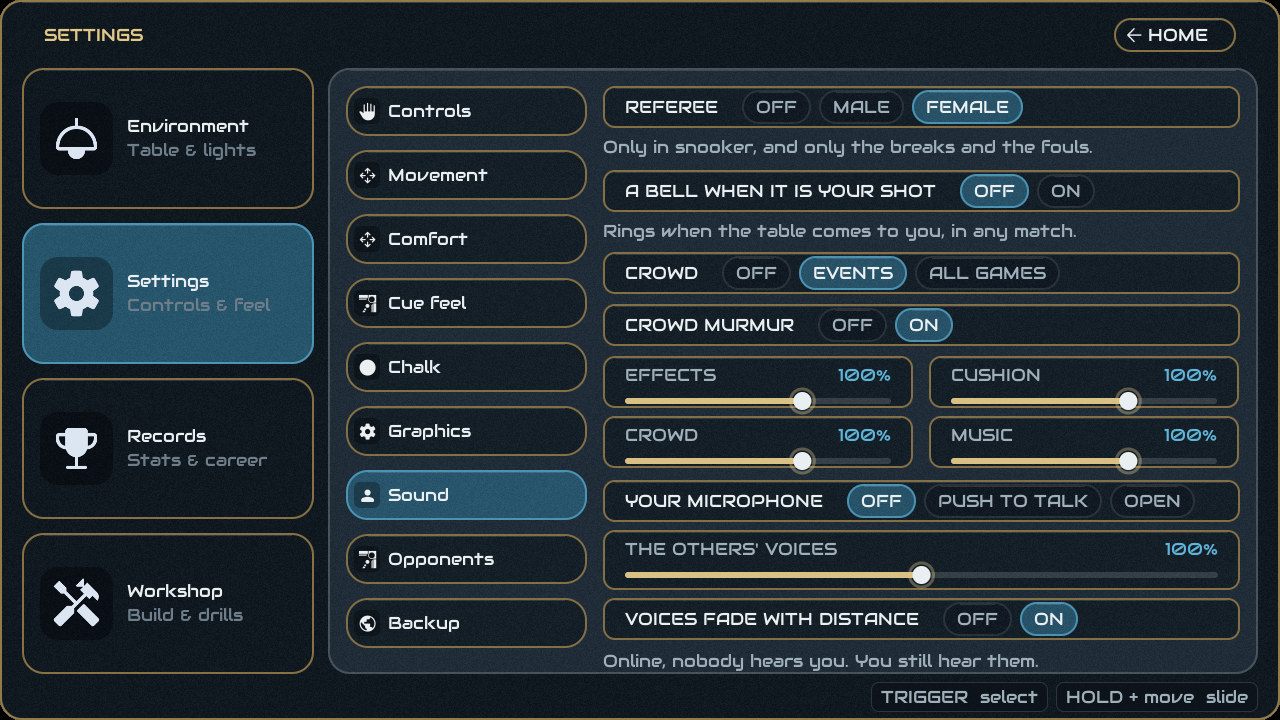
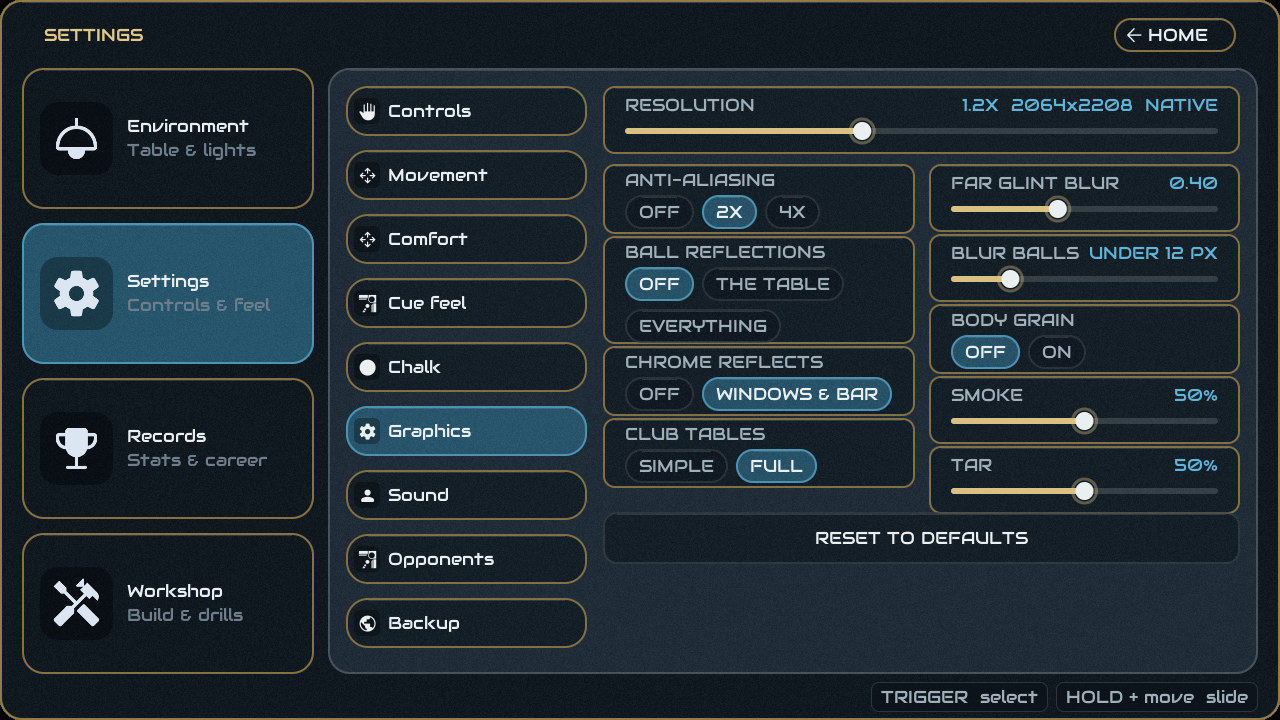
Settings — How you hold and play the cue, moving around, comfort, graphics, sound and backups.
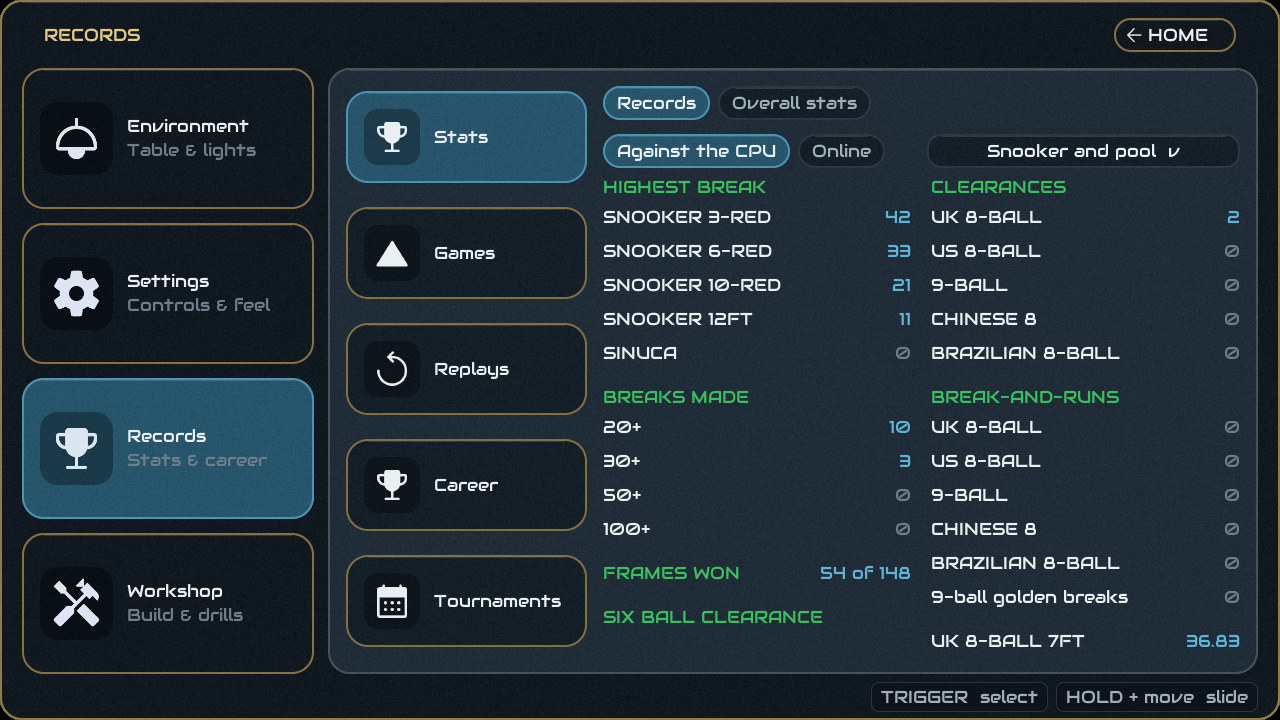
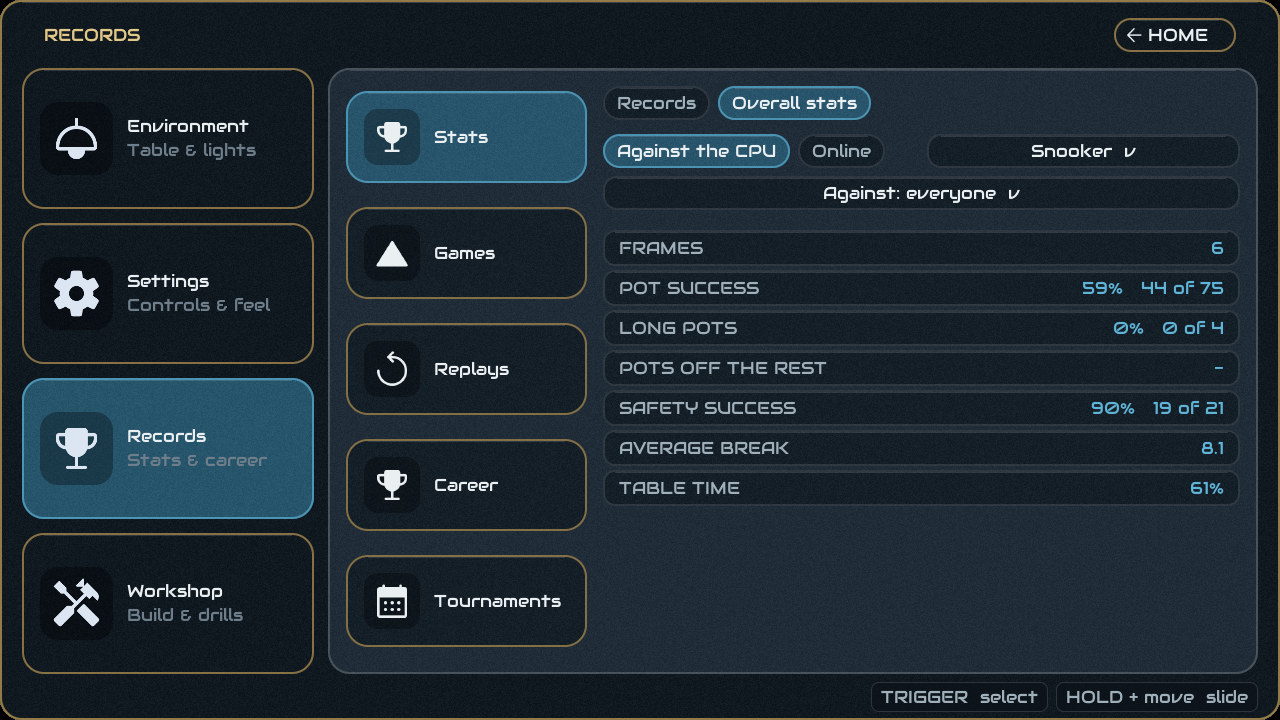
Records — Your stats, the games you have played, replays, your career and club tournaments.
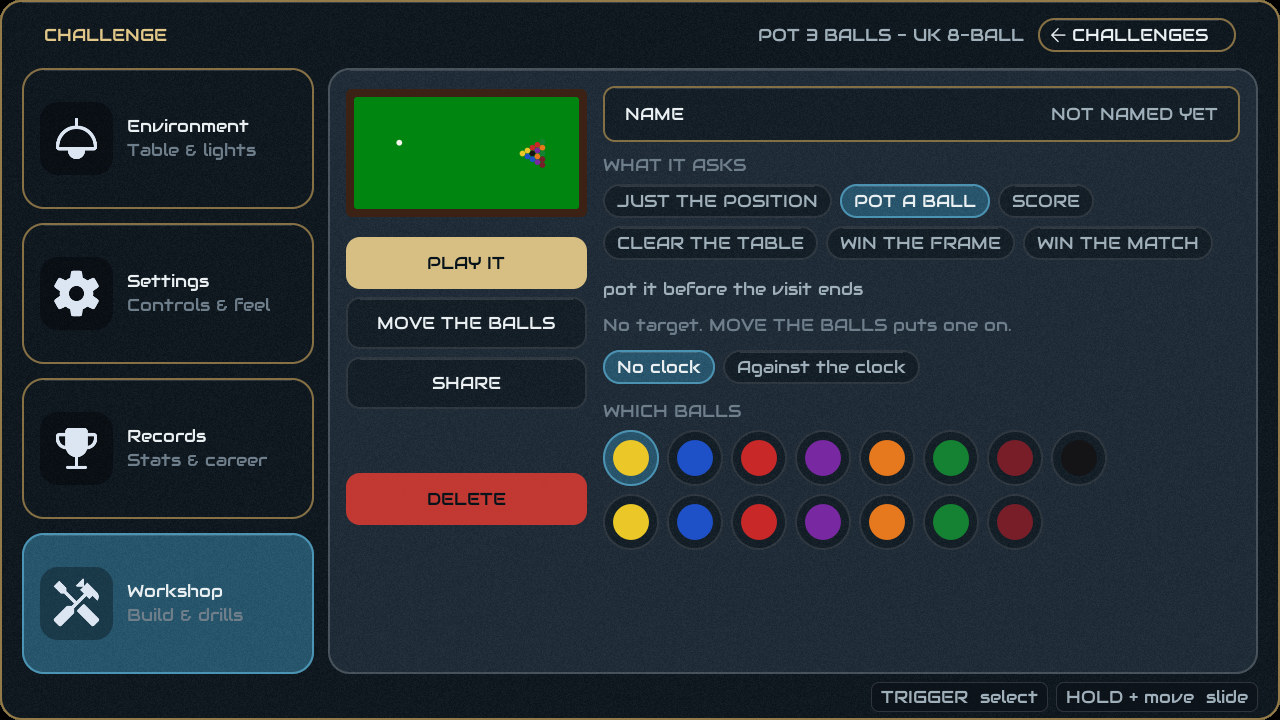
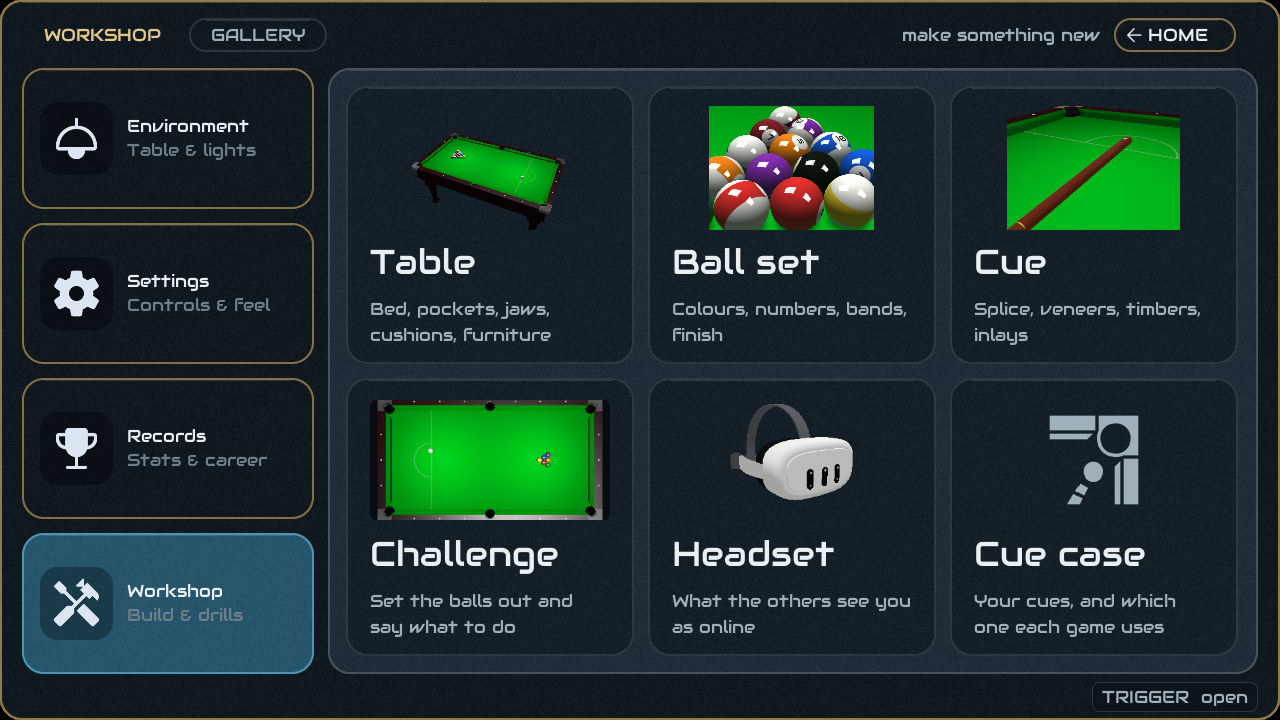
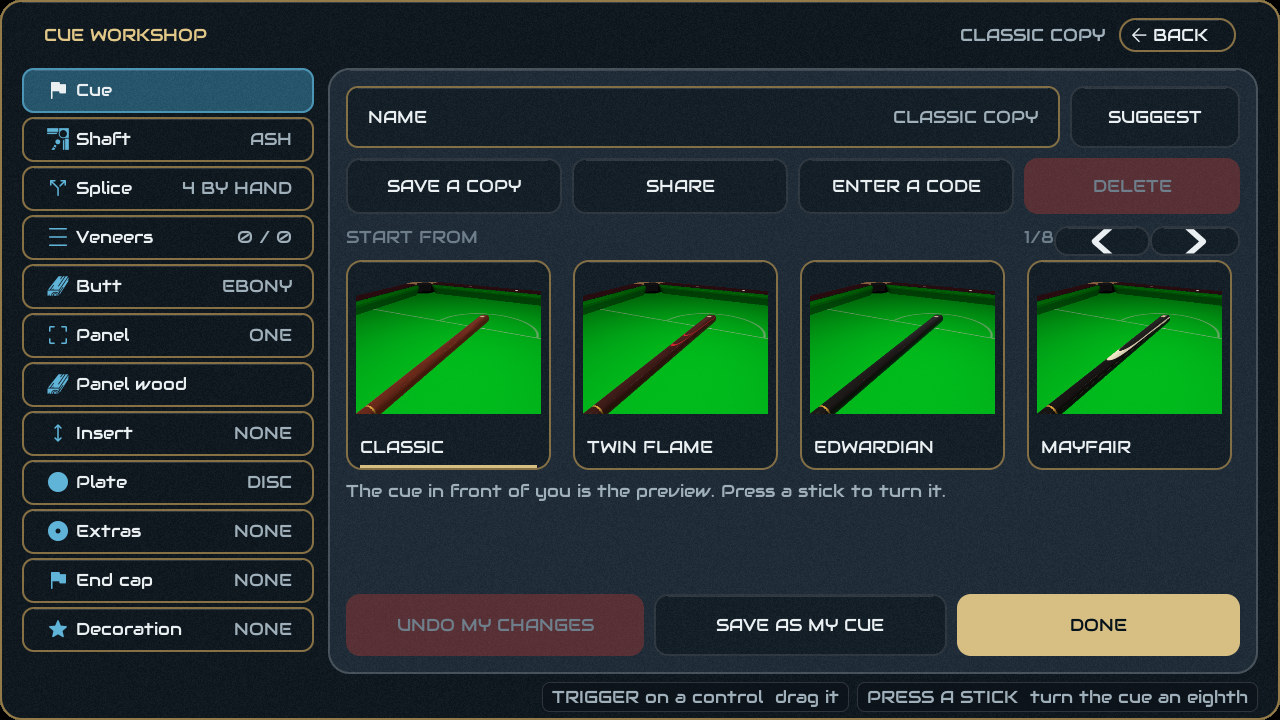
Workshop — Build your own table, ball set, cue or challenge.
The buttons — Point and pull the trigger to choose. Tap MENU to close the menu. Hold MENU to bring it to where you are standing.
The pause menu
ABCDEFGHIJK
ROOM — Change the room around the table without leaving the frame: your own room in mixed reality, or one of the game's rooms.
MOVEMENT — What the thumbsticks do: Table moves the table, Camera moves you. Mixed reality and the game's rooms each remember theirs.
THIS GAME — The rules of the game you are playing, and the stats for this match. Practice adds its row here, with the drills and moving the balls.
Resume — Back to the frame. Tapping MENU does the same.
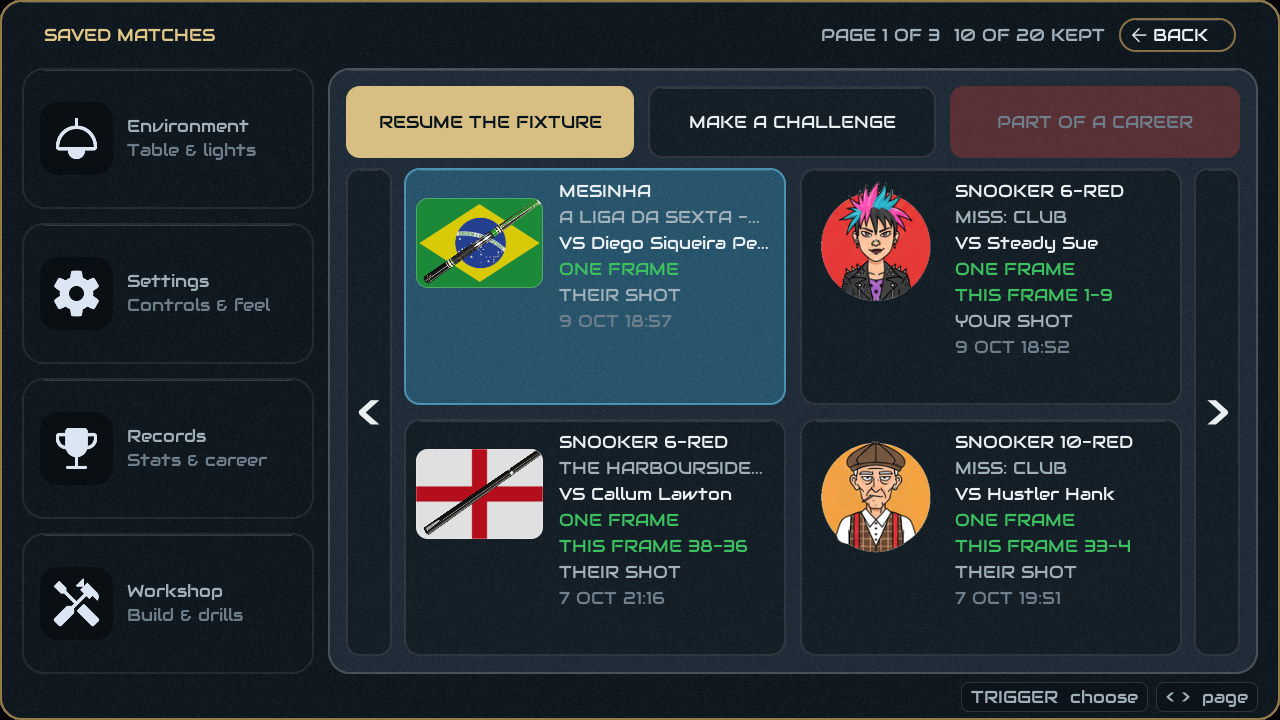
CONTINUE MATCH on Home, or SAVED
MATCHES beside it for the rest. See Saving and resuming.
Play with a real cue or a pen
Settings → Controls →
CALIBRATE A CUE, and Settings → Controls → CUE to switch between
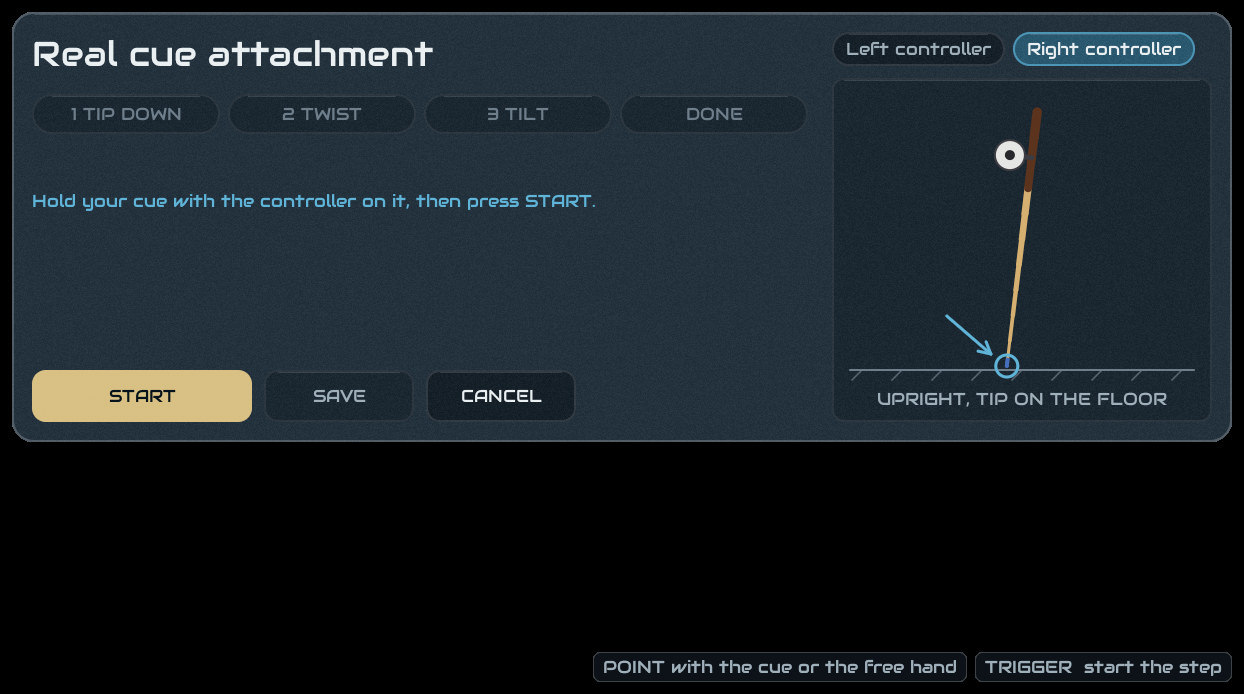
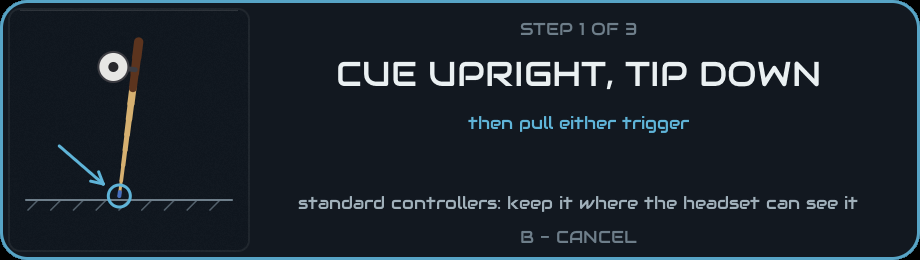
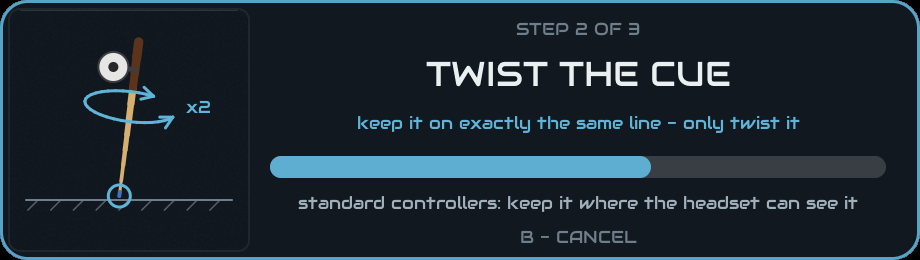
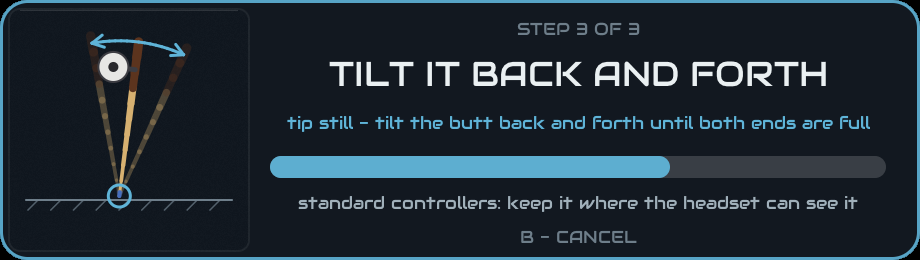
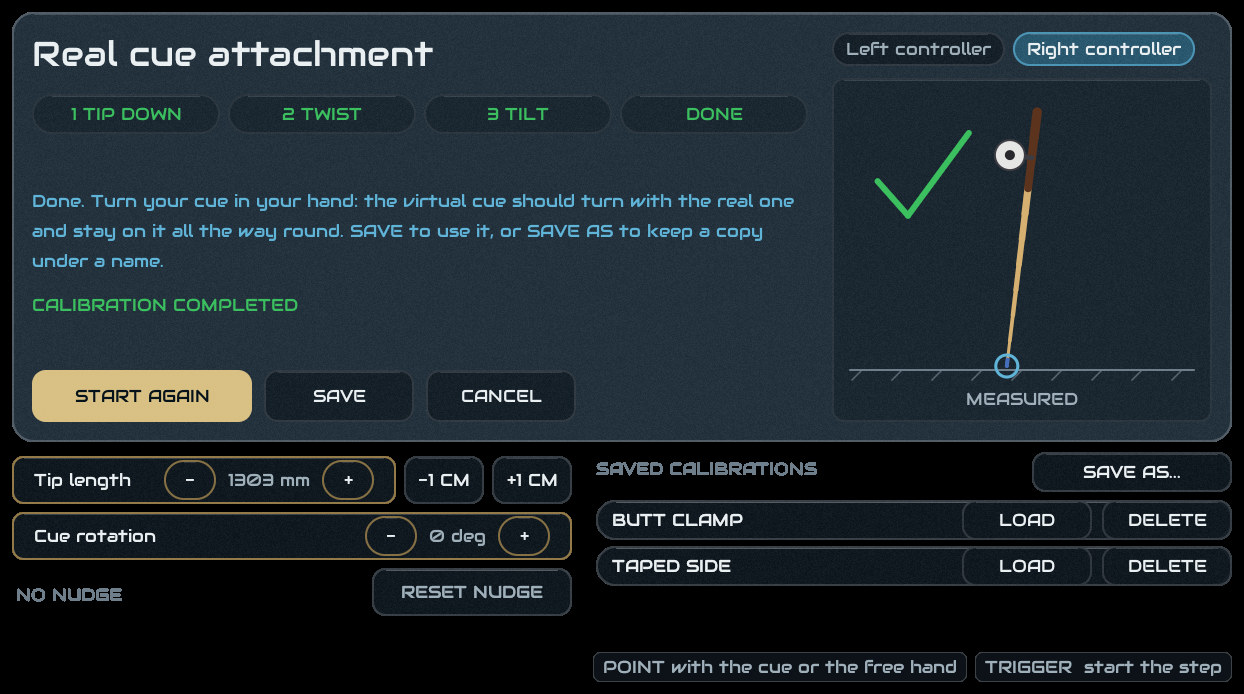
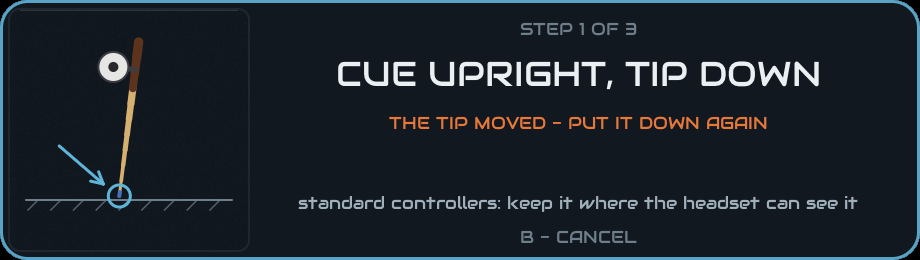
CONTROLLERS and REAL CUE. See Real cue
attachment.
Cue deflection
Settings → Cue feel → CUE DEFLECTION,
from NONE to 5 degrees.
Line the drawn cue up on my real one
Tap either side
trigger, then press and hold it, at the table — and move your cue onto the
frozen one. See Fine-tuning it.
How the sticks move you
Settings → Controls → TABLE
MOVEMENT. ONE STICK, EITHER puts the same control on both hands, which is what you
want with a cue in your hands. See One stick has to do
everything.
Cloth and timber
CLOTH and TIMBER on the strip along the
foot of the main menu.
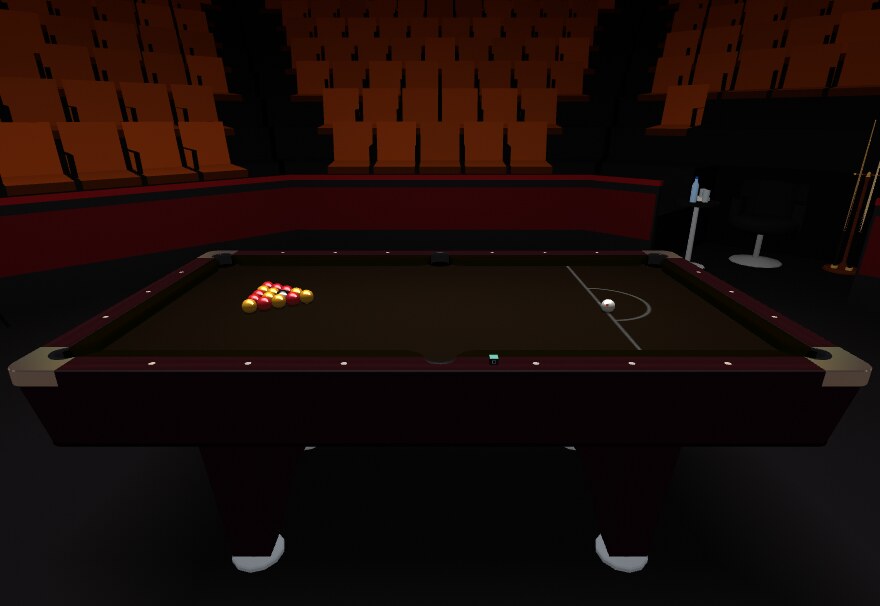
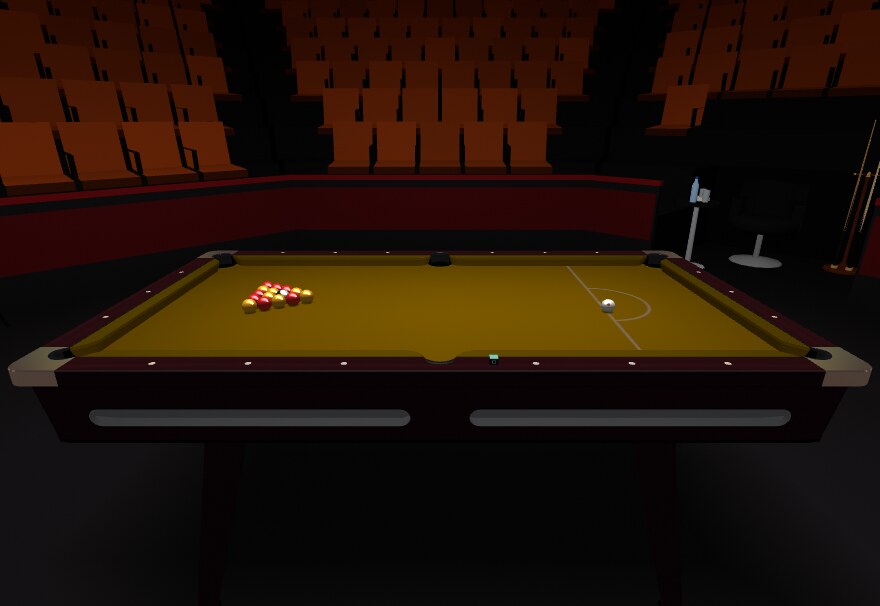
Lighting and surroundings
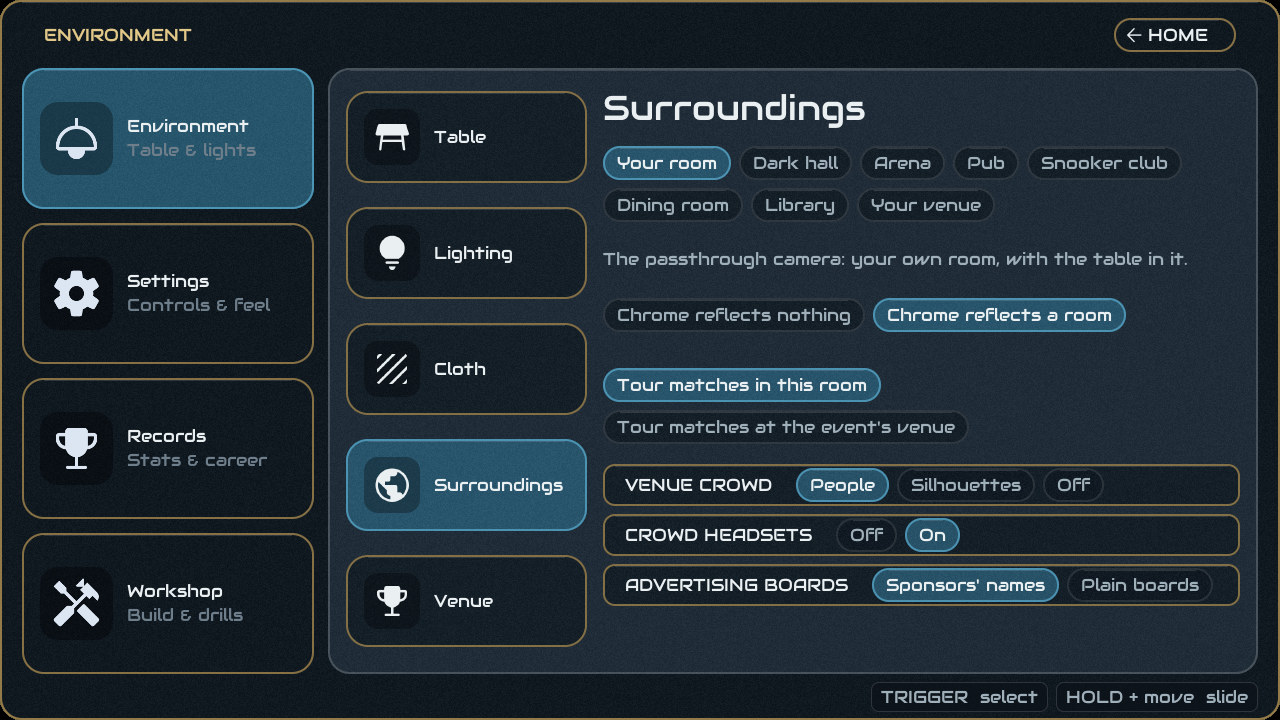
Environment → Lighting or
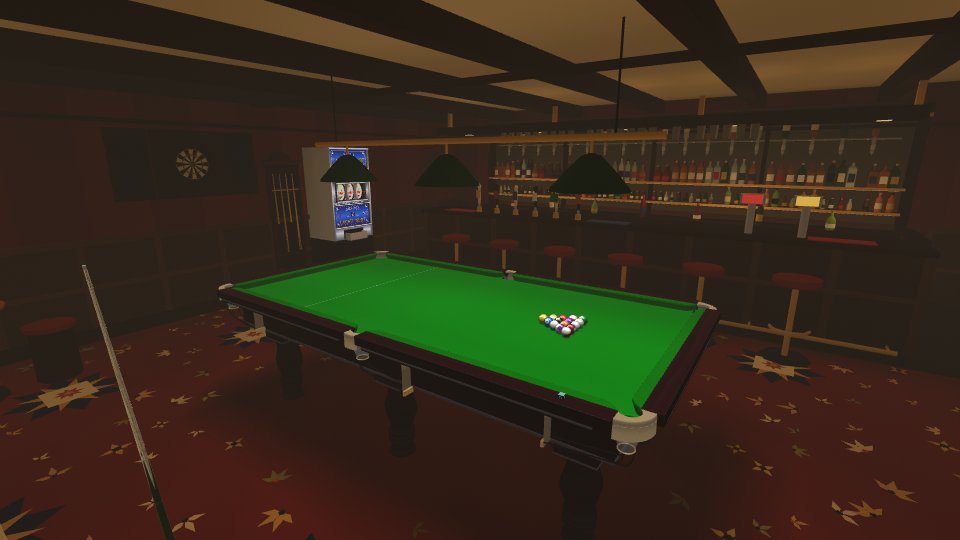
Surroundings. Your room, the dark hall, the arena, the pub, the snooker club, the
dining room, the library and your venue are also chips on the pause menu, since that
is the one you change mid-frame. Online, Host's room there puts you in the host's
room. See Playing in the host's room.
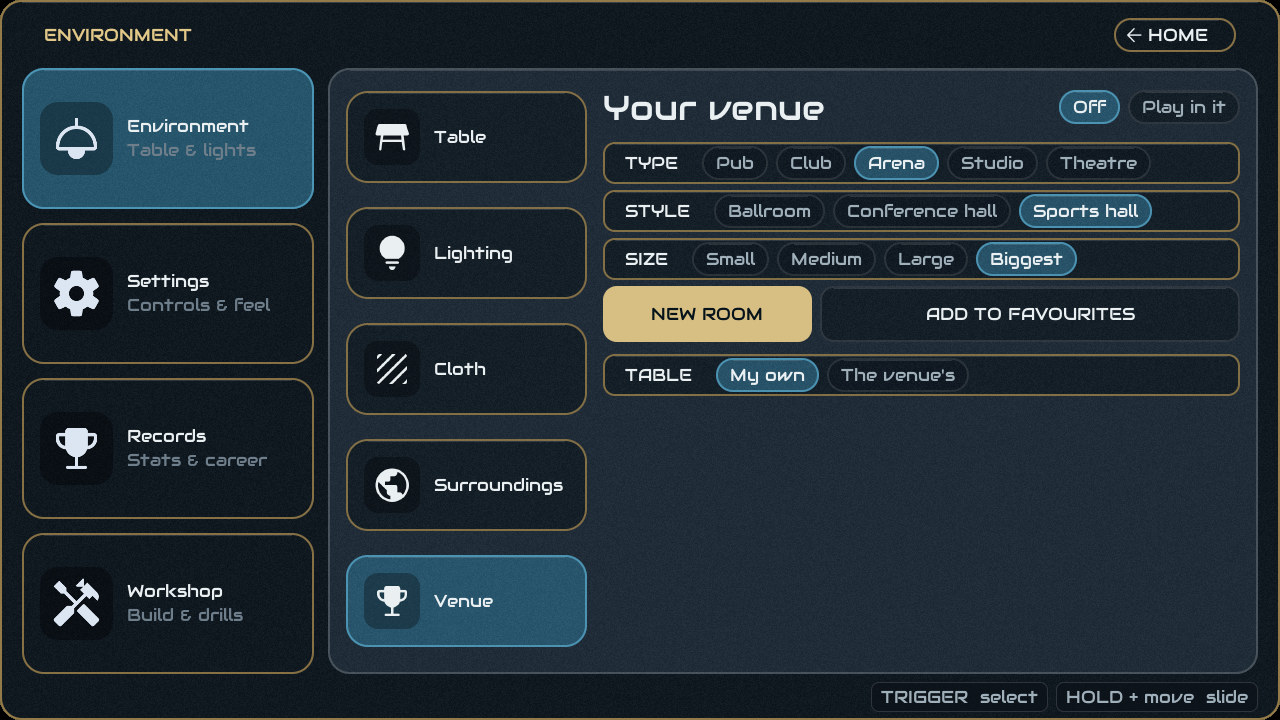
A venue of your own — a pub, a club, an arena, a studio or a
theatre
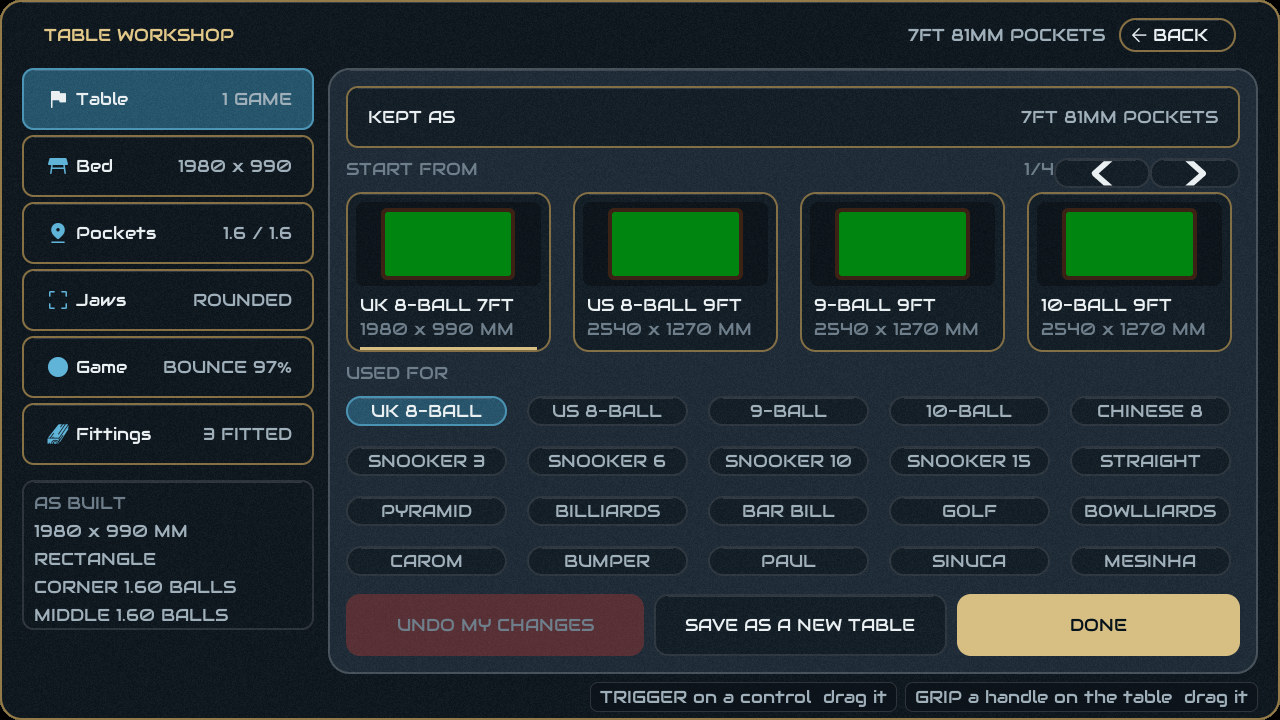
Workshop → Table, or the TABLE panel on
the strip, which carries the pocket templates.
Bring the menu back to where I am standing
Hold MENU for a
second, from anywhere.
The rules of the game you are in
MENU in a frame →
RULES OF THIS GAME.
A scorecard
MENU in a frame → SCORECARD, at golf
and bowlliards.
Practice tools, drills, the clearance clock
MENU in a frame,
with the opponent set to FREE PRACTICE: they are chips above the squares — move
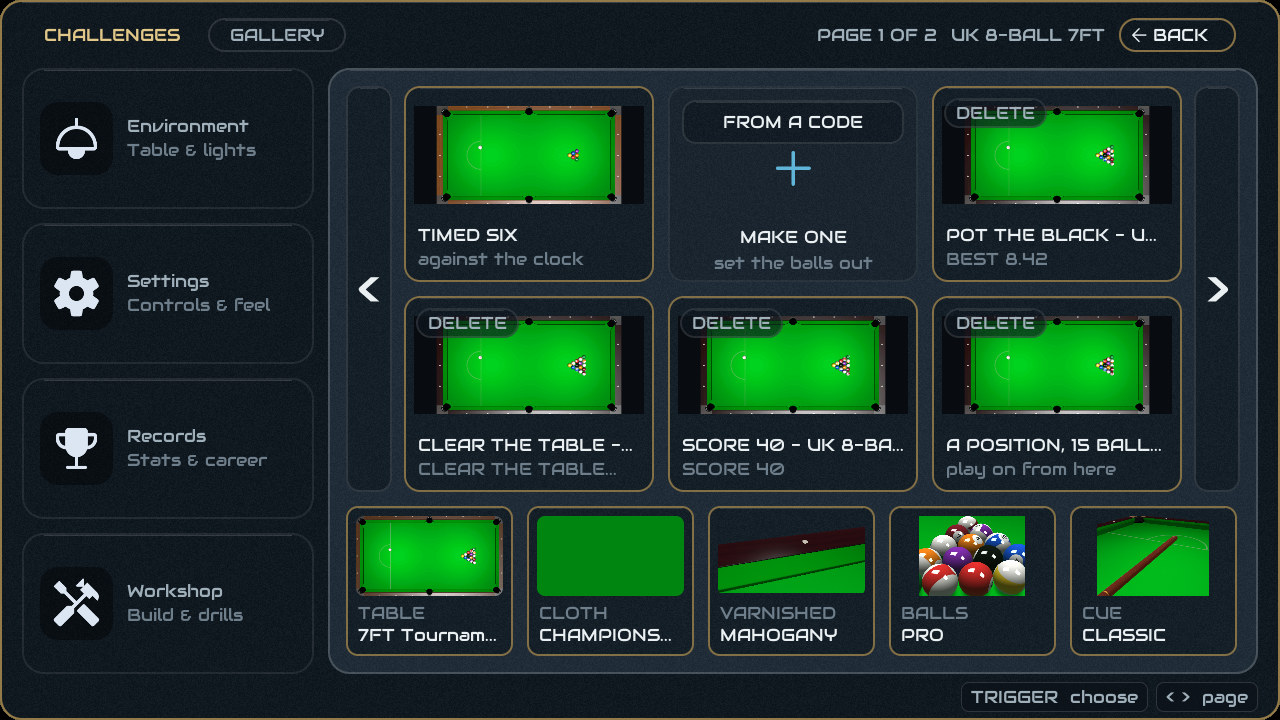
the balls, the timed six, and the challenges.
Stop the colours going back on
The Auto respot chip on the same
pause menu. On, they come back until the reds are gone and then stop, so you can play a
clearance.
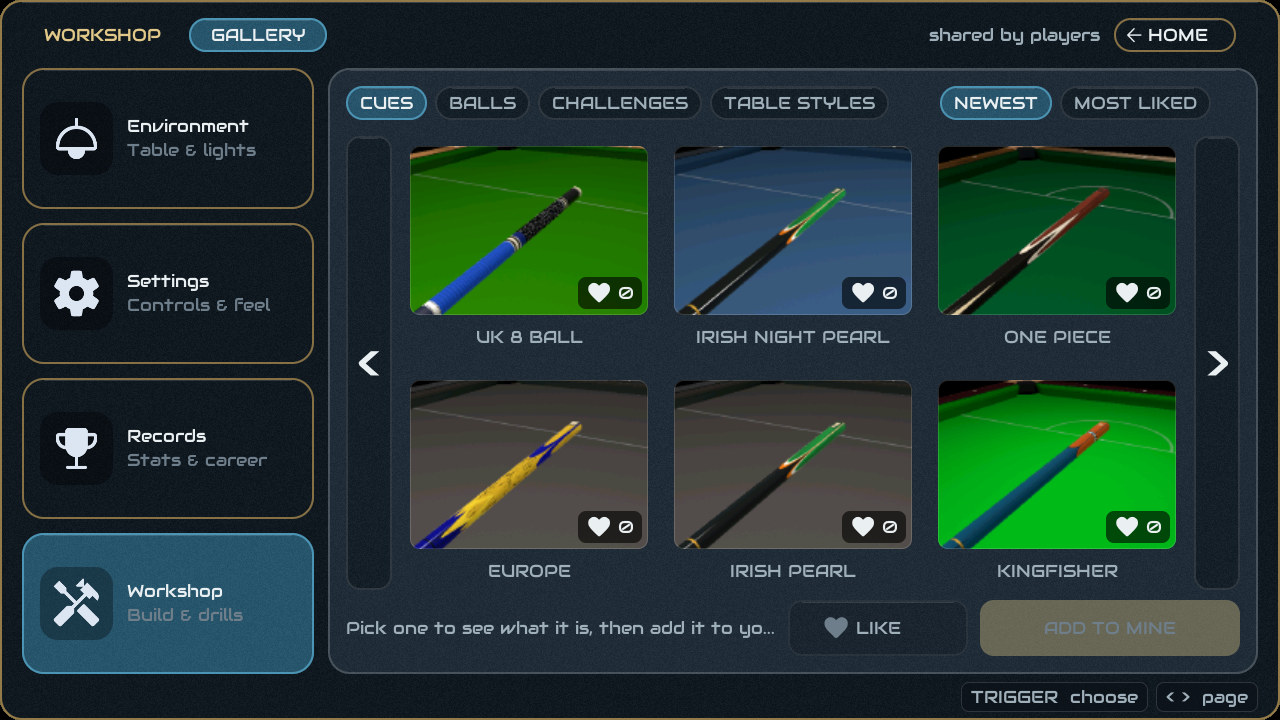
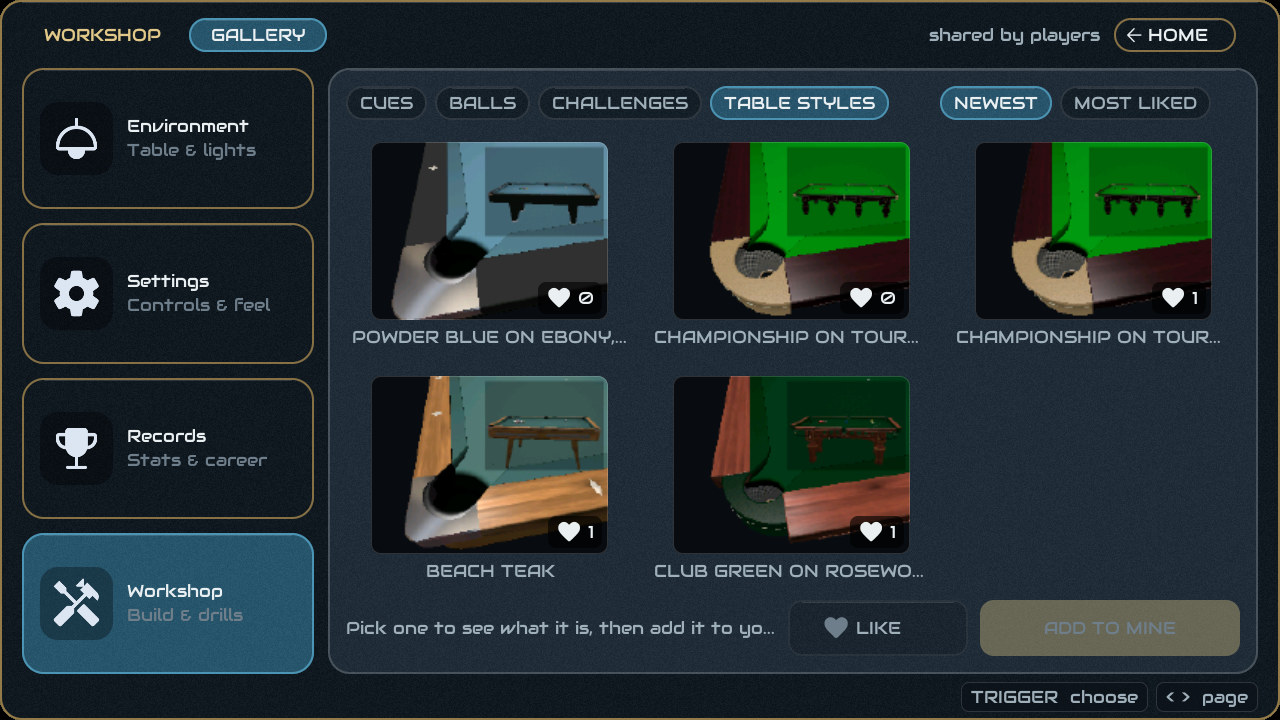
Things other players have made
GALLERY, beside the title in the
Workshop and on the cue, ball, challenge, cloth and timber pickers. See
Sharing and the gallery.
Keep the look of my table
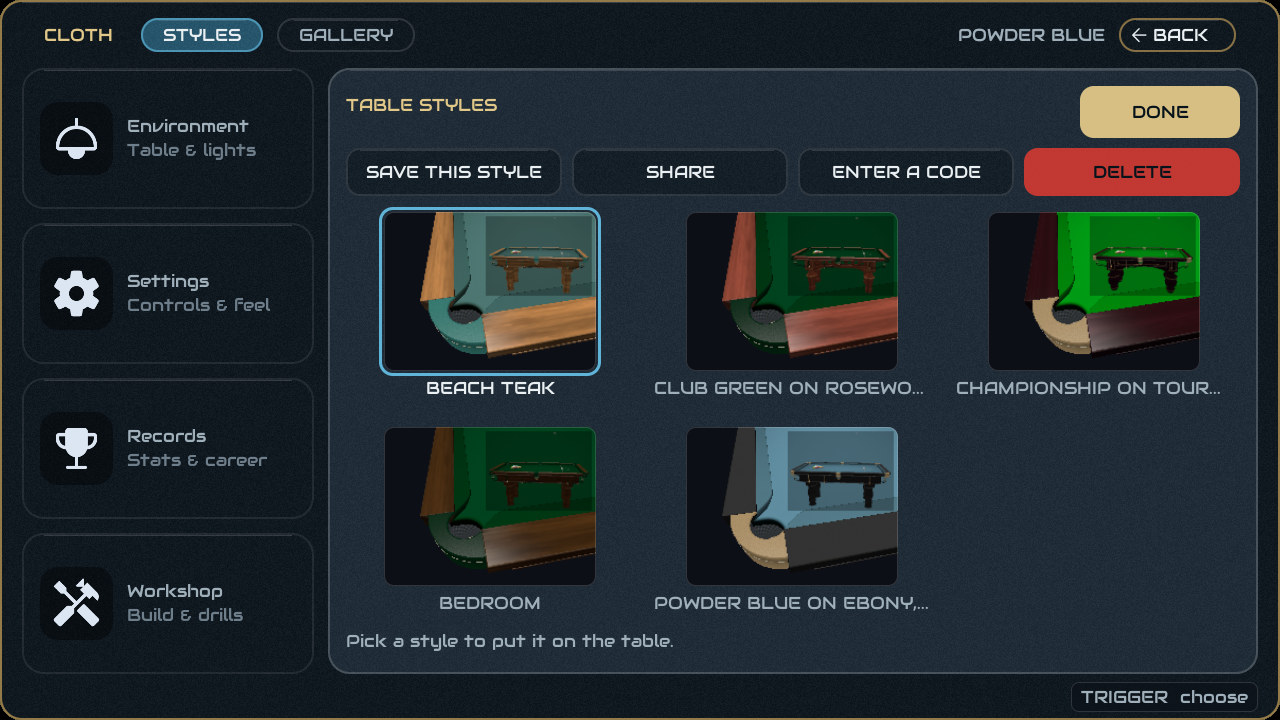
STYLES, beside the title on the cloth
and timber screens. See Table styles.
Give a friend my cue, ball set, challenge or table style
SHARE
on its screen gives a six-letter code; they type it into ENTER A CODE (FROM A
CODE for a challenge).
A target to play position to
Target on on the same pause menu, in
practice or a challenge; Move the target puts it where you want it. See
The target.
Setting up the table
Before you play, tell the game where your real desk or table is, so the game's
table sits on top of it.
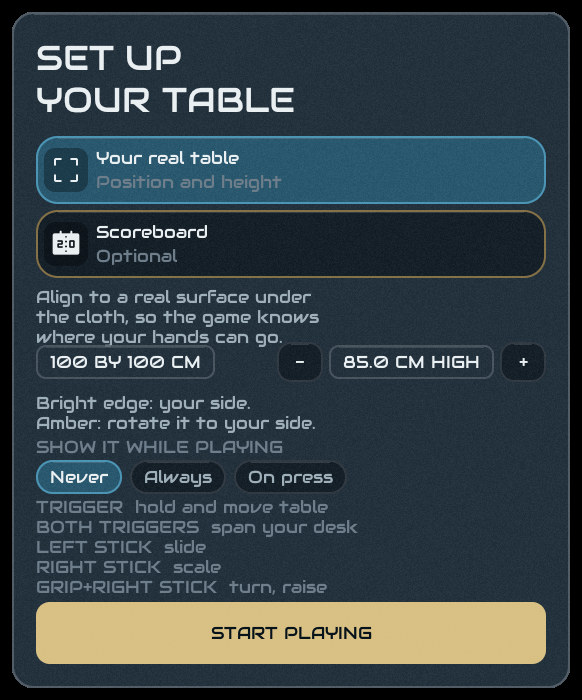
The table panel. Two steps down the side, Your real table and Scoreboard; under them what the step is for, the size and height it is at, whether the outline shows while you play, and a line for each control.
CueVR's table works best on top of something real, such as a desk, a dining table or the end
of a bed, so that when you rest your bridge hand on the cloth it lands on something solid. On the
panel you mark that real surface with an outline. The game's table then stands on it, at the same
height and facing the same way.
Putting the outline on your desk
Stand at the side of your desk you will play from.
Hold the trigger. The outline moves with your hand.
Move your hand so the outline sits on the desk and runs along it, then let go.
Point at START PLAYING, or press A. The game remembers it next time.
With two controllers there is a quicker way: put one hand on each front corner of your desk
and hold both triggers. The outline lines up with the edge between your hands.
To
Do this
Move the outline
Hold the trigger and move your hand, or push the left stick.
Make it bigger or smaller
Push the right stick.
Turn it, or raise or lower it
Hold the side grip button and push the right stick.
Move one corner
Hold the side grip button near that corner and drag it.
Finish
Press A, or point at START PLAYING.
The bright edge of the outline is the side you play from. If it turns amber, you are
standing at a different side: turn the outline round until the bright edge is in front of
you.
With a real cue, one stick does all of this. Press the side grip button to switch
between moving, resizing and turning; the panel shows which one is on. See
One stick has to do everything.
SHOW IT WHILE PLAYING, on the same panel, sets whether you see the outline during a
frame: Never, Always, or On press. With On press, a short press of the upper
button on your cue hand shows it for a couple of seconds.
The table starts at 85 cm high, the height of a real snooker table. Your room does not need
to be as big as the table: you can move and turn the table with the sticks at any time, even
during a frame, to bring the shot you want in front of you.
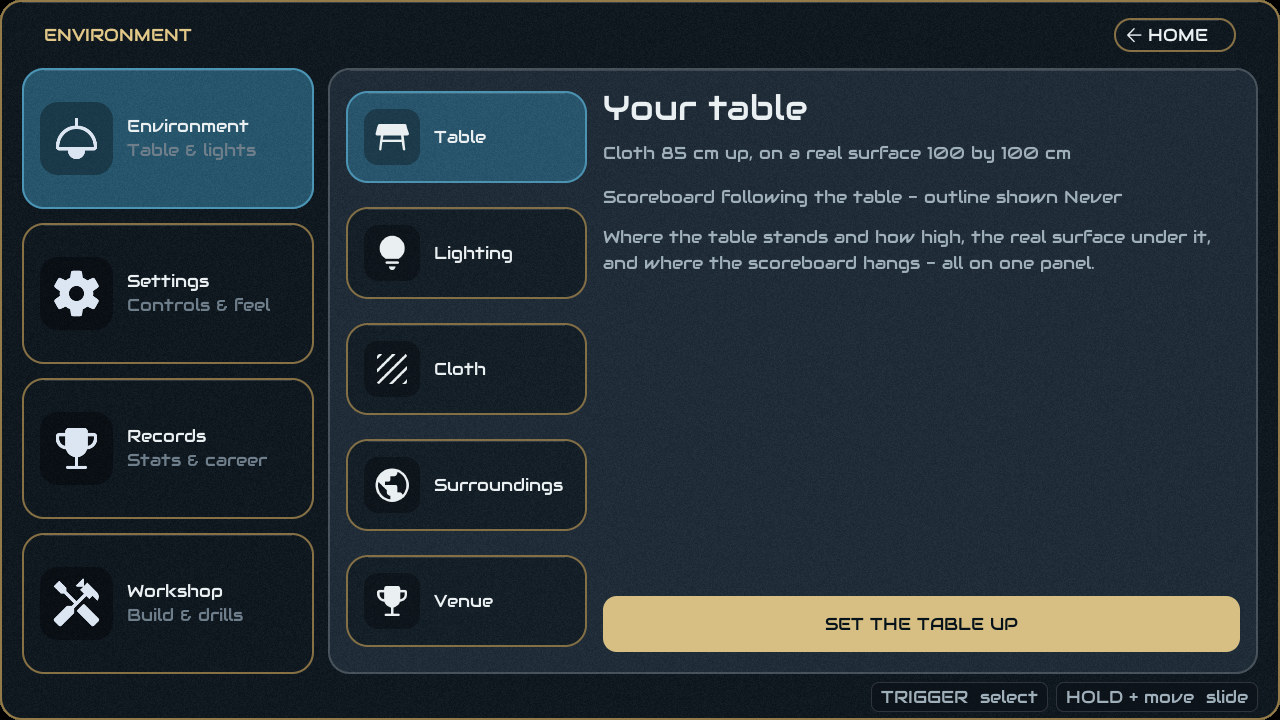
To change any of this later, press MENU and choose Table, or go to
Environment → Table on the main menu.
Environment → Table, from the main menu: what your table is set to, and SET THE TABLE UP to change it.
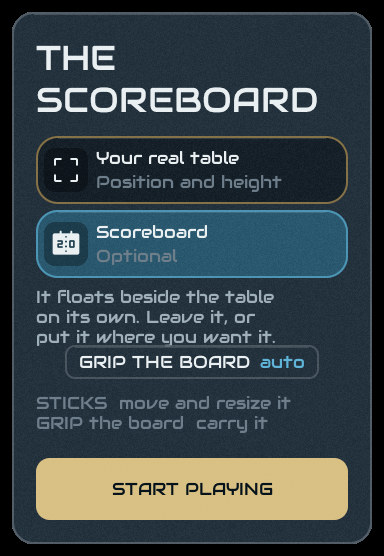
Pinning the scoreboard
The scoreboard normally hangs above the far end of the table and moves with it. If you would
rather it lived somewhere real — a wall, or a television that is switched off — tap
Scoreboard, the second step on the table panel. Grip the board, carry it to where you want
it and let go; it stays flat where you left it. Press A when you are done. It keeps
that place between sessions, exactly as the table does, until BACK TO AUTO puts it back
above the table.
The second step. Leave the board floating beside the table, or grip it and carry it where you want it.
The arena and the rooms have scoreboards built in. A pinned board is a place in your
real room, and they are not your real room — so while you are in one the scoreboard goes where
that room keeps it: the arena's screen in the far wall, the pub's television, the club's board
at the head of the table, the dining room's gilt frame and the library's frame among the books.
Your pinned position is not lost: it comes back the moment you go back to your own room or the
dark hall.
Controls
There are four ways to hold the cue. Start with two controllers; you can switch
at any time on Settings → Controls.
The cue lies between your two controllers, and the line between them is the line of the
shot. One hand is your bridge hand, where the front of the cue rests; the other holds
the back of the cue and plays the stroke. With CUE HAND on RIGHT, your right hand is at
the back.
To
Do this
Play a shot
Pull the trigger in your back hand, keep it held, and move that hand forward through the ball. The faster you move it, the harder you hit.
Hold your bridge still
Hold the side grip button in your bridge hand. The bridge stays put while your back hand aims through it.
Shorten or lengthen the cue
Hold the side grip button in your back hand and move it back or forward.
Move your bridge for good
Tap, then hold, the side grip button in your bridge hand and move the hand. Double-tap it to put it back.
Use the rest
Press Y (B if left-handed). Press again for the next notch; hold it to put the rest away. See Playing off the rest.
See the table from above
Hold X.
Take a shot back, in practice
Hold B (Y if left-handed).
Move and turn the table
Left stick slides it, right stick turns it, at any time.
Raise or lower the table
Press a thumbstick in and push it up or down.
Pause
Press MENU on the left controller. Hold it to bring Home to you.
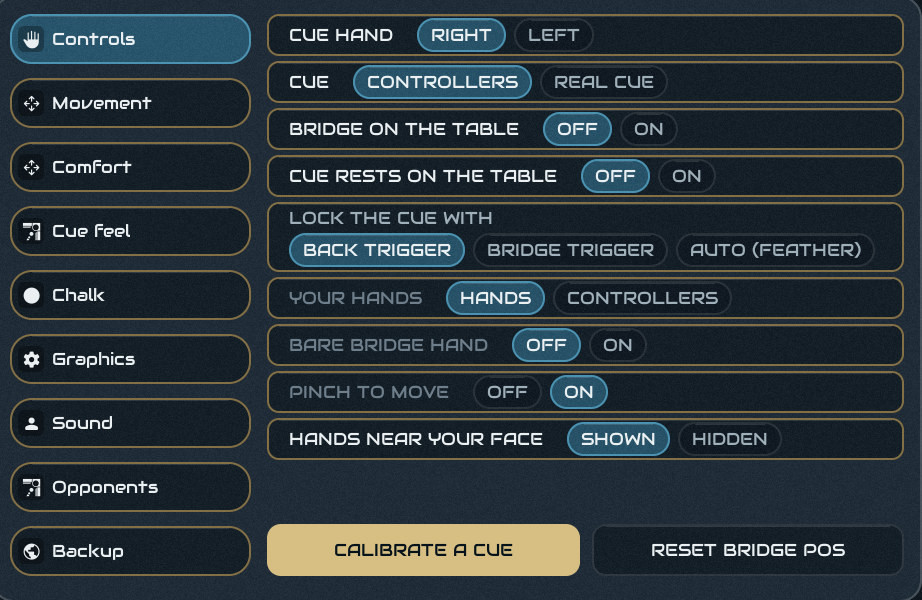
Settings → Controls
1234567891011
CUE HAND — The hand that holds the back of the cue. Left-handed? Set it to LEFT.
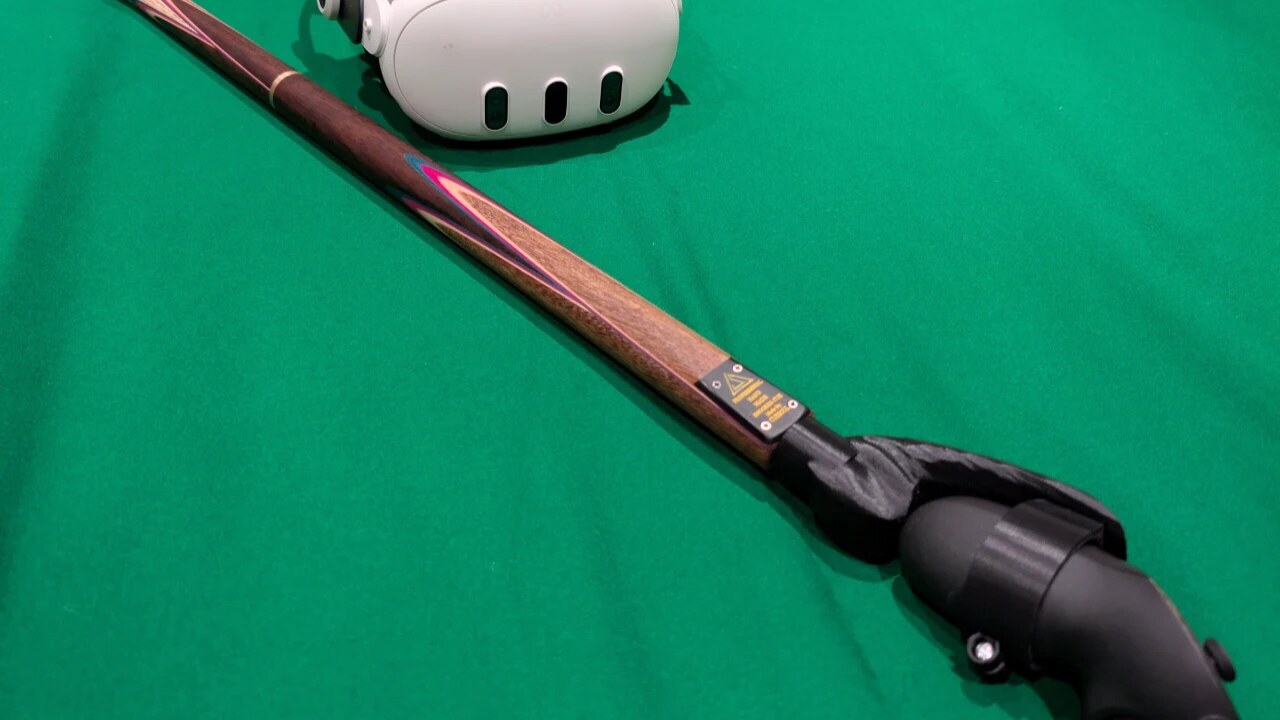
CUE — CONTROLLERS to play with your controllers, or REAL CUE once you have clamped a controller to a real cue and calibrated it (see Real cue attachment).
BRIDGE ON THE TABLE — On: your bridge stays where you put it on the cloth, like a real bridge hand, instead of following your controller in the air.
CUE RESTS ON THE TABLE — On: if your hands go too low, the cue lies on the rail or cloth instead of sinking into the table.
LOCK THE CUE WITH — What fixes your aim for the shot. BACK TRIGGER: pull the trigger in the hand at the back of the cue. BRIDGE TRIGGER: pull the trigger in your bridge hand once the tip is at the ball. AUTO (FEATHER): just feather at the ball and it locks by itself; stop feathering and you can aim again.
YOUR HANDS — Shows your own hands instead of controllers, where the headset can see them. Needs hand tracking on in the headset's settings.
RESET BRIDGE POS — Puts the cue back between your hands if it has ended up somewhere odd.
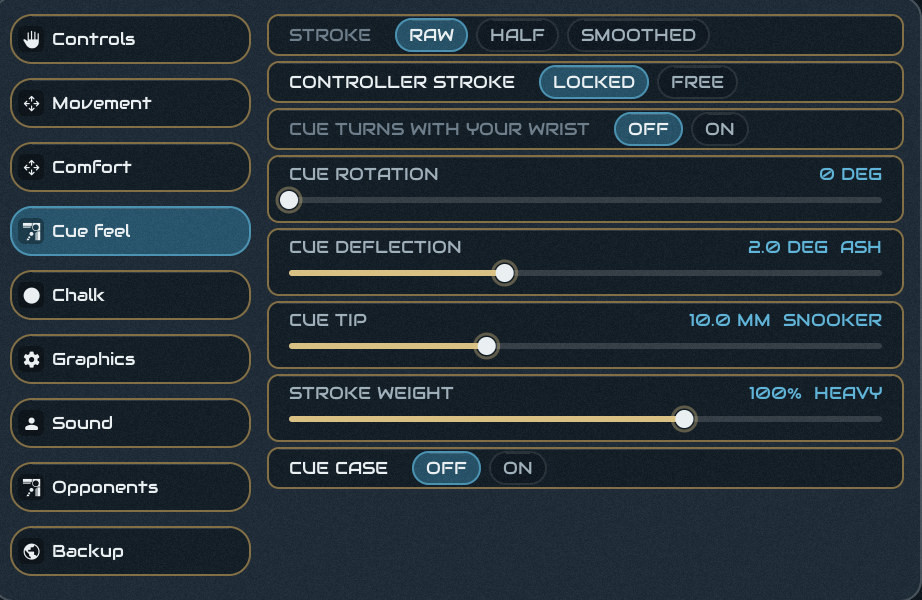
Settings → Cue feel
12345678
STROKE — Real cue only: how much of your hand's shake is smoothed out of your aim. Your power is never changed.
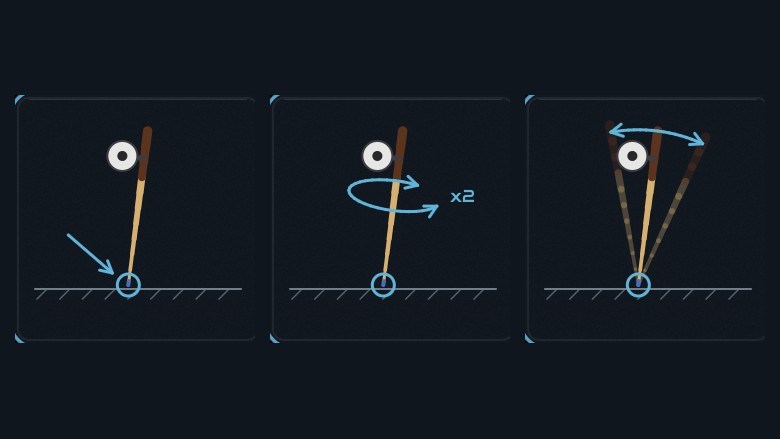
CONTROLLER STROKE — Controllers only. LOCKED keeps the cue on the line you aimed once you pull the trigger. FREE lets your back hand steer it during the stroke, as a real cue does, and tells you afterwards how straight you were. On the rest, FREE turns the cue about the rest's head. FREE suits Pro controllers.
CUE TURNS WITH YOUR WRIST — Real cue only: the drawn cue rolls when you twist your real one, so its markings stay facing the same way.
CUE ROTATION — Real cue only: turns the drawn cue round so its markings face the same way as your real cue's.
CUE DEFLECTION — How far the cue ball is pushed off your line when you hit it with side. 0.5° is a low-deflection carbon shaft, 2.0° an ash snooker cue. NONE turns it off.
CUE TIP — The width of your tip, 8 to 14 mm. A wider tip lets you put more side on the ball before it slips.
STROKE WEIGHT — How hard a given swing hits the ball. Turn it down if your gentle shots come out too hard, up if you struggle to get the ball up the table. It does not change a full-power stroke.
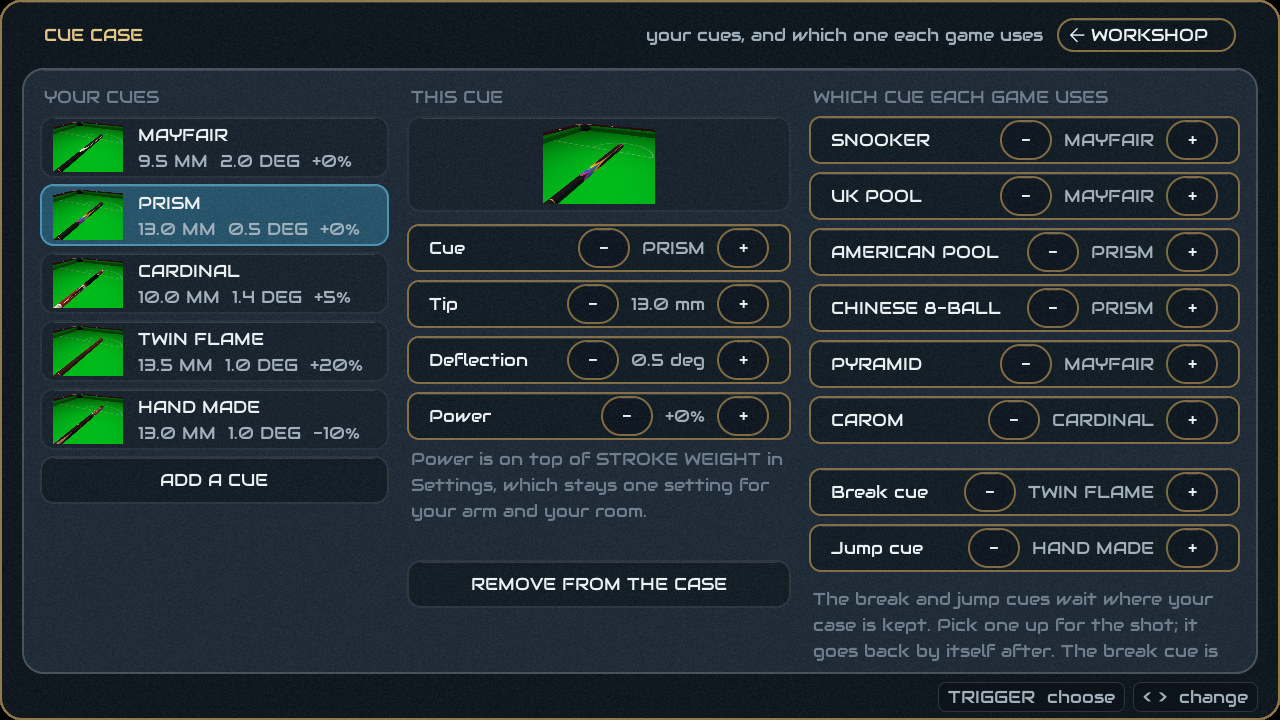
CUE CASE — On: a cue for each kind of game, plus a break cue and a jump cue. Set it up in Your cue case.
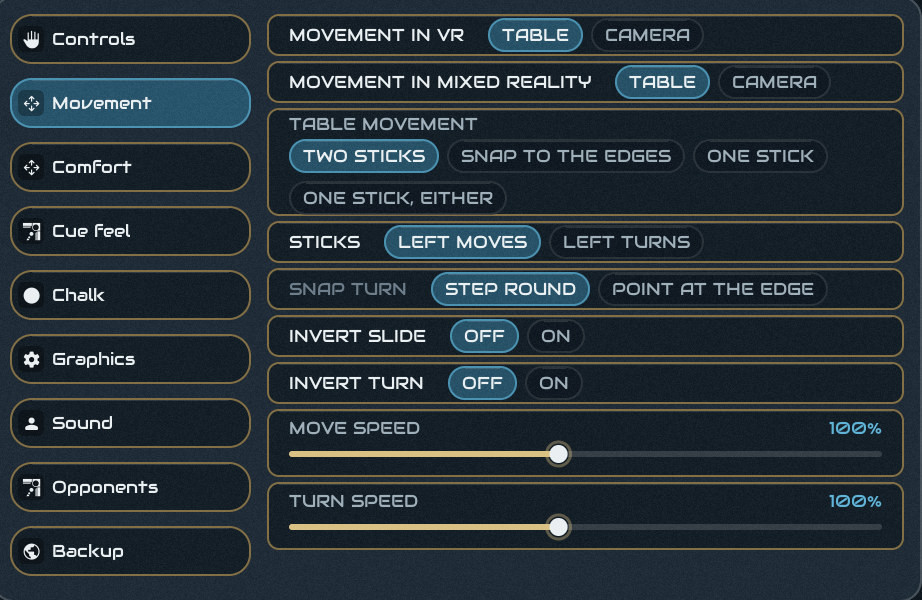
Moving about
The sticks move the table, so you can bring any shot in front of you without walking. In the
game's rooms you can switch them to move you instead and walk about. Walls stop you,
and stairs take you up and down.
1234567
MOVEMENT IN VR — In the game's rooms: TABLE makes the sticks move the table, CAMERA makes them move you, as in a first-person game.
MOVEMENT IN MIXED REALITY — The same, in your own room. TABLE is the one to use there.
TABLE MOVEMENT — TWO STICKS: one slides the table, the other turns it. ONE STICK: everything on one stick, for a real cue. SNAP TO THE EDGES: keeps the table lined up with your real desk (see Snap to the edges). ONE STICK, EITHER: the same control on both hands.
STICKS — Which stick slides and which turns.
SNAP TURN — With SNAP TO THE EDGES: step round the table a side at a time, or point the stick at the side you want.
INVERT SLIDE / INVERT TURN — Flip either stick if it moves the table the wrong way for you.
MOVE SPEED / TURN SPEED — How fast the sticks move and turn the table.
Walking on one stick in mixed reality. With CAMERA movement in your own room, and
TABLE MOVEMENT set to ONE STICK or ONE STICK, EITHER, one stick does all
the walking:
Up and down walk you forward and back.
Left and right turn you.
Hold a side trigger and left and right step you sideways instead.
It is whichever stick you push, in both modes. In the game's rooms the sticks work as they
always have: the left one moves you and the right one turns you.
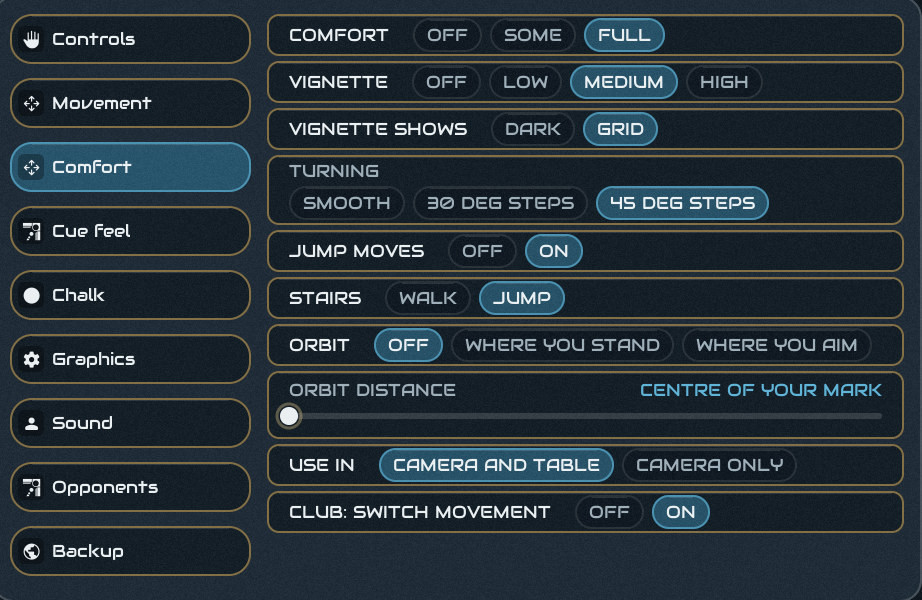
Comfort
Moving through a virtual room while your body stays still makes some people feel sick. These
settings help, and they start on. They only apply in the game's rooms: in your own room,
nothing moves you.
12345678910
COMFORT — Sets all the rows below at once: OFF, SOME or FULL. It starts on FULL. Change any row yourself and this reads CUSTOM.
VIGNETTE — Darkens the edges of your view while you move or turn, which stops most people feeling sick.
VIGNETTE SHOWS — DARK edges, or a faint GRID of your real room that stays still while the virtual one moves.
TURNING — Turn smoothly, or in 30° or 45° steps, one step for each push of the stick.
JUMP MOVES — Instead of gliding: push the stick forward, aim the arc at the floor, let go and you are there.
STAIRS — Walk up them, or jump straight to the other end.
ORBIT — At the table, push the right stick to choose where to stand round the cue ball, and let go to be there. It works in your own room too.
ORBIT DISTANCE — How far in front of you the cue ball ends up after an orbit.
USE IN — Use these when you move the table too, or only when you walk about.
CLUB: SWITCH MOVEMENT — In the club: TABLE movement while you are at a table, CAMERA while you walk about.
Your hands
Where the headset tracks your hands, CueVR draws them as hands instead of controllers.
Turn it on or off with YOUR HANDS on Settings → Controls. It needs hand
tracking switched on in the headset's settings.
With two controllers, your cue hand holds the butt in a fist, and your bridge hand makes a
bridge when you put it down on the cloth: fingers spread, thumb up, the knuckles as high as the
cue over them. A hand only makes a bridge at the table, or within 30 cm of it. With a real cue, the cue is in that hand, so only your bridge hand is drawn.
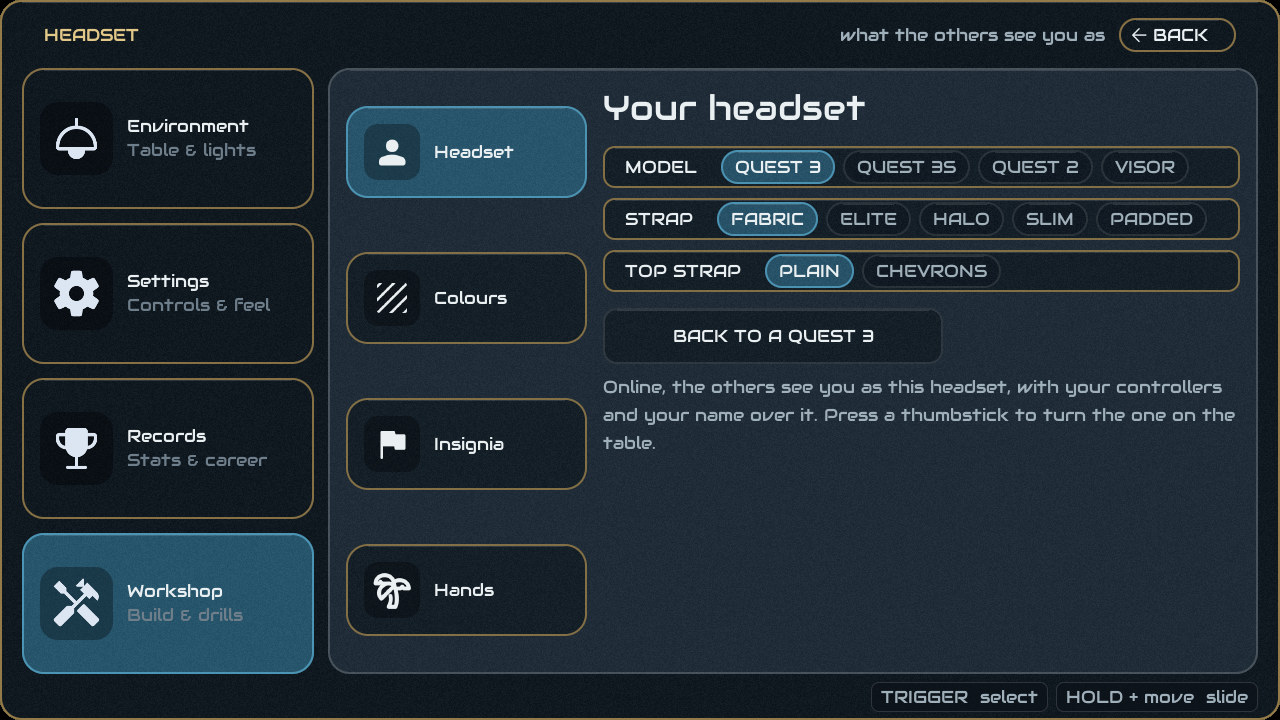
Online and in the club, the others see your hands too, and you see theirs. Choose their
colour on the workshop's HEADSET page, under Hands: six skin tones, or any colour
you like.
A bare bridge hand with a real cue
Turn on BARE BRIDGE HAND on Settings → Controls and you can put your other
controller down and bridge with your own hand. The cue still follows only its controller,
and that controller still vibrates. Without a controller in that hand:
Do this
And
Pinch on a panel
Presses what you are pointing at. Your hand points from your
shoulder through your first knuckle, as the headset's menus do.
Pinch twice quickly
Opens the pause menu.
Pinch in the air and move your hand
The stick: left and right turn the table
about the white, away and back bring it nearer or further.
Pinch, with the ball in hand
The ball sits between your finger and thumb.
Take it down to the cloth and pinch to put it down. A pinch higher up still moves the
table.
A pinch only counts with your hand well above the cloth, so a looped bridge, where your
thumb and finger touch, never presses anything or moves the table.
One controller and your bare hand
With controllers, turn on BARE BRIDGE HAND and put your bridge controller down. The
controller in your cue hand is the back of your cue, and the cue pivots in the V
between your bridge hand's thumb and first knuckle, where a real cue would rest. While you move
your hand the pivot follows it. Once your bridge has settled the pivot holds still, so the
tracking cannot wobble your aim, and if the headset loses sight of your hand the pivot stays where
it was until your hand is seen and settled again. The pinches above work the same way.
Your bridge hand is the one opposite your CUE HAND. Turn BARE BRIDGE HAND
off to play with two controllers again.
Which hand bridges
With controllers, your bridge hand is always the one opposite your CUE HAND. To play
the other way round, change CUE HAND on Settings → Controls. Switching hands
by itself could not be made reliable with controllers.
With a real cue and hand tracking, YOUR BRIDGE HAND on Settings → Controls
says which hand you bridge with: LEFT, RIGHT or AUTO, which works it out as
you play from the bare hand nearer the tip. So with a real cue you can bridge with either hand,
and a cue clamped to the controller in your other hand works too.
PINCH TO MOVE turns off moving the table with a pinch in the air, if you would rather a
pinch only pressed things.
HANDS NEAR YOUR FACE: set it to HIDDEN and your hands and controllers are not drawn
while they are close to your face, so cueing in front of your face with both hands, the trombone
way, does not block your view. The others still see them.
Why the side triggers do not move your aim. Sliding your hand along a real cue does not
move the cue. Holding either side trigger tells the game you are adjusting your hands rather
than aiming, so the hand travels and the line you have set stays where it is.
Changing the table's height at the table
You can raise or lower the table without going back to the set-up screen. Press a
thumbstick in and, while it is held, push it up or down. With two controllers you can also hold
Y (B if you play left-handed) and push your cue hand's stick up or down. The height
shows on your glass as it changes and is kept for next time. It works with a real cue, with one
controller or two, and with the MX Ink stylus.
While you are changing the height, that stick does nothing else. Only a push that starts
while you are holding counts, so a stick you are already pushing, or one you hold in to talk,
does not move the table.
Playing a shot
You play a shot the way you would at a real table. The cue lies between your two
controllers: point it where you want the ball to go and swing your back hand. There is no power
meter. How fast you swing is how hard you hit.
Down on the shot: the tip at the cue ball, your bridge controller near it, your back hand behind.
Step by step
Put the tip on the ball and point the cue where you want the cue ball to go.
Pick the spot on the ball. Tip higher for topspin, lower for backspin, left or
right for side. Where the tip is, is where you hit.
Pull the trigger in your back hand and hold it. This locks the cue's line, so the
shot goes where you aimed, even if your hands wander as you swing.
(Controls has other ways to lock it.)
Swing through the ball, still holding the trigger. A gentle push rolls the ball; a
break needs a proper swing. Let go of the trigger after the shot.
You can feather (move the cue back and forth at the ball) as much as you like before you pull
the trigger. Nothing counts as a shot until the trigger is held.
Ball in hand
When you have the cue ball in hand, it floats just in front of your back hand. (With a real
cue, in front of your free hand.) Carry it where you want it and pull that hand's
trigger to put it down. The game keeps it where the rules allow, and clear of the other
balls.
Then let go of the trigger. Press it again when you are ready to play the shot. Changed your
mind? PICK UP BALL on the pause menu gives it back to you, until you play the shot.
Shots you cannot reach
Move the table, not yourself. At any time, even in the middle of a frame, the left
stick slides the table and the right stick turns it. For a shot tight against a
cushion, hold your back hand's side trigger and pull that hand back to make the cue
shorter. If you play over a real table, snap mode can move you to the shot
instead.
The rest
For a shot you cannot stretch to, use the rest, as at a real snooker table. Your bridge hand
holds the end of the rest, and the head sits on the cloth. Your cue lies in a notch on the head
and you play through it.
To
Do this
Pick up the rest
Press Y on your bridge hand. It is put down a little
short of the cue ball, on the line back to you.
Aim it
Swing your bridge hand left or right. The head stays where it is on the
cloth and the stick turns about it, like a real rest.
Slide the head sideways
Twist your bridge hand and hold the twist. The head
keeps sliding until you untwist.
Push the head further away, or pull it in
Hold the side trigger on your
bridge hand and move that hand. Let go and it holds.
Use a higher or lower notch
Press Y again. There are three heads and
eleven places for the cue, from 40 to 87 mm high: the cross; the spider's
middle, left and right notches; the high spider's, which stands over a ball; then
the spider's two windows and the high spider's.
Put the rest away
Hold Y. It also goes back by itself after each shot,
and the next time you pick it up it is on the notch you used last.
The rest is 1.30 m long and stays that length. If you need more reach, an extension
screws onto the end. Holding the trigger locks the cue to the rest's line, as it does for a
normal shot. With CONTROLLER STROKE set to FREE, your back hand can still steer the cue: it
turns about the rest's head. While the rest is out, the trigger does not bring up the pointer
for calling a ball or pocket: put the rest away to call.
With a real cue: press the rest button and lay your cue on your real table where you
want the rest's head. The tip says where the head goes and the cue says which way it points.
Press again to change notch, and hold to put it away. Your free hand then plays the shot:
the cue turns about the rest's head as you steer it, and that controller is the one that
buzzes. Both controllers stay controllers while the rest is out, even with BARE BRIDGE HAND
on and a controller held in your other hand.
The lag: who breaks
Some games start a match with a lag, as their rule books say: pool, UK 8-ball,
Chinese 8-ball and the Shoot Out. You and your opponent each send a ball up to the top cushion
and back at the same time. Yours is the white, theirs is the yellow. Whoever stops nearest the
bottom cushion wins the lag.
A ball that does not reach the top cushion, goes in a pocket or off the table loses the lag.
If both are no good, or they are level, you lag again.
The winner chooses who breaks: I'll break or Opponent to break. This
happens once, at the start of the match, and the breaks in the frames after follow from it.
Snooker and English billiards do not lag: who breaks is drawn, then it takes turns. Practice
never lags.
The games
There are 32 games. Eighteen have a card each, and the rest are
versions you choose on a card's RULES row. Each is played on its real table with its real
balls, and the game referees every rule below for you.
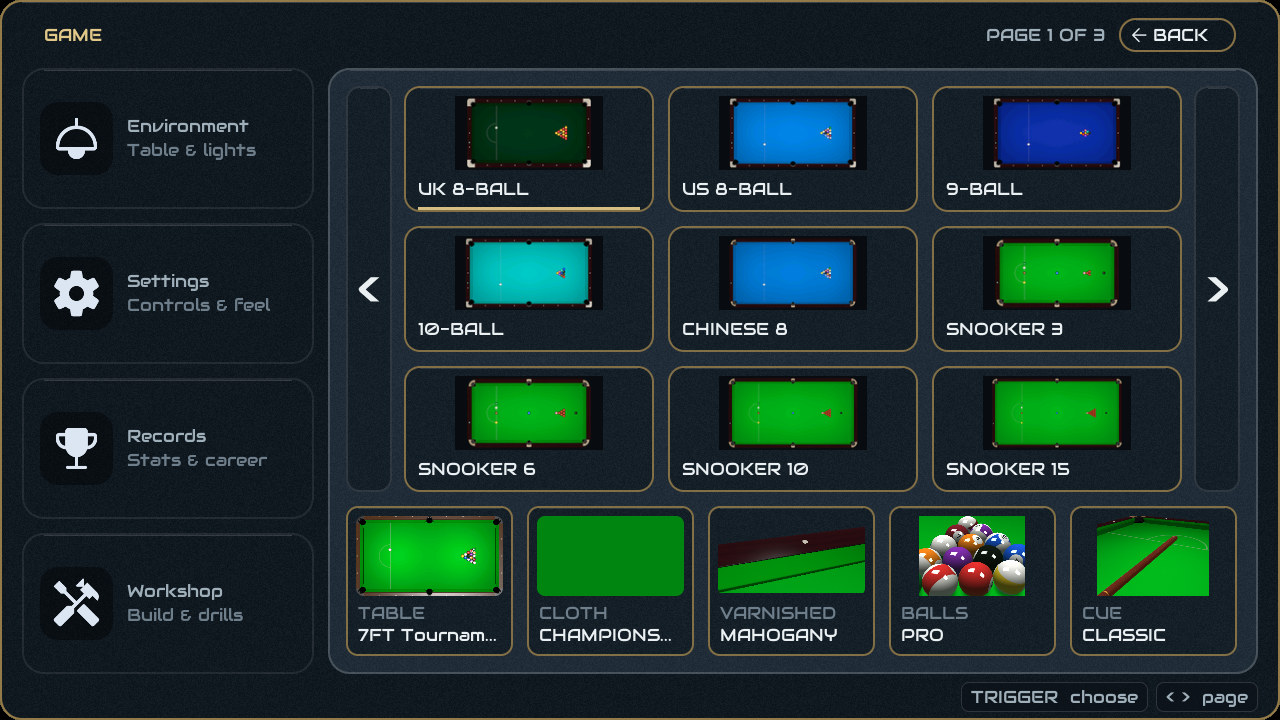
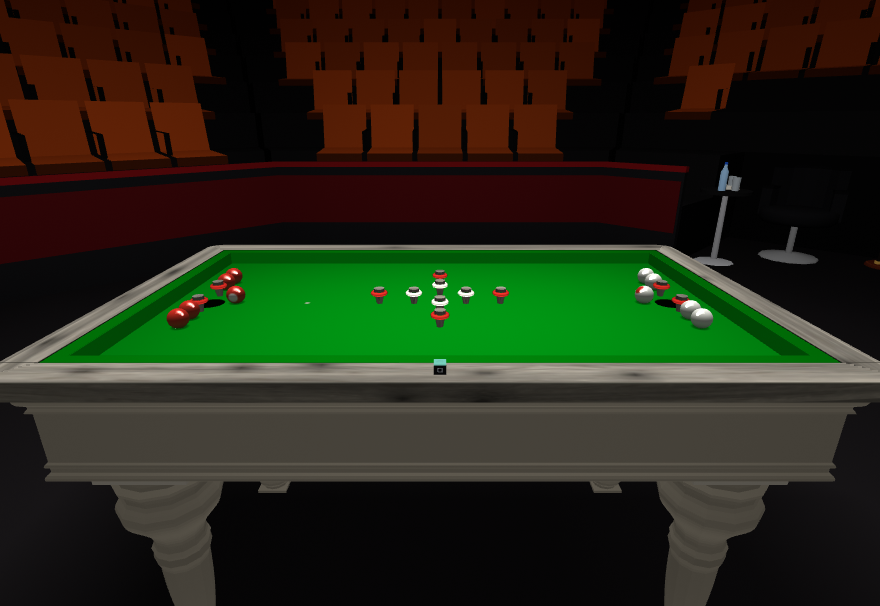
Point at step 1 GAME on Home to see the cards. Each card shows that game's table,
racked and ready.
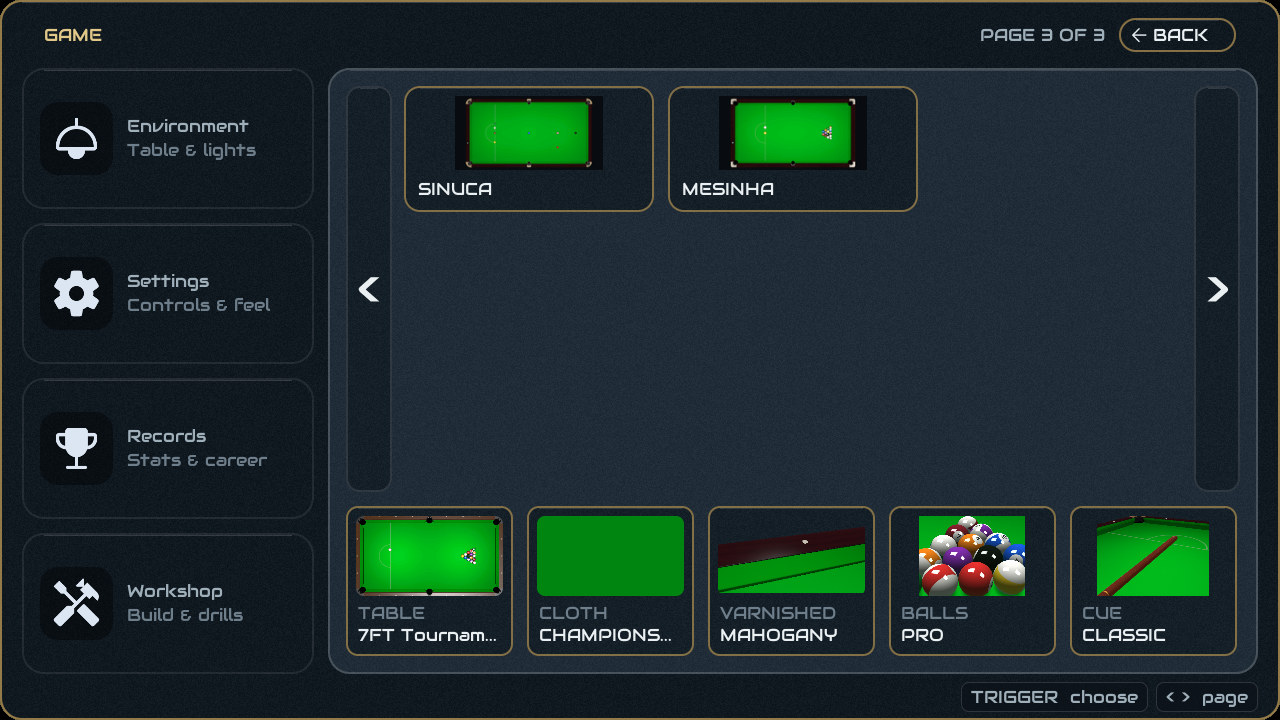
Page one.Page two. Nine to a page.
Turning the page: point at the arrows in the top right corner, next to the page
number. Every page of cards in the game works the same way.
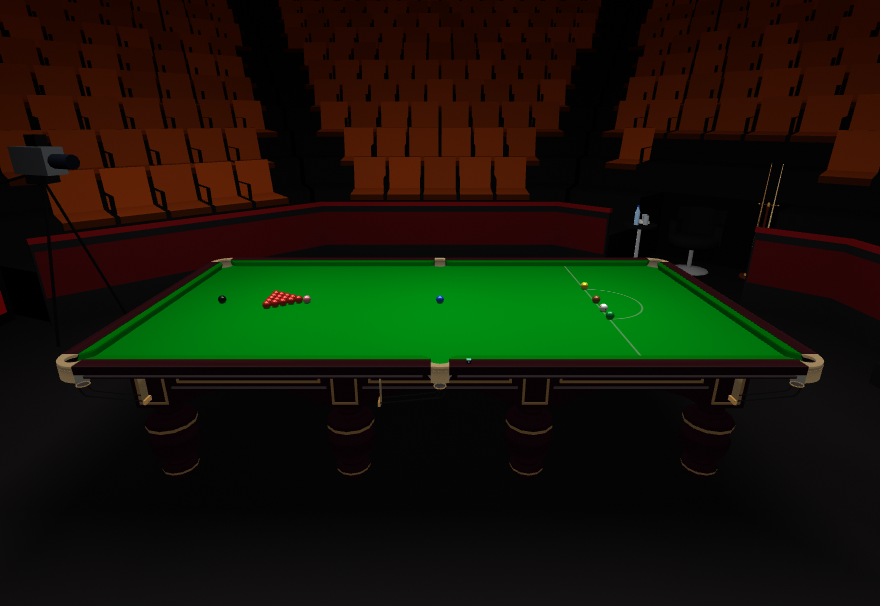
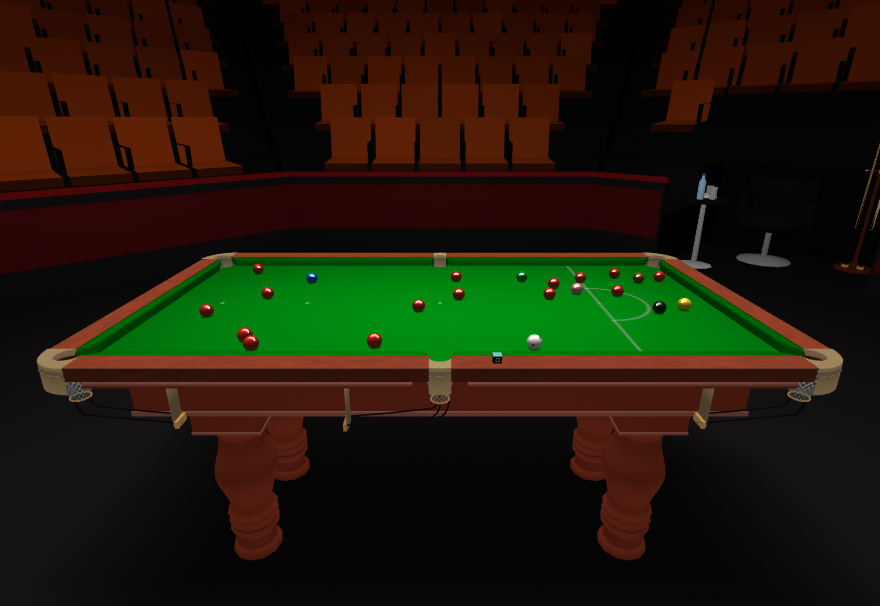
Snooker
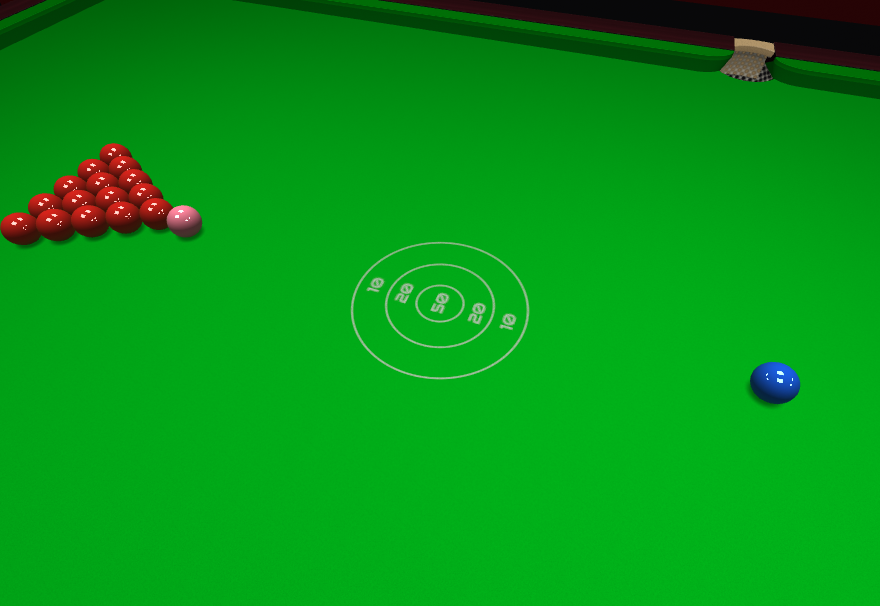
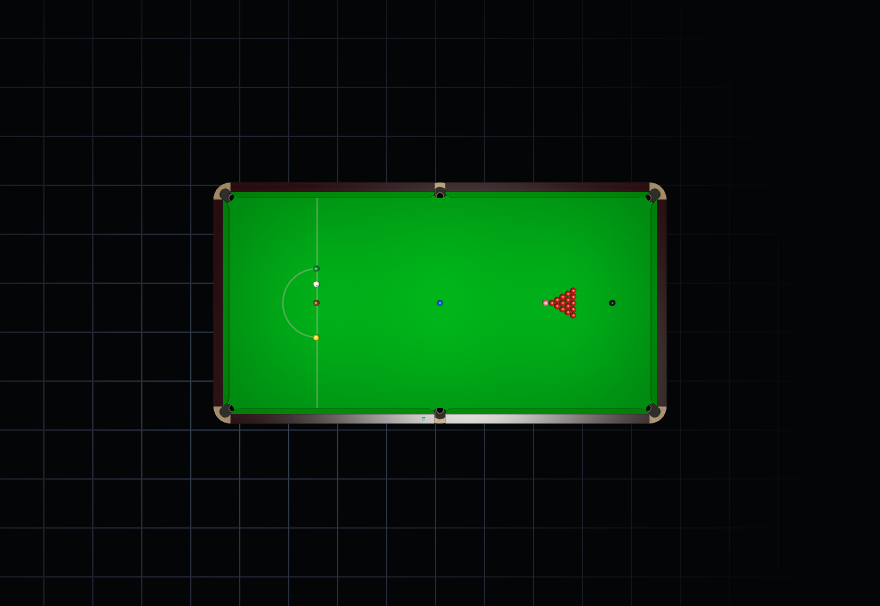
12FT TABLE · 15 REDS · 6 COLOURS
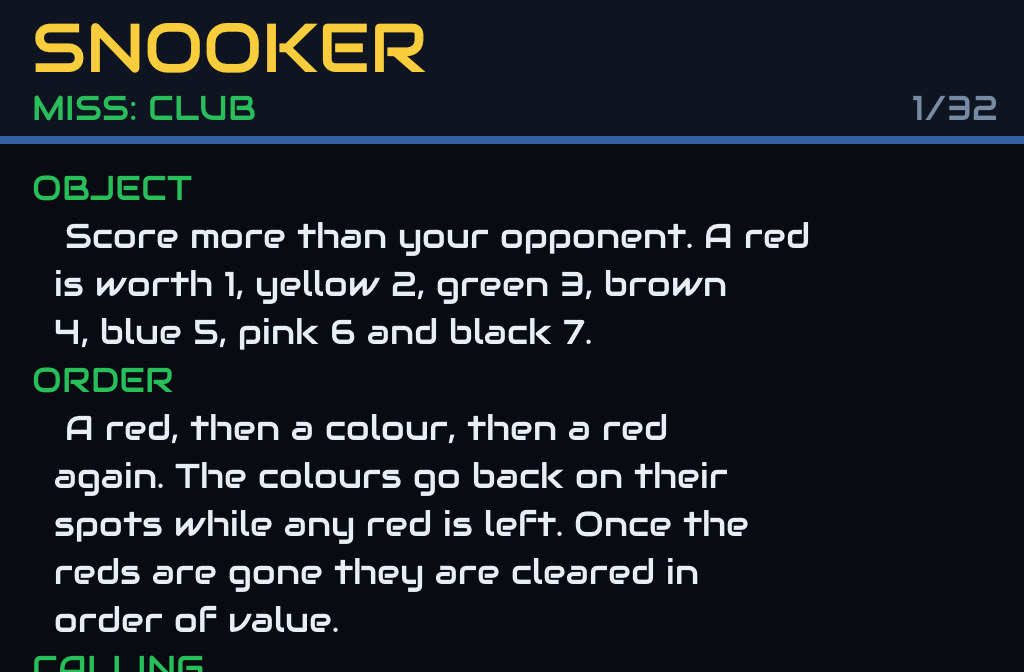
Pot a red, then a colour, then another red, and so on. Each red you pot stays down; each
colour goes back on its spot until the reds are finished. When the last red and the colour
after it are gone, you clear the colours in order from yellow to black.
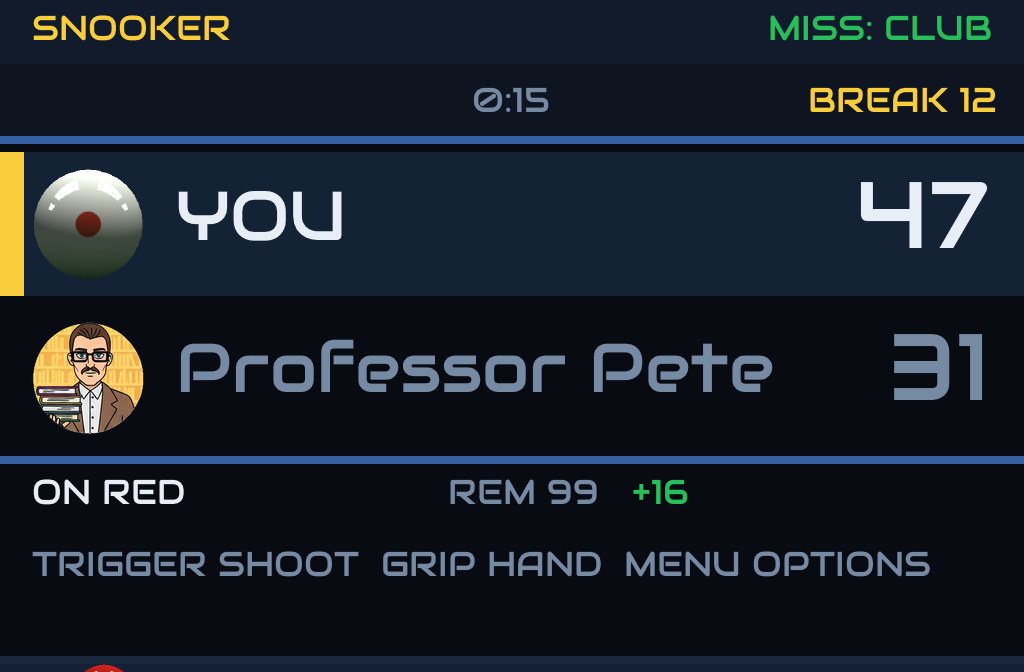
Values. Red 1, yellow 2, green 3, brown 4, blue 5, pink 6, black 7.
Nominating. When you are on a colour you have to say which one, and the game takes
the colour you aim at.
Fouls are hitting nothing, hitting the wrong ball first, potting the cue ball,
jumping the cue ball over a ball, and driving any ball off the table. The penalty is four
points, or the value of the ball you were on, the ball you hit first, or the highest ball you
potted — whichever of those is greatest. The points go to your opponent.
No cushion requirement. Unlike the pool games, a shot that hits the ball on and
sends nothing to a cushion and pots nothing is perfectly legal — that is what a safety often
is.
After a foul your opponent plays from where the balls are, or from in hand if the
cue ball was potted. If the foul leaves them unable to hit the ball on, they get a
free ball: they may nominate any ball as the one they are on, and it scores what the
real ball on is worth. Once you name a free ball you must hit it first, a foul with it costs
what the ball on is worth, and you may not leave your opponent snookered behind it, except
when only the pink and black are left.
Miss. Failing to hit the ball on is always a foul, and the referee judges whether
it is also a miss — whether your attempt was good enough — at the standard set on the
RULES row (see Rules and the referee). When a miss is called your
opponent may make you play the shot again from exactly where it was. Failing to escape a
snooker counts — that is the most common miss there is. Only a miss lets your opponent put
the balls back: if you hit the ball on and the white goes in-off, it is an ordinary foul.
No miss is called when either player needs snookers, before or after the shot, so a
hopeless frame cannot be dragged out by replays.
Three misses in a row lose the frame, but only misses with the balls put back each time,
from a position where you could hit the ball on full. If your opponent plays on from where
the balls lie, or takes the shot, the count starts again. When the balls are put back after
your second miss, the referee warns you.
The end. Once the black is potted the frame is over. It is also over when only the
black is left and one player is more than seven points ahead, once the visit of the player
at the table ends: there is no playing on for snookers, but a player still at the table can
pot the pink and the black to finish their break. Exactly seven ahead plays on, as the black can still tie it. If the scores are level, the
black is respotted and there is a draw: the winner chooses who plays it first, from in hand,
and the next score wins.
Snooker: how strictly the miss is called (the miss levels), the Snooker
Shoot Out and The 900.
10-red snooker
10FT TABLE · 10 REDS · 6 COLOURS
Exactly the rules above — reds and colours, the same values, the same fouls, free balls,
misses and respotted black — with ten reds instead of fifteen, on a ten-foot table.
A frame takes about half as long as the fifteen-red game.
6-red snooker
7FT TABLE · 6 REDS · 6 COLOURS
Snooker again, unchanged in every rule, with six reds on a seven-foot table.
Every ball is within reach of the cushions and frames are short.
3-red snooker
7FT TABLE · 3 REDS · 6 COLOURS
The same bed, the same balls and the same rules as the six-red game, with a two-row
triangle instead of a three. A frame runs to 51 and takes a few minutes, which is what the
format is for — a whole match in the time one snooker frame would take.
It shares the snooker RULES row, so the miss standards, the Shoot Out and THE 900
are all available on it.
Snooker Shootout is the fourth stop on the snooker RULES row, after the three
miss standards. One ten-minute frame on a shot clock: fifteen seconds a shot, ten once
the frame is into its last five minutes, with the same five beeps and klaxon as Ultimate Pool.
After any foul the cue ball is in hand anywhere on the table, and every shot must pot a
ball or send one to a cushion. A frame that ends level is settled on the blue: one
attempt each from in hand in the D, round after round, until one goes in and the other stays
out. Each attempt is played into a pocket you call: the pocket lights come on for the blue,
you call by aiming as you would in straight pool, and the blue only counts in the pocket you
called.
THE 900 is the fifth stop, and it is the Shoot Out with a longer frame: fifteen
minutes — nine hundred seconds, which is where it gets its name — and a flat twenty
seconds a shot that never steps down. Every other rule is the Shoot Out's, tie-break
included. The Shoot Out rewards going for everything; the 900 leaves you time to think.
UK 8-ball
7FT TABLE · REDS AND YELLOWS · BLACK · FOUR RULE SETS
The pub game. The table is open until somebody pots a colour, and that colour becomes
theirs; the other player takes the rest. Clear your seven, then pot the black to win.
Fouls, in every rule set: potting the cue ball, hitting nothing at all, hitting the
other player's colour first, hitting the black before you are on it, and driving any ball off
the table. Jumping the cue ball is not a foul in pool — except at BLACKBALL, whose
book forbids it.
The black: potting it before your own colours are gone loses the frame, as does
fouling on the shot that pots it.
What differs between PUB, INTERNATIONAL and ULTIMATE POOL is what a foul costs you,
whether a shot has to reach a cushion, and what happens if the black goes in off the break.
The fourth set, BLACKBALL, is described after the table. Choose on the RULES
row of the main menu.
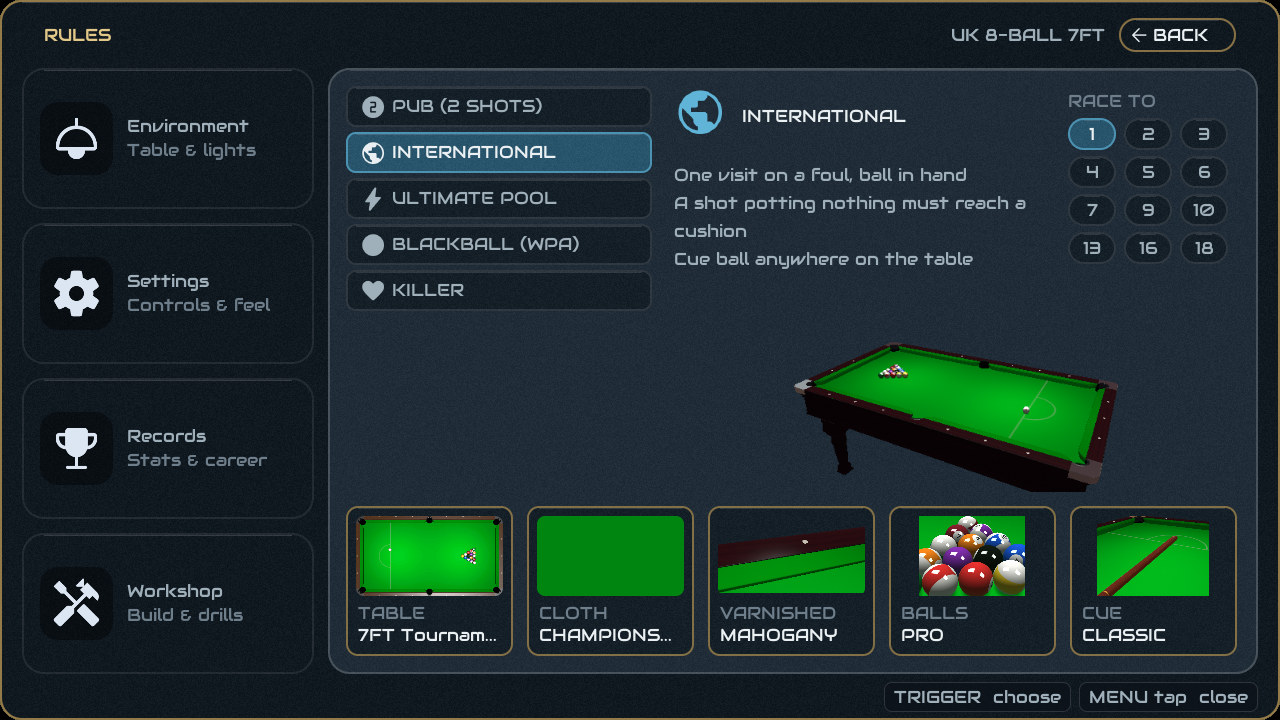
PUB (2 SHOTS)
INTERNATIONAL
ULTIMATE POOL
After a foul
Your opponent gets two visits. The cue ball stays where it finished.
One visit, ball in hand anywhere on the table.
If the cue ball was potted
They play from in hand, behind the baulk line, inside the D.
Anywhere on the table, like any other foul.
The first of the two shots
Free — they may hit any ball. Potting one of their balls cancels the second shot.
Not applicable: there is only one visit.
Must a shot reach a cushion?
No. A shot that pots nothing and touches no cushion is legal.
Yes. Pot a ball, or send some ball to a cushion after the contact,
or it is a foul.
Black off the break
Put back on its spot, break stands.
Put back on its spot, break stands.
Golden break — you win the frame. With the cue ball as well, or with any other
foul, you lose it: the golden duck.
Which is which. PUB is the game in most pubs — the two-shot carry. INTERNATIONAL is the
International 8-Ball ruleset, now used by the WEPF and the EPA. ULTIMATE POOL is that same
ruleset as played by the Ultimate Pool Group, whose tournaments add the golden break.
BLACKBALL is the WPA's rulebook.
BLACKBALL (WPA), the fourth set, is the official world rulebook. After any foul your
opponent gets a free shot — they may play any ball on the table — plus one visit to
follow. Go in-off and the cue ball comes back to baulk. The break has to pot a ball or send
two object balls past the middle pockets, jump shots are fouls, and every shot is
on a sixty-second clock.
ULTIMATE POOL is on a shot clock. Thirty seconds from the table becoming yours, running
while you are lining up as well as while the balls are rolling, with a beep for each of the
last five seconds and a klaxon when it expires. Let it run out and it is a foul, scored
like any other in that rule set: your opponent has ball in hand anywhere. It is what the
televised game does. PUB and INTERNATIONAL have no clock, and neither does practice; BLACKBALL
runs a gentler one at sixty seconds.
And Ultimate Pool matches are timed as well. Alongside the shot clock there is a
match clock: four minutes for each frame needed to win, so a single frame runs four
minutes, a best of five twelve and a best of eleven twenty-four. When it expires, whoever is
ahead on frames has won the match; if you are level, the frame in progress decides it.
KILLER is on the same row — and on US and Chinese 8-ball's rows too, each on that game's table and balls. It is the pub elimination game: you each start with three lives and
take one shot a turn. Pot any ball and you are safe. Miss or foul and a life goes;
scratch and it is a life and ball in hand for the next player. A dry break costs
nothing, and if the table runs out of balls with both of you still standing it is racked
again. Last player with a life wins.
UK 8-ball: PUB (2 SHOTS), INTERNATIONAL, ULTIMATE POOL, BLACKBALL (WPA)
and KILLER.
US 8-ball
9FT TABLE · SOLIDS AND STRIPES · 8 BALL
WPA rules. The table is open after the break — whatever you pot first decides whether you
are solids or stripes — and once your group is clear you are on the 8.
Fouls are potting the cue ball, hitting nothing, hitting the other group first,
hitting the 8 first while the table is open or before your group is clear, hitting anything
other than the 8 once you are on it, driving a ball off the table, and — as WPA rules
require — playing a shot that neither pots a ball nor sends any ball to a cushion.
Ball in hand. Any foul gives your opponent the cue ball anywhere on the
table, not just behind a line. It is a heavy penalty.
The 8. Pot it after your group is clear and you win. Pot it early, or foul on the
shot that pots it, and you lose. On the break it is simply put back.
The RULES row carries four ways to play it. WPA 8-BALL is the code above and calls
nothing. CALL THE BLACK asks for the last one only, which is how most people play it.
CALL SHOT (WPA) is the rule book to the letter: ball and pocket declared on every
stroke. KILLER is the pub elimination game on the same table.
ULTIMATE POOL USA, at the end of the row, is Ultimate Pool's rules — its
break requirement and its golden break — played on this American table.
9-ball
9FT TABLE · 9 BALLS · DIAMOND RACK
You must always hit the lowest numbered ball on the table first, but any ball may
then go in. Pot the 9 legally and you win at once — including straight off the break, and
including off a combination.
Fouls are potting the cue ball, hitting nothing, hitting anything other than the
lowest ball first, failing to pot a ball or send any ball to a cushion after the contact, and
driving a ball off the table.
Ball in hand anywhere on the table for the opponent, as at US 8-ball. If the 9 was
potted on a foul it goes back on its spot. Three fouls in a row loses the frame.
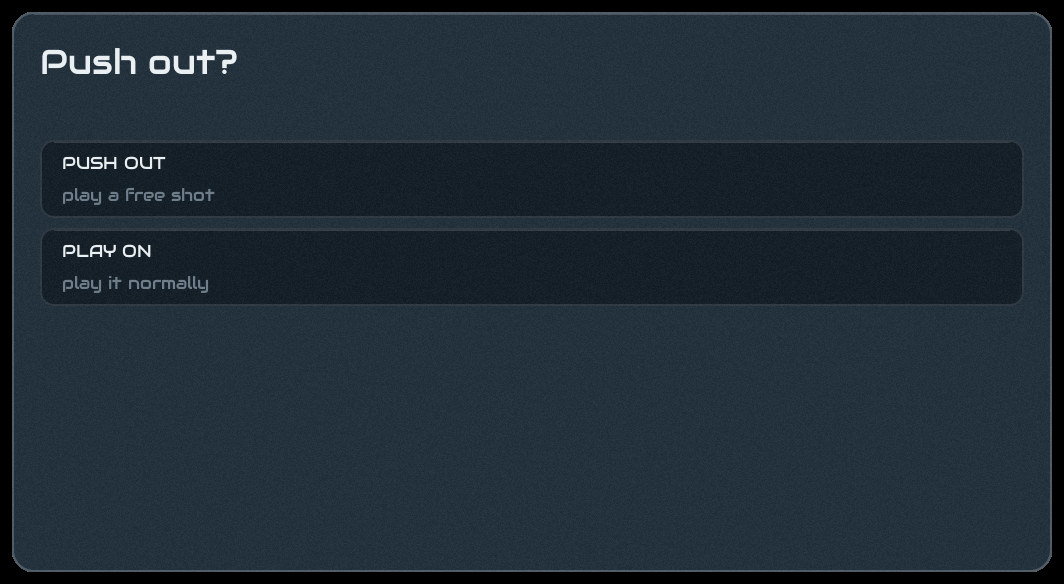
The push-out. The player who takes the first shot after the break may declare a
push-out: they may hit the cue ball anywhere they like, with no need to hit the lowest ball
or reach a cushion, and the only foul is potting the cue ball. A 9 potted on a push-out goes
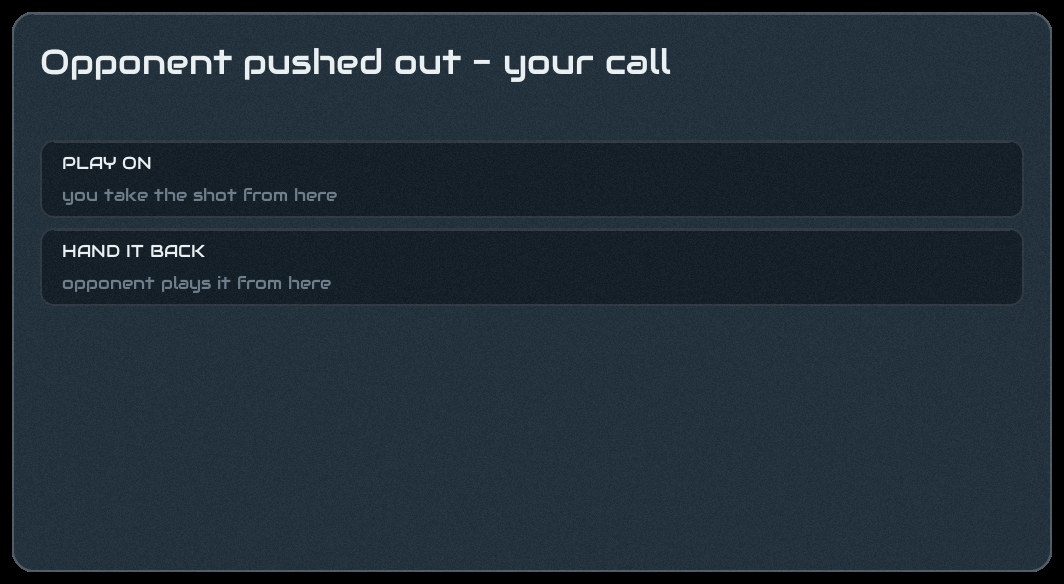
back. Afterwards their opponent decides whether to play the resulting position or hand it
straight back.
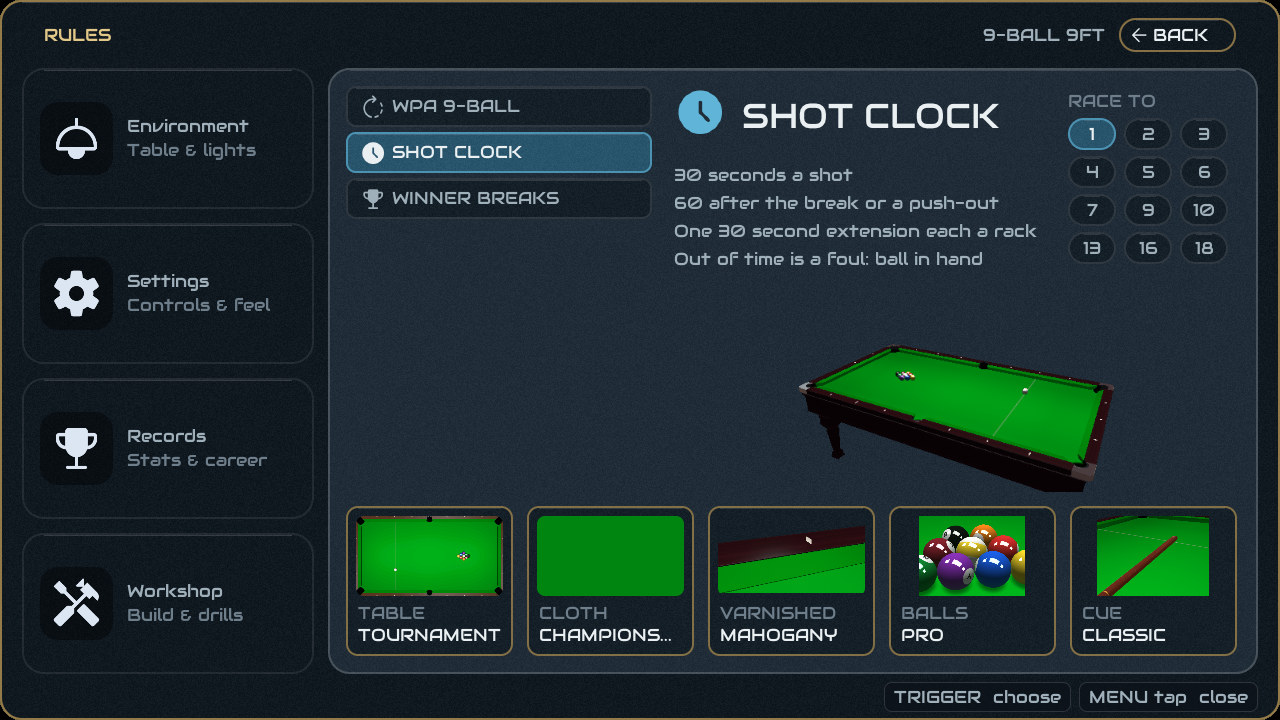
Three rule sets on the RULES row. WPA 9-BALL is the game above.
SHOT CLOCK is the same game played to the World Nineball Tour's clock: 30 seconds a
shot, 60 for the first shot after the break and for a push-out and the shot after it, and
one 30 second extension each a rack (see Playing against the
clock). WINNER BREAKS is the same game, with the winner of each frame of a match
breaking the next one instead of the break alternating.
9-ball9-ball: WPA 9-BALL, SHOT CLOCK and WINNER BREAKS. See
Playing against the clock.PUSH OUT9-ball, after the break: PUSH OUT (a free shot) or PLAY ON.PLAY ON...and after your opponent's push-out: PLAY ON from there, or HAND IT
BACK.
10-ball
9FT TABLE · 10 BALLS · TRIANGLE RACK
The same bed and the same rotation game as 9-ball: lowest ball first, any ball may then go
in, three fouls in a row loses the frame, and the money ball ends it. The rack is what
changes — ten balls out of a triangle instead of nine out of a diamond. A diamond opens
up off almost any break and a triangle does not, so the table stays cluttered and the
lowest ball is more often tied up.
The rack puts the 1 on the foot spot at the apex, the 10 in the middle — the
centre of the third row — and the 2 and 3 on the two back corners, rows of one, two, three
and four.
Fouls and ball in hand are 9-ball's exactly, including the cushion requirement and
the push-out on the first shot after the break. The 10 potted off the wrong ball first is a
foul: it goes back on its spot and your opponent has the table.
Slop counts — unless you say otherwise. WPA 10-ball is call-shot: a ball that drops
off a lucky contact is spotted rather than scored. Unless you change it, this game counts
whatever goes in, and the board tells you so at the start of the frame. Set the
RULES row to CALL SHOT (WPA) and it referees the real thing — how you say a
call is under Rules and the referee. The third stop,
WINNER BREAKS, is call shot (WPA) with the winner of each frame of a match breaking
the next.
Chinese 8-ball
10FT TABLE · SOLIDS AND STRIPES · ROUNDED POCKETS
Pool balls and WPA 8-ball rules — identical to US 8-ball above, including ball in hand
anywhere for any foul, and including the cushion requirement: a shot that neither pots a ball
nor sends any ball to a cushion after the contact is a foul. Played on a ten-foot table built
like a snooker table, with tight rounded pockets and dressed in the same napped baize.
Those pockets are the whole difference. They reject a ball hit too hard and punish an
approach that is even slightly off. Of the pool games it is the tightest at 1.50 ball widths, and only the two Russian pyramid tables are harder.
The RULES row carries four ways to play it. HEYBALL is the standard code and calls
nothing — the obvious shots are exempt by the book, which is how the game is normally played.
CALL THE BLACK asks for the last one only. CALL SHOT (CBSA) is the tournament
reading, where ball and pocket are declared on every stroke. KILLER is the pub
elimination game on the same table.
Straight pool
9FT TABLE · 15 BALLS · 50 UP
14.1 continuous, the old scoring game. There is no ball you must hit, no group and no
order: every ball on the table is worth one point, whichever ball it is. You pick one, say it
is going down, and if it does you score and carry on. First to 50 (or 25: choose under POINTS on the rules page) wins the frame — the
real game is played to hundreds, this one is cut to a frame that fits a session.
Calling a ball. The ball you are aiming at is the ball you have called; there is no
menu for it and nothing to press. Whatever your cue is pointing at when you strike is what
you have declared. Aim at nothing in particular and you have called nothing, which makes the
stroke a safety.
Scoring. Pot the called ball and it scores one, and so does every other ball that
happened to go down on the same stroke — the accidental extra is a real part of the game. If
the call is not made, nothing on that stroke counts and every ball that went down comes
straight back up onto the long string behind the foot spot.
In practice it never runs out. With the opponent set to FREE PRACTICE, when
one ball is left the other fourteen are racked again, as in the real game, so you can keep
going.
Your visit. Keep making your calls and you stay at the table. Miss one and your
opponent is in, and the board says MISSED CALL — or SAFETY, if you called
nothing at all.
The pocket is optional. Real 14.1 calls ball and pocket, and the RULES
row carries both readings. On CALL THE BALL, the default, you name only the ball and
it may go down any pocket, so a called ball that drops in a pocket you never
intended still scores. On CALL BALL AND POCKET it has to be the pocket you named as
well, and that is the only setting on this game that lights the pocket lamps — how you say a
call is under Rules and the referee.
Fouls are potting the cue ball, hitting nothing, driving a ball off the table, and
a stroke that neither pots a ball nor sends any ball to a cushion. A foul is
minus one, and the opening break is the one stroke that costs minus two —
the break has to pot a called ball, or send the cue ball and two object balls each to a
cushion. A ball that goes into a pocket counts as reaching a cushion. If the break does that
and the white then goes in, it is an ordinary foul, minus one, with ball in hand behind the
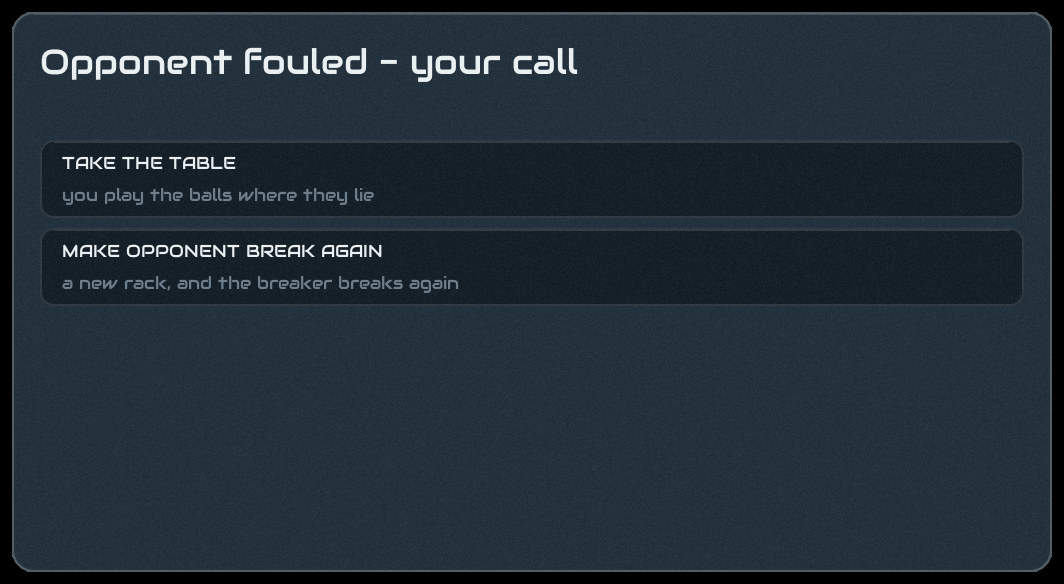
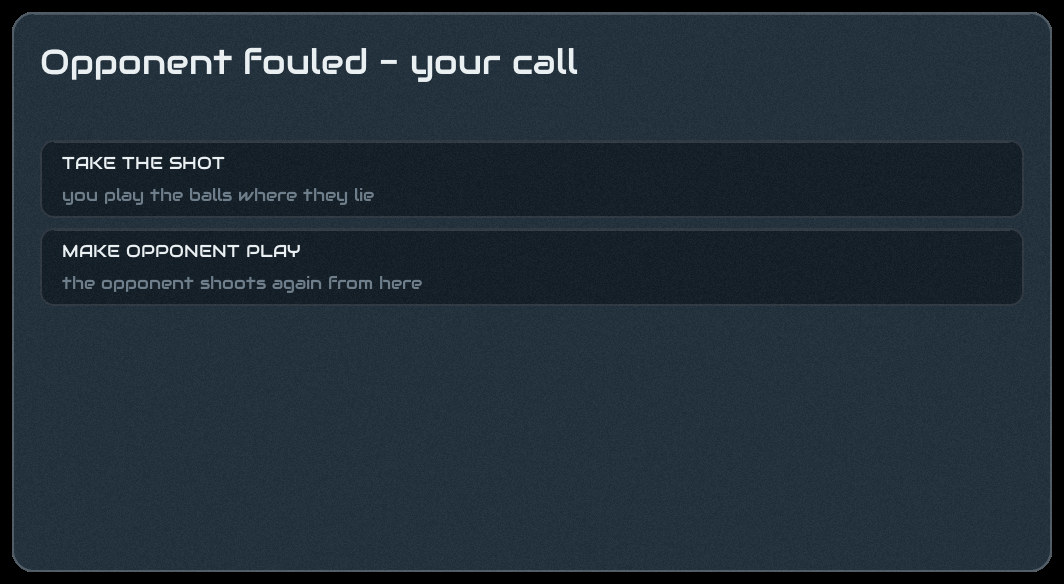
head string. After a breaking foul your opponent chooses: TAKE THE TABLE as it lies, or MAKE OPPONENT BREAK
AGAIN from a new rack. Breaking fouls do not count towards three in a row.
Three fouls in a row costs fifteen more and the whole table is racked again with the
offender breaking it.
The rerack, which is what continuous means. You never clear all fifteen.
When one ball is left the other fourteen go back as a triangle with the apex space empty; the
break ball and the cue ball stay exactly where they lie, and that break ball is what you use
to open the new rack. Your visit is not interrupted — play carries straight on, which is why
the fifteenth stays where it lies while the other fourteen are re-racked. Clear the table
outright and all fifteen go back and you break from in hand.
One visit, start to finish. Fourteen balls are still on and you are down on the 12
near the side pocket. You aim at it and strike; it drops, and the 5 it clipped on the way in
drops too — two points, and you are still at the table. You line up the 9 next, hit it too
thin, and it stays out: MISSED CALL, and your opponent is in. Under CALL THE BALL that is
the whole of it. Under CALL BALL AND POCKET you would have had to name the pocket the 12 was
going in as well, and a 12 that fell anywhere else would have come straight back up.
Straight pool, after a breaking foul: TAKE THE TABLE, or MAKE OPPONENT
BREAK AGAIN from a new rack.
Russian pyramid
12FT TABLE · 67 MM BALLS · 15 IVORIES · 8 WINS
Any of the fifteen is on, in any order, and each one you pot scores one.
Eight wins: more than half, so it cannot be caught.
Pockets barely wider than the ball. A corner is under five millimetres wider than
the ball and a middle fourteen (81 mm, as a tournament table's), on a ball 67 mm across,
both measured at the narrowest point. That leaves a couple of
millimetres either side of a straight corner pot. The middles are the wider of the
two, the opposite of every other table here, and the jaws are cut as a straight mitre rather
than the English curve. The point of each jaw is rounded as the federation's rules ask:
5 mm at the corners and 11 mm at the middles, and the cushion's nose stands 42 mm above
the cloth.
Club tables.CLUB 12 FT and CLUB 7 FT, in the table picker, have the
more forgiving pockets clubs keep for beginners and casual play: 74 mm corners and 83 mm
middles on the 12 ft.
The house, not a D. You play from the дом: the whole width of the table behind the
baulk line rather than an arc. A pyramid table has no D, so none is drawn.
Three sets of rules, on the card's RULES row: COMBINED (the
default), CLASSIC and FREE PYRAMID. All three are first to eight, from the house.
COMBINED is the Russian federation's discipline, and the one most played. The
coloured ball is always the cue ball, and nothing is called: every ball potted on a fair stroke
scores one.
Pot the cue ball off a white and it counts too: you take any ball you like off
the table for a point (look or point at it and pull the trigger), and play on from in hand
in the house. From the house, the first ball you hit must lie outside it. If every ball is
in the house, you play from the other end instead.
The break has to open the pack: a ball potted, or three balls to a cushion, or two
to a cushion and one across the centre line. If it does not, your opponent takes a ball for
a point and then chooses: play on, make you play on, re-rack and break, or re-rack and make
you break again.
With nothing potted, a stroke is only fair if some ball, after the first
contact, comes off a cushion and then touches another cushion, or drives a ball to another
cushion, or crosses the centre line; or crosses the centre line and then reaches a
cushion, or drives a ball to one. One cushion by itself is not enough.
A foul — hitting nothing, a stroke that does not do enough, a ball off the
table, a first ball struck in the house from hand — gives your opponent any ball off
the table for a point. If the cue ball went in or off, they play from the house. Anything
a foul potted, and any ball driven off the table, goes back on the spot.
CLASSIC is the game as it was first shipped. Fouls are hitting nothing, potting the
cue ball, potting nothing and reaching no cushion, and driving a ball off the table. The
penalty is the sting of the game: one of your own potted balls goes back on the table
for your opponent to shoot at, and they play from in hand in the house. A frame can go
backwards.
Fifteen plain ivories with a small black numeral on both poles, and a red cue ball. With
fifteen identical balls, that colour is the only thing telling you which one you are about to
strike.
Your opponent plays it as the game it is. On a pocket this size what decides a pot
is not how thin the cut is but the angle the object ball ARRIVES at: much past twenty degrees
off the middle of the hole it meets a jaw however well it was struck, which is why nothing is
ever potted along a cushion here. The computer looks for balls already sitting on a line into
a pocket rather than for balls it can cut in, and it will not give up such a line to buy
itself a better angle on the next one — which is the trade every other game on the row is
built around, and the wrong trade in this one.
FREE PYRAMID: the break is played from the house as usual; after that any ball can be your cue ball —
whichever one your cue is lined up on is the one you strike. Every ball you pot counts,
including the one you struck once it has hit another ball, and first to eight wins. A foul
puts back whatever it potted, and your opponent then takes any ball they like off the
table and scores it, naming it the way you name a ball (your CALL setting in the
controls), and plays on from where the balls lie. A ball driven off the table goes back on
the spot, and it is only a foul if it was the ball you struck.
Pyramid, after an illegal break: play on, make them play, or re-rack with either
of you breaking.
Pyramid, 7 ft
7FT TABLE · 57.15 MM BALLS · 15 IVORIES · 8 WINS
The same game, every rule unchanged, on the bed people actually own: 1.98 × 0.99 m with
57.15 mm balls, the smallest pairing the federation lists. It does not have a separate card:
pick PYRAMID and then the 7 ft bed on the TABLE panel, which brings the smaller
ball size with it.
The pockets keep the same clearance rather than the same size — five millimetres
at a corner and fourteen and a half at a middle — so it is just as tight as the big one and
everything is within reach. This is the one to try pyramid on.
English billiards
12FT TABLE · THREE BALLS · 50 TO 200 UP, OR A CLOCK
Two whites and a red on the full-size snooker table. There are no pockets to clear and no
order to keep: you score by cannons, pots and in-offs.
Stroke
Scores
Cannon — your ball touches both the others
2
Pot the other white, or go in-off the white
2
Pot the red, or go in-off the red
3
They all count on the same stroke, so a cannon that pots both balls is seven. An in-off
played with a cannon is priced by the ball you struck first — three if that
was the red, two if it was the white.
An in-off leaves you in hand and you carry on. A legal stroke that scores nothing
ends your turn and the table is played as it lies.
The red always comes back — on the Spot, or the Pyramid Spot if that is occupied,
or the Centre Spot if both are. Pot the red over and over with nothing else in the stroke and
it goes Spot, Spot, Centre in sequence. A potted white waits for its owner: it is off the
table until their turn, and they then play from in hand.
Caps — 75 consecutive cannons and 15 consecutive hazard strokes. Exceeding either
is a foul.
Every foul is two to your opponent and never more than two however many rules one
stroke broke; the points already made in the break stand. A coup — in hand, cue ball
pocketed, nothing struck — is a foul and not an in-off.
What the game is played to is set on the RULES row: 50, 75, 100, 150 or 200
up, or a clock of 5, 10, 15 or 30 minutes. On a clock the referee calls TIME, the
stroke already played is allowed to finish and score, and the higher score wins. Level at
TIME, the game plays on and the next points scored win it; the board says LEVEL - NEXT
POINTS WIN. Against the clock there is also a shot clock of 60 seconds: run out of
time and the turn passes with no score and no foul (OUT OF TIME - NO SCORE), so a
player who is ahead cannot run the game's clock down standing at the table.
Double baulk. Leave both object balls behind the baulk line while your opponent is
in hand and they cannot play straight at either one: from the D the cue ball has to be played
out of baulk, and no part of a ball that is in baulk may be struck directly. Breaking that is
a foul. If they play out properly and simply fail to hit anything, that is a miss —
still two points, but not a foul.
From in hand, always. The same rule applies every time you play from the D, not
only on the break: after an in-off, after your opponent pots your ball, after a foul. To
reach a ball in baulk you must come off a cushion out of baulk first; coming back off
the baulk cushion does not count. The computer plays by it too.
Potting your opponent's ball scores two and you play on from where your own ball
lies.
At every change of turn the two whites swap over, so the ball in front of you is always
your own.
English billiards: first to 50, 75, 100, 150 or 200 points, or the most
points in 5, 10, 15 or 30 minutes.
Bar billiards
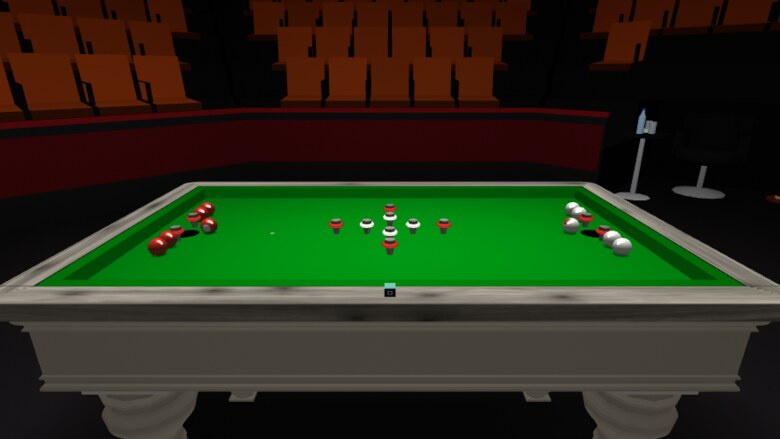
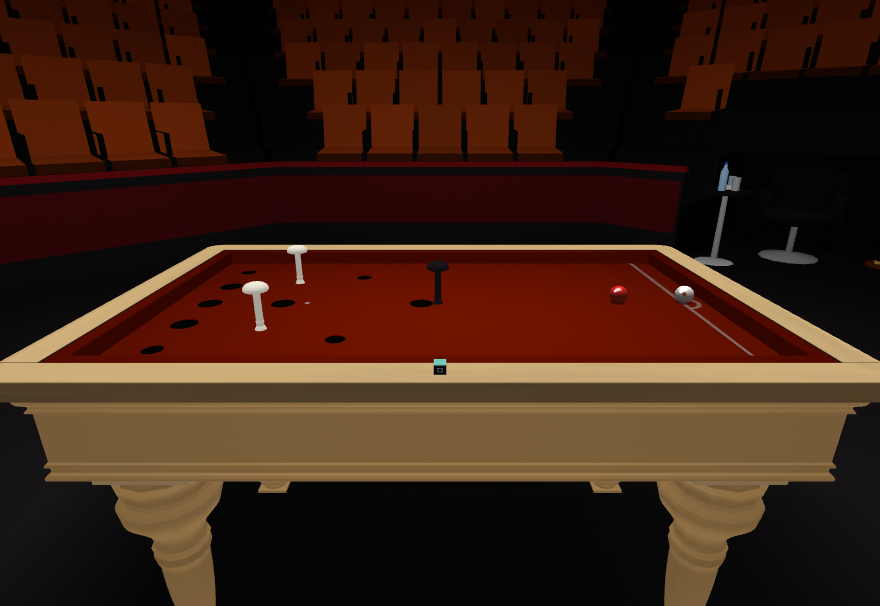
142 × 79 CM · NINE HOLES IN THE BED · NO RAIL POCKETS · A RED AND SEVEN WHITES
The odd one out in every way. Four unbroken cushions and no pockets on the rails at
all — instead there are nine holes bored through the bed, worth 10 to 200, and three
wooden skittles standing among them. Eight balls: one red and seven whites, all the same
size. There is no cue ball to scratch. Every white on the table is one, you strike
whichever the shot wants, and a white down a hole is a score.
The red scores double, so the red in the 200 is 400.
The board, from above, with the values written on. Nothing marks them on the cloth
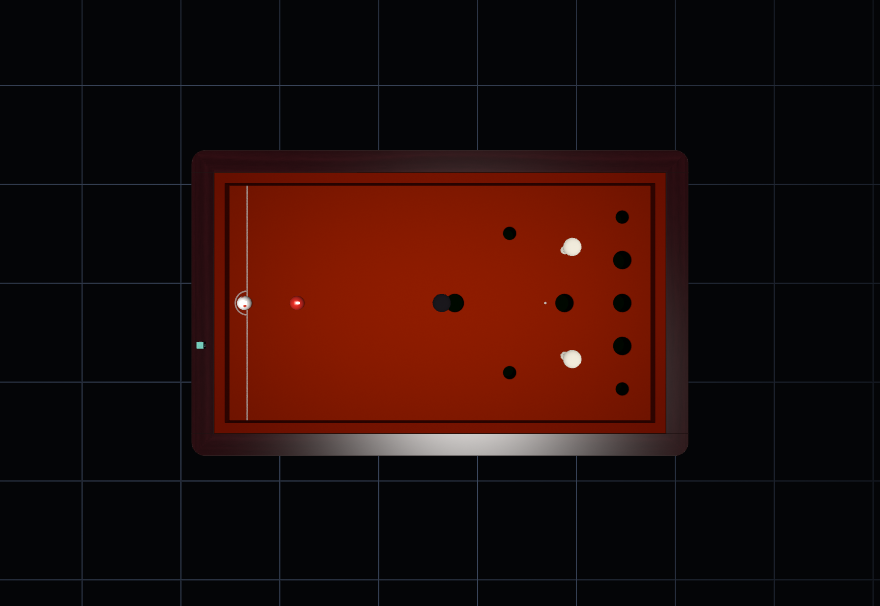
in the game, so this is the diagram to learn. You stand at the D end, on the left.
Where the holes and skittles are
The four holes nearest you are a diamond: the 200 at the front of it with the
black skittle standing right in front of that, the two 50s at its sides, and the
100 at its back between the two white skittles. Across the far end is a row of
five: 30-20-10-20-30.
Every stroke is played from the D at the near end, so you are always shooting
away from the 200. Reaching it means bringing a ball back down the table off a
cushion or off another ball, and past a skittle you must not knock over. The easy scoring is
the row of five at the far end.
The 200, the 100 and the 10 all sit on the centre line, so a ball sent straight up the
middle drops into the first of them it reaches — which is why the 100 and the 10 have to be
played on an angle.
A ball has to be rolled in, not driven. Rolled in gently it drops; hit hard it
skips the far lip and carries on up the table. The holes are real holes with the cloth turned
over the edge and a shaft below, so this is the same free fall a real board gives you.
The skittles are turned beech, 114 mm tall and 48 g, and they are rigid bodies —
a ball loses about a quarter of its pace through one, a thin clip rocks one without felling
it, and a felled one slides and tumbles. They are stood back up once the stroke has been
scored.
Playing it
Where you play from
The D at the base, every stroke — a half-disc of 40 mm radius round the break spot. The
opening stroke is played from the spot itself, and the last-ball stroke from the middle of
the D.
Which ball you get
One out of the trough while the rack still holds one. When the rack is empty you take
the ball on the table furthest from the top cushion.
Your break
Runs on as long as you keep potting. A stroke that pots nothing ends it, and so does
any foul.
Fouls cost your break, not points
Knocking over a white skittle; hitting nothing; sending a ball off the table or
back over the baulk lines; and potting from the break position four times running (you get
a "LEAVE ONE UP" warning after the third).
The black skittle
Knock it over and you lose your entire score. If a white went over as well,
whichever fell first decides which penalty applies.
The end
A 17-minute clock, not a rack running out — a coin buys fifteen to twenty
minutes on a real one. When it expires the bar drops: potted balls stop coming back out of
the trough and play carries on until the balls are swallowed.
The last ball
With one ball left, the two white skittles are moved into the 50 holes and the stroke
is played from the middle of the D. It only counts if the ball goes into the 100 or the
200 off one side cushion, and touching a white skittle voids it. Players take turns
until it goes down — or the black falls.
Bumper pool
142 × 79 CM · TWO CUPS · TWELVE BUMPERS · FIVE BALLS EACH
A small table with no pockets on the rails. There are two cups sunk in the cloth,
one at each end on the centre line, and twelve bumpers — rubber-collared posts standing
at cushion height — eight of them in a cross across the middle and two guarding each cup.
Five red and five white, and no cue ball. The reds are one player's and the whites
are the other's; you strike your own balls, and the one you are pointing at is the one you
will play. Your five start at the far end from the cup you are shooting into, so the opening
stroke is a bank off a side cushion and not a roll down the table.
One ball of each five is marked, and it has to go down first. Until it does, another
of your balls dropping in your cup counts for nothing and comes straight back out onto its
spot.
Your own ball in your own cup scores, and you carry on. Your own ball in your
opponent's cup is a forfeit: they lift two of theirs and count them, taken at the start of
their turn. Put one of their balls down their cup and it counts for them.
First to get all five down takes it.
The bumpers turn a ball the way a cushion does — they are rigid posts with a rubber collar,
and a ball comes off one with rather less pace than it went in. Most of the table is played
around them rather than through them, and the computer plays it the same way: it looks for a
line to its cup, and when the posts have taken every straight one away it banks.
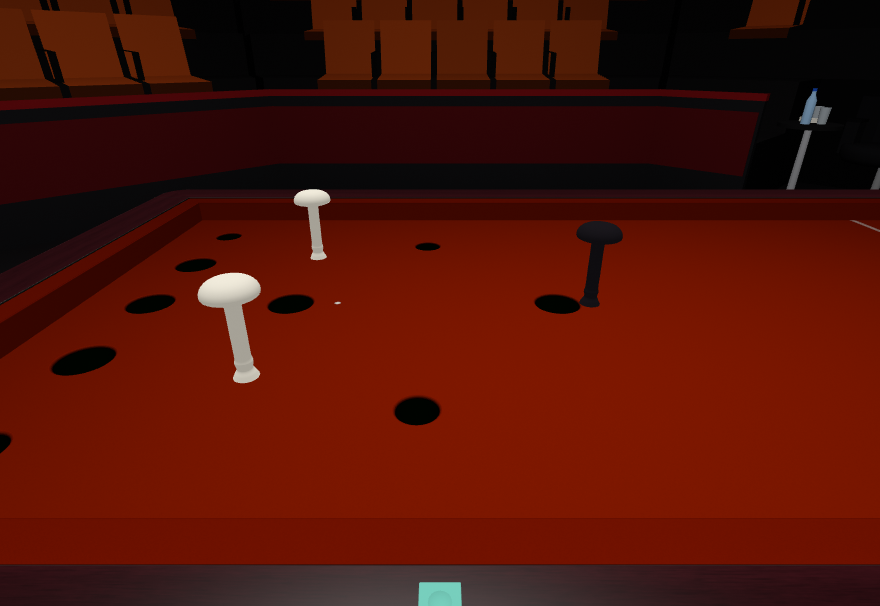
From above. The two cups are on the centre line at either end with two bumpers
guarding each, and the other eight stand in a cross in the middle. The gap between the middle
four is barely wider than a ball, so a ball sent straight up the table is stopped rather than
threaded — which is why the game is played on the diagonal.A bumper close to. Each is a 44 mm post with a rubber collar at ball height, red
and white alternating round the cross. The collar is what turns the ball, and it gives back
rather less than a cushion does.
Sinuca Brasileira
2.84 × 1.42 M BED · 54 MM BALLS · SEVEN BALLS, 1 TO 7
Brazil's snooker, on the mesão: the federation's table, with leather pocket plates, nets
and collectors. There is one red and the six colours, worth 1 to 7, and the lowest
ball on the table is the ball on.
The break is from the D and must play the red. If it goes in, or you foul, break
again.
A visit. Start on the ball on, or on any other ball — but any other ball has to
go in, or it costs you 7. Pot the ball on and it stays down; then any ball is free to try,
and potting that lets you try one more, at the same risk of 7. Every ball except the ball on,
potted in its turn, goes back on its spot.
Every foul is 7 to your opponent, who can play on or make you play again; the same
choice follows a colour you tried and missed.
The end. The frame is over when the 7 goes in, when the 6 goes in with a lead of more
than 7, or when a player is too far behind to catch up once the 5 or higher is on. Level after
the 7, the 7 alone is played again.
The card's RULES row also offers SIX-RED SNOOKER on the same table: snooker's rules, on the mesão.
Mesinha
2.00 × 1.00 M BED · 50 MM BALLS, 54 MM WHITE · FIVE GAMES
Brazil's bar table, beside SINUCA. The balls are 50 mm with a bigger 54 mm white; the
corner pockets are cut to the federation's shape, the middles nearly square, and the cups are
the bar table's 64 and 69 mm. The TABLE panel has it in three sizes, sold by their
outside measurements: 2.20 × 1.20, 2.20 × 1.30 and 1.90 × 1.20 m.
The break is from anywhere behind the line across the D, and the first ball potted
on it decides who has which group. After an in-off the white goes in the D. Hit one of your balls first; pot one of yours and you play on; pot one of theirs and it is a foul, and the
ball stays down for them.
A foul costs balls, not points. Balls come off the table, so somebody has fewer left
to pot. The game is chosen on the card's RULES row:
Game
Groups
A foul
To win
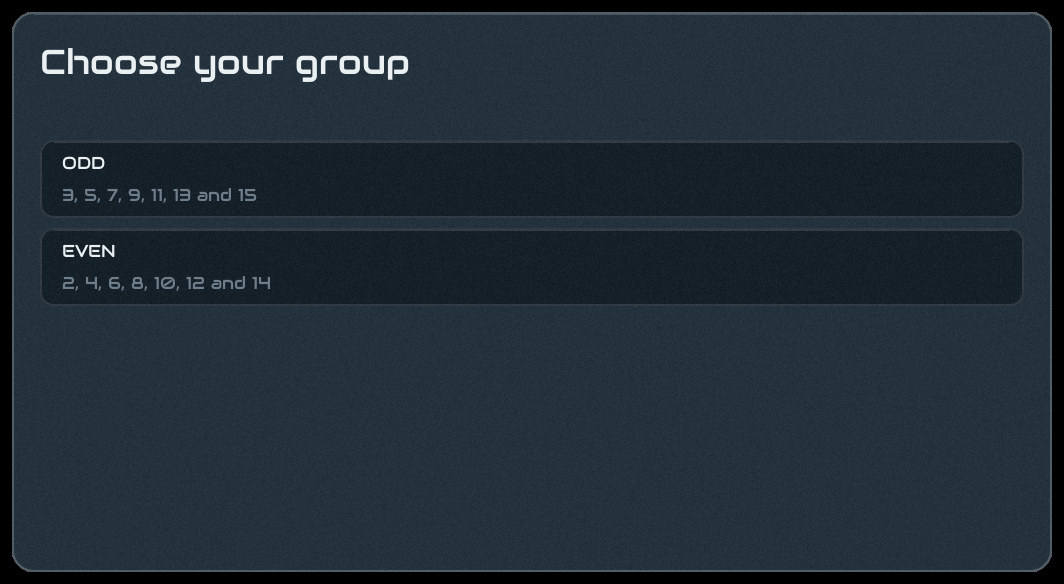
Par ou ímpar
Odd (3–15) against even (2–14); the 1 is
the money ball, on its mark
Takes your opponent's lowest ball off; hitting one
of theirs first takes two
Clear your group, then the 1. The 1 too soon loses
Par ou ímpar, 1 ball a foul
The same
Always one of your
opponent's balls
The same
Par e ímpar (CBBS)
Fourteen balls, 2–15, odd against
even
Takes your opponent's lowest ball off; they play on or make you play
again
Pot the last of your group, or be on your last ball when they foul
Mata-mata
1–7 against 9–15; no 8
Your opponent
takes one of their own balls off, then plays on or makes you play
again
Pot the last of your group
Bola 8
Solids against stripes
As mata-mata
Clear
your group, then the 8. The 8 too soon, or off the table, loses
On the scoreboard: once the groups are decided, each player's group is shown
beside their score: the 3 or the 10 at mata-mata and bola 8, and the 1 or the 2 with
ODD or EVEN at par ou ímpar and par e ímpar.
Taking a ball off. At mata-mata and bola 8, when your opponent fouls you choose which
of your own balls comes off: look or point at it and pull the trigger, as at free pyramid.
The computer takes off the ball it would find hardest to pot.
Choosing a group. At par e ímpar, a break that pots nothing, or goes in-off, hands
the other player the choice of odd or even.
Mesinha's par e impar: choose ODD or EVEN.
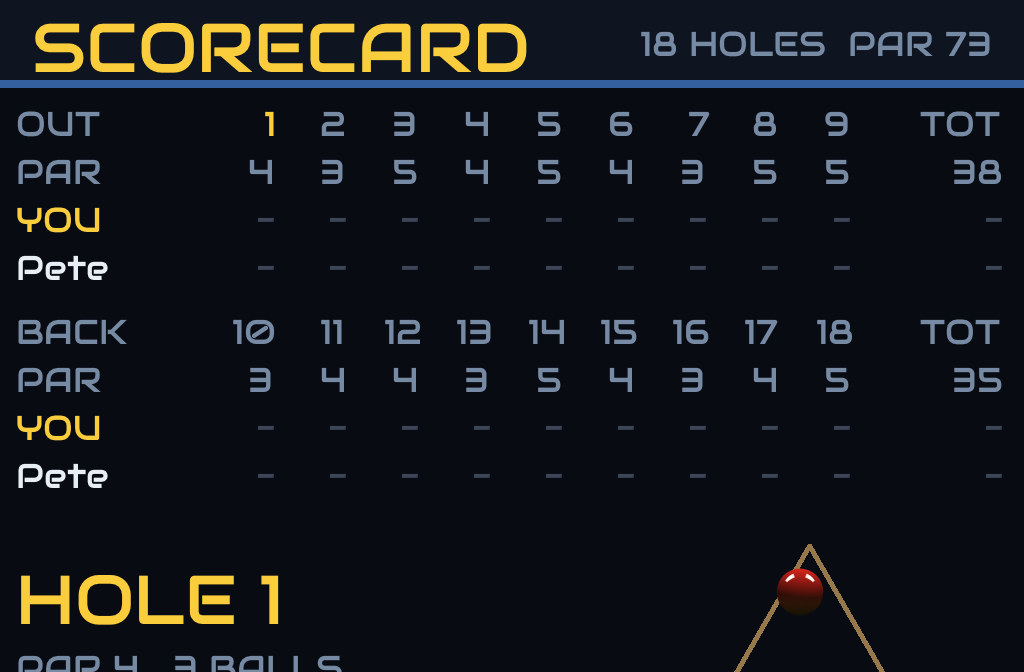
Billiards golf
7FT TABLE · 18 HOLES · PAR 73
Eighteen holes on the pub table, off the old Billiard & Golf scoreboard. Each hole is a
fixed arrangement of two, three or four reds inside the rack triangle, with a par of one more
than the number of balls. Strokes are the score and fewer is better.
There are no fouls at all. No ball you must hit, no cushion requirement, no turn to
lose. Missing everything simply costs you a stroke. Potting the cue ball costs one extra
— so that stroke costs two — and the white goes back to the middle of the baulk line with the
reds left exactly where they lie. Every other stroke is played from where the ball is.
The scoreboard carries your card as you play. Each player's holes so far, their
total, and how they stand against the par of the holes they have played — the number a golfer
actually wants, without opening anything.
A hole ends when the last red goes down, or at eight strokes, whichever comes first.
The board tells you where you are in golfer's language: "HOLE 4 — 2 FOR PAR", then "THIS FOR
PAR", then "THIS FOR BOGEY".
Two players play the same hole from identical racks. The lower score takes the
honour and leads off the next hole; a tie leaves the honour where it was. Low total wins the
round. The RULES row chooses eighteen holes, the front nine (par 38) or the back nine
(par 35).
Or play it as matchplay, which is the same holes scored as a different game. The
RULES row has all three rounds a second time — MATCHPLAY 18, MATCHPLAY FRONT 9
and MATCHPLAY BACK 9 — and in those, each hole is won, lost or halved separately, and the totals are thrown away. The board stops talking about par and says where the match is:
ALL SQUARE, or who is how many holes up.
And you pick up a hole you cannot tie. Playing second at a hole, once you have taken
as many strokes as your opponent needed and the reds are not gone, nothing you do can halve
it — so the visit ends there rather than making you play out a hole that is already lost. The
card shows a dash where the score would have been, which is what a paper matchplay card
carries, and the hole counts as lost exactly as if you had played it out.
It changes what a bad hole costs. In strokeplay a fourteen follows you round for the rest
of the round; in matchplay it loses that hole and nothing else, and you can be all square on
the next tee having been beaten by nine strokes on the last one. It also ends when it is
decided rather than when the holes run out — more holes up than there are holes left and the
match is over, which the board calls in golfer's shorthand: 3 AND 2.
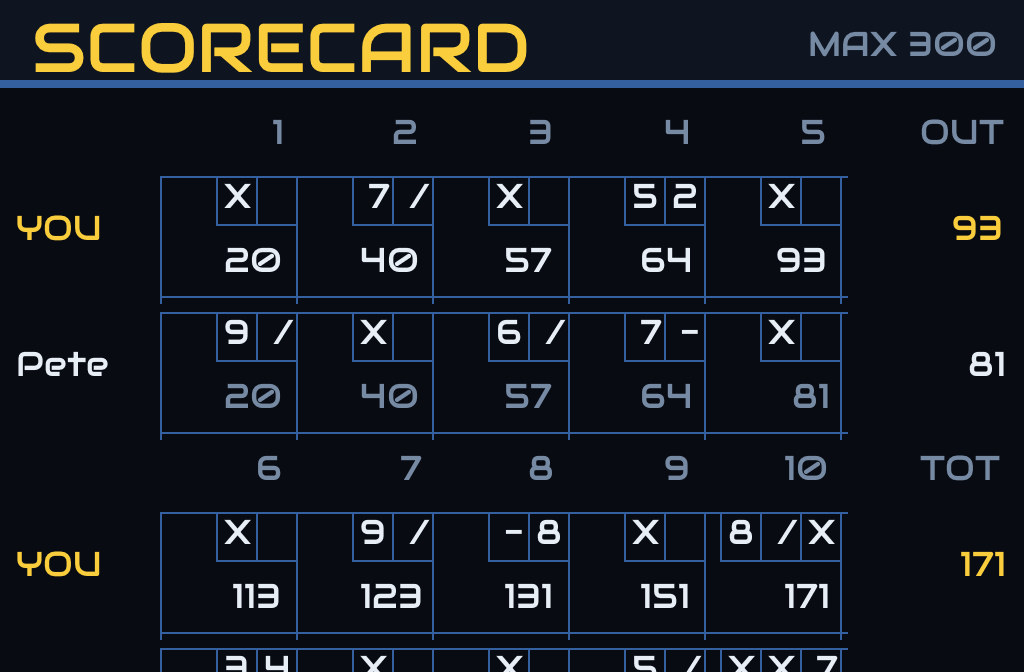
Billiards golf's SCORECARD, from the pause menu: a column for each hole with par above, the nines and the round added up. Your plus or minus is against the par of the holes you have played so far.
Paul
6FT HOME TABLE · 42 MM BALLS · SCATTERED AT RANDOM · 54 MM POCKETS
There is no rack. The whole snooker set — fifteen reds, six colours and the white —
goes onto the cloth at random, differently every game, so there is no opening to learn
and nothing to break. The white lies wherever it landed.
The break hits nothing. The opening stroke must touch no ball and no cushion.
Touch either, or pot anything, and it is a foul worth two shots to your opponent.
Then alternate visits, and pot whatever you can reach — there is no ball on and no
order. A red is one, a colour is two, the black is four, and everything
potted stays down: nothing is ever spotted. A miss is not a foul; it simply ends your visit.
An in-off is a foul, worth two shots to your opponent, and the ball it potted scores
nothing. Two shots in hand are spent by potting, and after a scratch the white goes in the D,
which is the only thing the D is for in this game.
You win by leading by more than is left. Twenty-nine points go on the table at the
start, and the frame ends the moment one player is further ahead than the remaining balls can
make up. If the table empties with the scores level, the black goes back on its spot and you
play for it.
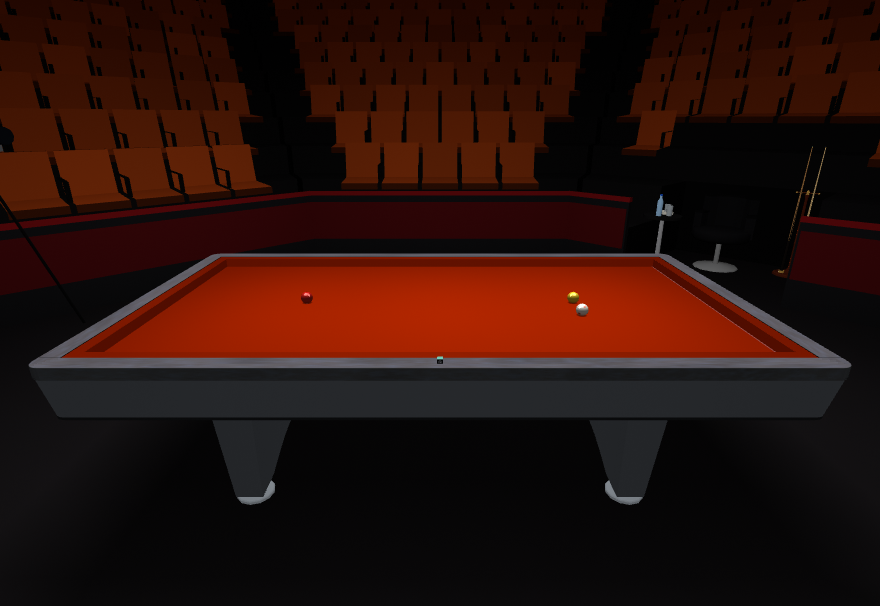
Carom — five games and no pockets at all
10FT TABLE · NO POCKETS · 61.5 MM BALLS · FIVE GAMES ON THE RULES ROW
A new table with nowhere for anything to fall: four plain cushions all the way round.
Nothing is ever potted, and every point is a cannon — your cue ball touching both the
other balls in one stroke. You and your opponent each have a cue ball of your own, with a red
between you, and the cloth is fast and the cushions the liveliest in the game, because the
game is played off them.
Carom is one card on the game row; which of its five games you play is the RULES
row, exactly as Killer sits on the 8-ball games. They differ in what the cannon must do
on the way:
STRAIGHT RAIL
A plain cannon scores. First to 30.
1-CUSHION
One cushion before the second ball. The step
between straight rail and the professional games, and the one UMB discipline CueVR was
missing. First to 20.
2-CUSHION
The cue ball must touch two cushions before
it reaches the second ball. First to 15.
3-CUSHION
Three cushions before the second ball — the
professional game, and very hard. First to 10.
FOUR-BALL
The Korean game, with a second red on the table: a
point is a cannon on both reds, and your opponent's cue ball is the ball you must
not touch. First to 15.
Each of the five can also be played to 10, 15 or 20: choose under POINTS on
the rules page, and each game keeps its own choice. Five-pin is always played to 50. Online,
both players play to the host's choice; tournaments and careers keep the usual targets.
One pocket
9FT TABLE · 15 BALLS · 8 UP · US 8-BALL'S RULES ROW
The most tactical game on a pool table, and unlike anything else here. You own one of
the two far corner pockets and your opponent owns the other. A ball is worth something to
whoever owns the hole it went down and to nobody else, and eight of the fifteen wins it.
The breaker chooses, after the break. Not before — you pick your pocket once you
have seen what the break left, which is how the game is played and half of what makes the
opening stroke worth thinking about. The board asks you and the table waits; the other
corner is then your opponent's. Against the computer it chooses for itself, and quickly.
Which pocket is yours is lit on the table — yours steady green, your opponent's
steady red, both lit for the whole frame. The other four pockets stay dark, which is exactly
their status: a ball down one of those is spotted and your visit is over.
A ball in your opponent's pocket scores for them, and there is no way to refuse it.
A ball down is down.
A foul costs a ball, not just the turn. One of your scored balls comes back out on
to the table, and if you have none yet you owe one, taken from the first ball you do
score. That is what makes the game the famous crawl it is: two players nudging balls a
millimetre at a time, because a foul is more expensive than a missed chance.
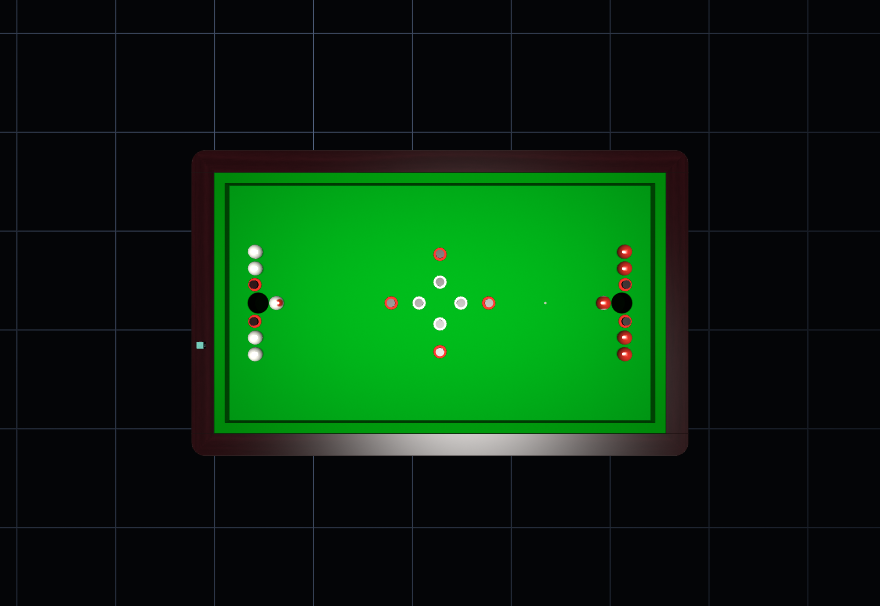
The far end of a one pocket table. Your pocket is lit green and your opponent's
red, all frame — the game is unplayable without knowing which is which, and being told once
at the rack is not the same as being able to look.
Rotation, and the games on its board
9FT TABLE · 15 BALLS · 61 UP · US 8-BALL'S RULES ROW
The oldest of the rotation family and the reason the family has that name. The
lowest ball on the table is always the one you must hit first, and a ball is worth its number. The numbers come to 120, so 61 wins — and the frame can be over with
balls still up, which is the whole shape of it. The 15 alone is a quarter of what you need,
so a player who took the low balls cheaply can still lose to one who took the high ones.
The rack is the same as rotation: the 1 at the apex nearest you, the 2 and 3 in the far corners,
the 15 buried in the middle. The ball you are obliged to hit is the closest one, the next two
lowest are as far away as the table allows, and the biggest score cannot be had cheaply.
ROTATION 61
The classic game. A foul puts the incoming player
behind the head string, which is a real penalty: you may not shoot at anything in
front of the line, so a pack at the far end has to be reached the long way.
FILIPINO ROTATION
The same board, two rules changed, and they are
the two that decide how it feels. A foul gives ball in hand anywhere, which hands
the table over rather than making you travel — and three fouls in a row loses the
frame, so a player who cannot reach the ball on cannot simply keep handing it
back.
15-BALL
Rotation without the rotation: the same scoring and the same
61, and nobody telling you what to hit. You pick which of the big balls to go
after rather than working your way up to them. Its rack is the mirror, with the 15 at
the apex.
Cowboy pool
9FT TABLE · THREE BALLS · 101 UP · US 8-BALL'S RULES ROW
Only the 1, the 3 and the 5 are on the table, spread down the bed on the foot,
centre and head spots, and there are a hundred and one points to be had off them three ways
at once: pocketing, cannons and in-offs.
To 90
Everything scores. A ball pocketed is worth its
number, a cannon off two balls is one, and an in-off is one.
91 to 100
Cannons only. Pocketing scores nothing from
here.
The 101st
A cannon with the 1 struck first, and nothing else
will do.
And you cannot overshoot. A stroke worth more than the phase has left scores nothing
and your visit is over. The ceiling before ninety is ninety, not 101, so a player on
88 cannot simply take the 5 — they need the 1, or a cannon, or an in-off.
The balls always come back to their spots.
Bank pool, Honolulu and speed pool
9FT TABLE · 15 BALLS · US 8-BALL'S RULES ROW
Three more games on the same bed, each built on refusing you one ordinary thing.
BANK POOL
Call the ball and the pocket, and bank it in. Only
the called ball, banked into the called pocket, scores — one ball a stroke.
Anything else that drops goes back on the table, and that is not a foul, so if your
called ball went in you keep the table. The break is not called, and what it banks in
counts.
What a bank is. The ball must come off a rail that does not run
into the pocket it drops in. A rail is the cushion between two pockets, jaws included,
so off the far side of the table is a bank, and so is off the jaw of a different
pocket. A ball that runs along one of the pocket's rails, or clips that pocket's jaw
on the way in, has not been banked. First to 8, and a foul costs a ball as it does at one
pocket.
HONOLULU
A straight-in pot scores nothing. The ball has to
arrive the hard way — off a bank, off a kick (the cue ball finding a cushion before it
reaches a ball), or through another ball as a combination or carom. A bank is judged as
it is at bank pool: off a rail that does not run into the pocket. The one shot every
other game on this table is built around is the only one this game does not have. A
straight pot is not a foul: it goes back on the table, and if you scored one properly on
the same stroke you keep the table. First to 8.
SPEED POOL
Not a frame at all. You each clear a full rack and
the clock is the score — lowest time wins. There is no turn to take from anybody
and nothing to defend: any ball, any pocket, as fast as you can get to the next one.
Potting the cue ball is not a foul — it comes back in your hand and the clock keeps
running, which costs you more than a lost turn would.
Bowlliards
9FT TABLE · 10 BALLS · BOWLING CARD
Pool kept on a ten-pin bowling card, and the only game here besides golf that you play
against a card rather than against the person opposite. Ten balls, ten frames, and a
maximum of 300.
A frame is two innings to clear the rack. Clear all ten in the first and it is a
strike; clear them across both and it is a spare; anything else scores the balls
you potted. The break is free — nothing on it counts, everything goes back up, and a scratch
costs nothing — and then you call ball and pocket on every stroke.
The scoring is a real bowling card, which means a frame cannot be totalled when you
finish it. A strike is worth ten and the next two innings; a spare ten and the
next one. So the box stays blank until the balls that score it have been thrown, exactly as
on paper, and the tenth frame earns two extra innings for a strike and one for a spare.
The board shows the five frames you are in, marked the way a bowler marks them: X a
strike, / a spare, - a miss. MENU, then SCORECARD, for all ten.
There is nothing to play safe for — you are clearing your own rack and the table changes
hands when your inning ends, not before — so the machine never plays safe at it either. It
takes every pot however thin and chooses between them by where the cue ball finishes, which
is what clearing ten actually asks of you.
The RULES row offers CANADIAN house rules as well as the standard game.
Under those you do not call anything — no ball, no pocket, pot what you can. The
break is a scoring stroke: whatever goes down on it stays down and counts towards your first
inning. You play the white from wherever it finishes rather than taking it in hand, unless
you potted it — a scratch on the break costs you the position and nothing else. And failing
to reach a cushion is still a foul, but the incoming player takes the table as it lies
instead of with the ball in hand.
Try it with the TENPIN ball set: ivory pins with the two red rings round the neck,
numbered one to ten as pins are, and a swirled bowling ball for the cue ball.
Bowlliards' SCORECARD.
Cribbage pool
9FT TABLE · 15 BALLS · US 8-BALL'S RULES ROW
The numbers on the balls are worth nothing by themselves. What scores is a
cribbage — two balls totalling fifteen, potted one after the other inside a single
inning. There are exactly seven of them in a rack: 1+14, 2+13, 3+12, 4+11, 5+10, 6+9 and
7+8. Five cribbages takes the game, and the rack is not played out once somebody has them.
In succession is the whole game. Pot the 4 and you are on a cribbage: the
next stroke must pot the 11, there is no option to leave it, and failing is a foul that
spots the unpaired ball and ends your inning. Pot two openers on one stroke and you owe both
— take them in whichever order you like, but keep going until the list is empty.
The 15 pairs with nothing and can start no cribbage. Potted early it is spotted and that
is not a foul; once every other ball is down it becomes a cribbage by itself, and it
decides a game that is level.
The board carries all seven fifteens. A pair struck through has gone, a pair lit is open,
and the ball you MUST POT is named beside them — which matters, because while you owe
one it is the only legal shot on the table.
The balls each game is played with
Every game uses the balls it is really played with, at the official size and weight. English
pool is the odd one out: its cue ball is smaller and lighter than the object balls, a
convention that comes from coin-operated tables needing to tell the white apart to return it.
You will feel it — a light cue ball checks back off a full contact instead of stunning dead, and
it throws the object ball further when you use sidespin. Billiards golf is played on that same
pub table and inherits it.
Game
Object balls
Cue ball
Specification
Snooker, 12ft and 10-red
52.5 mm · 142 g
52.5 mm · 142 g
WPBSA
Snooker, 6-red (7ft)
50.8 mm · 116 g
50.8 mm · 116 g
A compact set to suit the small table. 6-red is played full-size in competition, so
there is no official spec for it on a 7ft bed.
UK 8-ball
50.8 mm · 116 g
47.6 mm · 94 g
WEPF: 2.000″ ±0.005″, 116 g ±2 g, with the traditional 1⅞″ cue ball
US 8-ball, 9-ball and 10-ball
57.15 mm · 170 g
57.15 mm · 170 g
WPA: 2¼″ ±0.005″, 160–170 g
Chinese 8-ball
57.15 mm · 170 g
57.15 mm · 170 g
WPA balls on a 10ft snooker-built table
Straight pool
57.15 mm · 170 g
57.15 mm · 170 g
WPA, on the 9ft American bed
Billiards golf
50.8 mm · 116 g
47.6 mm · 94 g
The UK 7ft table's set, small white included
English billiards
52.5 mm · 142 g
52.5 mm · 142 g
Snooker balls: a red and two whites
Russian pyramid, 12ft
67 mm · 255 g
67 mm · 255 g
The federation's current tournament ball. The largest ball in the game, on the
smallest pockets.
Russian pyramid, 7ft
57.15 mm · 158 g
57.15 mm · 158 g
2¼″, the smallest pairing the federation lists
Sinuca Brasileira
54 mm · 155 g
54 mm · 155 g
The Brazilian federation's ball, all seven the same size
Mesinha
50 mm · 120 g
54 mm · 151 g
The bar table's set: a white bigger and heavier than the rest
Paul
42 mm · 110 g
42 mm · 110 g
A small home set: a full snooker set of twenty-two balls, at the size a 6 ft table
comes with. The smallest balls in the game, on 54 mm pockets.
Bar billiards
47.6 mm · 120 g
All eight balls are the same:
one red and seven whites, and any white on the table can be struck.
Carom
61.5 mm · 210 g
61.5 mm · 210 g
Two cue balls — one each — and a red. Four-Ball adds a second red.
Match length is set on the main menu: one frame, or best of 3, 5, 7, 9 or 11. The break
alternates between players and the score carries through the match. A player who cannot catch up
will concede rather than play it out.
Two games end on something other than a score: bar billiards ends when its clock runs
out, and billiards golf ends when the round does.
Practice and challenges
Two ways to play without an opponent.
Free practice gives you the table on your own with no rules and no scoring. Put the
balls wherever you like and hit them.
Breaks are still counted at snooker. Practice has no rules, but it does keep your break:
pot in the right order and the total climbs on the scoreboard and the referee calls it as he
would in a frame — a red, then a colour, then a red, and once the reds are gone one colour of
your choice and then the colours in order. Anything else ends it: two reds in two shots is two
pots and not a break of two. Miss, go in-off, or pot out of turn and the referee says
"end of break" and the count starts again from zero. Nothing is judged and nothing is
penalised, so you can practise a break and still know what you built.
And you can play a clearance.AUTO RESPOT keeps the colours on the table while
you practise, so you never run out of things to take after a red. Once the reds are gone it
stops: the colour after the last red goes back up as it would in a frame, and from there the
colours stay down and you can clear the table. Turn it off and practice follows the frame
rules throughout.
PracticePractice: PRACTISE gives you a free table where nothing counts and
B takes a shot back. CHALLENGES opens the challenges.The pause menu in practiceThe pause menu in practice. Two more rows: PRACTICE (Move the
balls, Timed six, Challenges and Show the shot off) and
TARGET (Target on, and Auto set position target).CHALLENGESCHALLENGES: the TIMED SIX, FROM A CODE (one somebody has
shared), MAKE ONE, and every challenge you have kept, each with its best result.
DELETE sits on your own. GALLERY beside the title has other players'.
The target
A chalk bullseye on the cloth to play the cue ball to: a 50 in the middle, then
20 and 10 rings, 26 cm across. Tap MENU in practice or a challenge and
choose Target on; it is chalked where you last left it. Move the target puts it in
your free hand, the same as a ball in hand: take it anywhere on the table and pull the trigger to
put it down. Target off rubs it out.
When the cue ball comes to rest inside the target, the ring it stopped in — the 50, the
20 or the 10 — lights up. It goes out as soon as the cue ball moves again or you move the
target.
A challenge can have its target. In the layout editor, PUT THE TARGET ON, then pull
the trigger near it to pick it up and carry it like a ball. It is saved with the challenge and
chalked on the table whenever the challenge is played; your practice target comes back when the
challenge ends.
The target, chalked on the cloth between the blue and the pink.
Challenges set you a goal on a fixed layout: a position to play from, a ball to pot, a
score to reach or a table to clear. Each one is judged over a single visit, so a miss ends the
attempt and you start again.
VS → Challenge on the main menu opens them as a page of cards; in free practice
they are a chip on the pause menu. Each card is a picture of the layout with its name, what it asks and your best
result underneath. Point at one and pull the trigger to open it. The first two cards are always
there: THE TIMED SIX, six reds against the clock, and MAKE ONE. You can keep
thirty-two challenges of your own.
A challenge's page
A challenge's page. PLAY IT starts it, MOVE THE BALLS opens the
layout, SHARE gives its code. On the right, what it asks and which balls count.
Row
What it does
NAME
Opens a keyboard. Type a name and press KEEP IT;
SUGGEST starts you from a description of what it asks. A challenge with no name is
described that way on its card, such as POT THE 1 TO THE 4 - US
8-BALL.
WHAT IT ASKS
JUST THE POSITION (play on from here, nothing is
judged), POT A BALL, SCORE or CLEAR THE TABLE.
No clock / Against the clock
Whether it is timed.
The target
If the challenge has a target, it can also
ask the cue ball to finish inside the 50, the 20 or the 10.
WHICH BALLS
For POT A BALL, the balls to pot. Pick more than one and
all of them have to go down in the visit.
MAKE ONE, or Workshop → Challenge, opens the layout editor with the balls
as they are on the table. So the
quickest way to make a challenge is to set a position up in practice, or stop at one you keep
getting wrong, and press MAKE ONE. A table with no balls on it starts from a full rack.
Setting the balls out. Pull the trigger near a ball to pick it up and again to put
it down; the panel holds the rest — save the position, take a ball off, put one back,
START FROM A FULL RACK, take them all off, or throw the changes away.
From a code
FROM A CODE, on the MAKE ONE card, takes a challenge somebody has shared: type the six
letters and press GET THE CHALLENGE. It joins your cards and opens on its page. Or pick
one in the gallery, where players put the challenges they want others to
try.
Challenges wait until your game is over. A challenge sets out its table, so PLAY IT,
MOVE THE BALLS, MAKE ONE and the timed six are shut while you are in a game, and the page says
so. Adding one from the gallery waits too. Getting one from a code does not change the table,
so you can do that any time.
Leaving one and coming back
Go to Home in the middle of a challenge and it waits for you. Home names it and offers
CONTINUE, which puts you back at the table where you left it, and END CHALLENGE,
which takes you to the challenge list. Tapping MENU goes back to the table too.
A match position
Set out a position by hand, from a classic match or one of your own, and see how you would
have done. MAKE ONE, lay the balls out, then on its page choose WIN THE FRAME or
WIN THE MATCH. Two chips under the goals set it up:
Chip
What you choose
THE MATCH
The opponent, the match length and the frames each.
THIS FRAME
The points each (in the games that score points), who is
to play, ball in hand, and at 8-ball whose balls are whose: open, 1 to 7 or 9 to 15.
The rest is read off the balls: at snooker, a red is on while any are left, then the colours
in order. MOVE THE BALLS still works. PLAY IT puts the position on the table,
and it is judged at the end of the frame or the match. Share it by code like any challenge.
Win from here
Or take the position from a match you are playing against the computer. Press MAKE A
CHALLENGE on the pause panel, or on a match in SAVED MATCHES, and the balls, the score and the
game are kept as they stand. Choose who you play and what the score is, then WIN THE FRAME or WIN
THE MATCH from there.
Opponents
Eight computer players. They differ in how straight they hit the ball, how much
they think about where the cue ball finishes, how much risk they take, and how well they get out
of trouble. The bars below are their actual settings.
Step 3 VS on the main menu opens the same cards you see below — face, name,
rating, style and five bars. The chips across the top switch between the computer players, a
game online, a career, an event and practice; SINGLES and DOUBLES pick the format.
Rookie Rick
Rating 1278 · beginner
Takes on everything and misses most of it. Hits the ball far too hard and has no idea
where the cue ball will finish. Start here.
Aiming
Power control
Position
Spin
Aggression
Steady Sue
Rating 1382 · cautious
Will not take on a pot she does not fancy, and plays safe instead. You will not get many
free chances, but she will not punish you hard either.
Aiming
Power control
Position
Spin
Aggression
Professor Pete
Rating 1428 · thinker
Plans properly and is good at breaking up awkward clusters, but he is not the straightest
potter. He will build a break if you let him.
Aiming
Power control
Position
Spin
Aggression
Hustler Hank
Rating 1447 · aggressive
Fast and attacking. Hits everything with pace and takes on pots other players would leave
alone. Streaky, and dangerous when it comes off.
Aiming
Power control
Position
Spin
Aggression
Clara CueQueen
Rating 1501 · all-rounder
Accurate, balanced and hard to fault. The first opponent who will make you work for the
frame rather than wait for a mistake.
Aiming
Power control
Position
Spin
Aggression
Deadshot Dave
Rating 1633 · potter
Pots nearly everything he looks at, from anywhere. He does not think much about the next
shot, so his breaks tend to end by themselves.
Aiming
Power control
Position
Spin
Aggression
Iron Nina
Rating 1715 · the toughest
Very straight and very controlled. She plays position on every shot, breaks clusters open
when she needs to, and will punish a loose safety.
Aiming
Power control
Position
Spin
Aggression
The Machine
Rating 1616 · no mistakes
Aims perfectly and thinks about every shot for as long as it takes. It makes centuries
at snooker regularly, with a best break of 134.
Aiming
Power control
Position
Spin
Aggression
Records on Home keeps your results against each player and your best breaks. At pool
it also counts your break-and-runs (frames won from your own break before the other player gets
a shot), and at 9-ball your golden breaks. Records only count on the standard tables: see
Which table.
Their cues
Each player plays with a cue made for them, in singles, doubles and Killer: Rick's
surf colours, Sue's studs and spikes, Hank's old hand splice, Pete's library, Clara's crown,
Dave's trench coat and one cyan eye, Nina's lace and pearls, and the Machine's circuit
bands.
At the table with you
While it is your shot, they stand back from the table on the side away from you,
holding their cue upright.
At their shot they walk round the outside of the table to it, get down on it, and stay down
a moment after the stroke. After a pot they step back with the cue held ready and carry it round
to the next shot; after a miss or a safety they stand it upright again and go back to their
place. In doubles, teams and Killer you see one computer player's cue at a time: the one at the
table, or while you are playing, the one who plays next.
Settings → Opponents → THEIR CUES BETWEEN SHOTS turns this off: HIDDEN shows a
computer player's cue only while it is down on the shot.
Opponents: whether the computer players stand back from the table holding
their cues between shots, and whether you see other players' headsets and hands
online.
Doubles and Killer
DOUBLES beside SINGLES on step 3 VS: you and a partner against two, taking a
stroke each in turn. Pick each place, then the player for it; YOU WATCH puts the
computer in your place too.
After a foul, PLAY AGAIN puts the player who fouled back at the table. On a Killer
game, step 3 VS has a PLAYERS row instead, from 2 to 8, and a pick for each player. The
order of play is drawn, and the scoreboard shows everyone's lives.
How they play
They aim for the part of the pocket a ball can really go in, and on a cut they miss on the
safe side. With ball in hand they put the cue ball where they have a shot.
They know every game. At English billiards they play cannons and in-offs as well as pots. At
bar billiards they play round the skittles and never risk the black one.
At snooker they break off like a snooker player: thin off the end red, round the
table and back into baulk. The stronger players get it right; the weaker ones often leave you
something.
Two things to know. On Russian pyramid the opponent plays properly but rarely
reaches eight balls, so treat a pyramid frame as practice. At bar billiards it is very
strong: the black skittle only screens the 200 from a ball coming straight up the table, so the
opponent scores the 200 from the side.
What the bars mean.Aiming is how close to the intended line they hit the ball.
Power control is how accurately they judge the weight of a shot. Position is how
much they play for the next ball rather than just the current one. Spin is how much
backspin and topspin they are willing to use. Aggression is how likely they are to take a pot on
instead of playing safe.
Rules and the referee
The rules are enforced for you, and called out loud. You do not have to keep
score or remember what is on.
The scoreboard: both players and their scores, a yellow bar beside whoever is at
the table, what ball is on, the points left, and the balls still to pot, drawn in the set you
are playing with.
The top line of the board names the game and its rules, such as UK 8-BALL ·
BLACKBALL or SNOOKER · MISS: PRO.
The referee knows every rule of every game: reds and colours in order at snooker, free balls
and misses, your group at pool, the two shots at UK 8-ball, the push-out at 9-ball, cannons and
in-offs at billiards, the skittles at bar billiards, and so on.
The break has to do something
Most games do not let you just tap the pack. What a break has to do depends on the
game:
Game
A legal break
If you fail it
UK 8-ball — pub
Nothing is asked.
—
INTERNATIONAL
Pot a ball, or four object balls to
a cushion.
Re-rack, opponent breaks.
ULTIMATE POOL
Three points: one a ball
potted, one a ball left wholly past the middle-pocket line.
Re-rack.
BLACKBALL
Pot a ball, or two object balls
across the line between the middle pockets. No cushion test at all.
Foul — your
opponent gets a free shot.
US 8-ball, Chinese 8-ball
Pot a ball, or four object balls to a
cushion.
Not a foul: re-rack and your opponent breaks.
9-ball, 10-ball
Hit the 1 first, and pot a ball or drive four
object balls to a cushion.
Foul — ball in hand.
Straight pool
Pot the called ball, or drive two object balls
and the cue ball to a cushion. Both.
Two points off, not the usual
one.
Rotation, Filipino, 15-ball
Pot a ball, or four object balls to a
cushion.
Foul.
Bank pool
Pot a ball, or four object balls to a cushion.
You owe a ball.
One pocket
Pot a ball, or send one object ball or the cue ball
to a cushion.
You owe a ball.
One pocket asks the least because a one pocket break is meant to be soft. The
four-ball rule from 8-ball would make nearly every good one pocket break a foul.
The rules of the game you are playing
Not sure why something was a foul? Press MENU and choose RULES OF THIS
GAME. It shows a short rule book on the scoreboard: what you are trying to do, how you score,
what a foul costs and how the frame ends. It covers only the rules you are playing (PUB, say,
not all four UK 8-ball rule sets). If it runs past one page, hold the trigger on it and drag to
scroll.
Hold X at any point and the board is replaced by a live photograph of the table
from above, for as long as you hold it.
What the board shows while you hold X: the whole table from directly
above, balls and all, updating as they move.
Hit a ball other than the cue ball with your tip and it is a foul, as at a real table.
The game does not steer your cue onto the white. What it costs depends on the game: four
points at snooker, ball in hand at 9-ball, and so on. Anything knocked in stays down.
On an L-shaped or many-sided table, a corner of the cushion can snooker you, just as a
ball can.
RULES OF THIS GAME, on the scoreboard, from the pause menu.
Playing against the clock
Some rule sets are timed. The break-off has no shot clock, and a timed frame or match starts
when the break-off is struck. After that, the shot clock starts when the table becomes yours and runs while
you line up; the scoreboard counts it down, it turns amber under ten seconds and red under
five, and each of the last five seconds beeps. When it runs out you hear a klaxon and the board
says OUT OF TIME. Online, a menu does not stop it: you cannot pause your opponent's
clock from your headset. When you are given ball in hand, you get ten extra seconds on
that visit to place the ball.
Rule set
The clock
Out of time
UK 8-ball, ULTIMATE POOL
30 seconds a shot, and a match clock of four
minutes for each frame needed to win.
A foul: ball in hand.
UK 8-ball, BLACKBALL (WPA)
60 seconds a shot.
A foul.
9-ball, SHOT CLOCK
30 seconds a shot, 60 for the first shot after the
break and for a push-out and the shot after it. Once a rack each player has a 30 second
extension: when your shot's time is up the clock runs on into it by itself, the board
counts it down after EXT, and it says EXTENSION: 30 SECONDS with a beep.
A foul: ball in
hand.
Snooker, SHOOTOUT
A ten-minute frame; 15 seconds a shot, 10 in the
last five minutes.
A foul.
Snooker, THE 900
A fifteen-minute frame; 20 seconds a shot.
A
foul.
English billiards against the clock
5, 10, 15 or 30 minutes, and 60 seconds a
shot.
The turn passes, with no score and no foul.
Online, only the player at the table can run out of time, and only their game calls the end
of a timed frame; the other player's game takes it from theirs, so both always agree on the
result.
When your opponent fouls
You are asked what you want to do. You can play on from where the balls have finished, or make
your opponent play the shot again. If a miss was called and the table can be put back as it was,
that is offered too. The referee announces what you chose.
Opponent fouled: take the shot from where the balls lie, or make them
play again. Snooker adds FREE BALL and the replay after a miss.
Foul and a miss
At snooker, failing to hit the ball on is always a foul. The referee also decides whether it
was a miss: whether you made a good enough attempt. If it was a miss, your opponent can
have the balls put back and make you play it again.
How strict the referee is, is set on the snooker RULES row:
MISS: AMATEUR
A genuine try is enough — within about three ball widths,
with most of the pace to get there.
MISS: CLUB
The default. Within a ball and a half, at nearly full
pace.
MISS: PRO
As on television: almost every failure is called. Within about
a third of a ball, and the cue ball must have had the pace to pass the ball on.
How the referee decides. He looks at the ball on that you came nearest to, and
asks two things:
How close you came
Measured in ball widths — roughly three balls at
AMATEUR, a ball and a half at CLUB, a third of a ball at PRO.
Whether it was a real attempt
How far the cue ball travelled against how
far it had to go. A dribble that stops short is a miss however well aimed it was.
He allows more room when you were snookered (three times as much) and on longer shots, as a
real referee does. Three misses in a row lose the frame, but misses from a snooker do not count
towards the three, and one good attempt starts the count again.
The same row has SHOOTOUT and THE 900. These are different, timed games with
no miss rule: see The games.
Calling a pocket
To call a shot is to say, before you play it, which ball you are potting and in which
pocket. Four games can ask for it, set on their RULES row.
Most of the time you do not have to call anything. When the pot is the obvious one, the
game calls it for you. You only call when it is not clear which pot you are playing.
Straight pool
CALL THE BALL, the default, wants the ball only, and
it may go down any pocket. CALL BALL AND POCKET wants both — nothing counts unless it
was declared first, and that is the real game.
10-ball
CALL SHOT (WPA). Every stroke is called; the break is not.
US 8-ball
CALL THE BLACK asks only for the last one, which is how most
people play. CALL SHOT (WPA) asks for every stroke, which is how the rule book has
it.
Chinese 8-ball
The same two, with CALL SHOT (CBSA) for the tournament
reading.
A small lamp is set into the timber beside every pocket. This one is solid green:
that pocket has been called.
What the lamps mean. There is one behind each pocket:
Flashing green
The game's call. It has picked this pocket for you;
play the shot and it stands.
Solid green
A pocket you declared.
Red
A call is owed on this stroke, and this is not the pocket it is
on.
Amber, filling up
The pocket you are looking at now, filling as the dwell
goes on. Keep looking until it is full and it is called.
Grey
Nothing needs calling this stroke.
The called ball also gets a chalk ring on the cloth. Nothing is called on the
break, and the scoreboard says NO CALL NEEDED.
To call it yourself, or change the game's choice, use one of three ways, chosen on
CALL A POCKET on Settings → Controls:
LOOK + TRIGGER
Hold the trigger on your free hand, look at a ball or a
pocket, and release to call it.
LOOK, STOOD UP
Just look at it, with no trigger. It only works while
you are standing up, so looking around while you are down on the shot calls
nothing.
POINT + TRIGGER
A laser from your free hand — or from the cue itself,
if you have a real cue attached.
The computer players call their pockets too, and you see the lamp light up as they
play.
Calling the break
At snooker, English billiards, Sinuca Brasileira, carom and straight pool the referee calls
your break as you build it: the running total after each scoring shot.
Turning the referee off
Settings → Sound → REFEREE sets a female voice, a male voice, or no voice at
all. The scoreboard stays either way.
When the match is over
After every frame and match you get the figures, side by side as on TV: pot success, long
pots, safety success, breaks of 20, 30, 50 and 100, average break, table time, fouls, and each
player's best break shown as the balls they potted, in order.
In a match the break takes turns from frame to frame, except under WINNER BREAKS
(9-ball and 10-ball), where the winner of each frame breaks the next.
RecordsThe end of a match. The same figures are kept in Records, so a match you
played last week is still there.MATCH STATSMATCH STATS, from the pause menu: the frame so far, your figures on the
left and your opponent's on the right, and the best break of each. BACK TO THE MATCH
returns to the pause menu.
Which table
Every game can be played on more than one table, and the table changes how it
plays: the size of the pockets, the speed of the cloth, the size and shape of the bed. Choose it
on TABLE, the first picture on the strip along the foot of Home. Your choice is kept for
each game separately.
TABLE: the tables this game can be played on, each named with its pocket
sizes, then the fun shapes and any you have built. The star on a card makes it a favourite;
NO FAVOURITES YET becomes a switch to show only those.
Bigger or smaller
Many games come in more than one size: 6 ft, 7 ft, 9 ft, 10 ft and 12 ft,
where that game is really played on them. Only the bed changes size. The balls and pockets stay
the same, so a smaller table is an easier one. The lines and spots are drawn to suit each
size.
UK 8-ball also has the 6 ft and 7 ft nets tables: string nets under the pockets and a
snooker-style cloth, as in the odd pub or pool club.
A 6 ft nets table for UK 8-ball, in a player's style (teal cloth, teak
rails).
Pro, Tournament and Club
The standard table comes in three versions. They differ in how big the pockets are and
how fast the cloth is. Each card in the picker gives its pocket sizes in millimetres,
corners first, measured at the narrowest point.
Table
PRO
TOURNAMENT
CLUB
Snooker 12 ft and 10-red, English billiards CORNER
1.54 · 80.9 mm
1.64 · 86.0 mm
1.79 · 94.0 mm
MIDDLE
1.65 · 86.5 mm
1.70 · 89.5 mm
1.90 · 100.0 mm
UK 8-ball 7 ft, 6-red snooker, billiards golf CORNER
1.60 · 81.3 mm
1.65 · 84.0 mm
1.75 · 89.0 mm
MIDDLE
1.60 · 81.3 mm
1.69 · 86.0 mm
1.81 · 92.0 mm
US 8-ball, 9-ball, 10-ball, straight pool CORNER
1.78 · 101.6 mm
2.00 · 114.3 mm
2.06 · 117.5 mm
MIDDLE
1.40 · 80.0 mm
1.62 · 92.7 mm
1.73 · 99.0 mm
Chinese 8-ball 10 ft CORNER
1.50 · 85.7 mm
1.54 · 88.0 mm
1.61 · 92.0 mm
MIDDLE
1.50 · 85.7 mm
1.58 · 90.0 mm
1.66 · 95.0 mm
Cloth
Fast
Normal
Slow, and the cushions are 2% deader with it. On the snooker and billiards tables,
only a touch slower than normal
Which to choose:PRO has the tightest pockets and the fastest cloth, and is hard
work. TOURNAMENT, where you start, is a little kinder. CLUB has the pockets most
people learned on, with a slower cloth. Try all three: the difference is big.
A few games have only one table, marked ONE TABLE, AS BUILT: the two Russian pyramids
(their pockets are barely wider than the ball), bar billiards, Paul and carom (no pockets at
all).
Shaped tables
After the three standard tables come four shapes: L-SHAPEDHEXAGONOCTAGONROUND.
Play a real frame of snooker round a corner. Every game can use them except bar billiards,
English billiards and carom. The pockets keep the game's size, so the pots are no harder;
the angles are what change.
L-SHAPEDThe L-shaped table.HEXAGONThe hexagon.OCTAGONThe octagon, from above.ROUNDThe round table, from above.
Your own tables
Build a table in the workshop, choose which games it is for, and
press KEEP THIS TABLE. It then appears in the picker for those games, named after what
it is, such as L 84MM or ROUND 112MM. You
can keep twelve. FORGET IT deletes one.
Records only count on the standard tables: PRO, TOURNAMENT and CLUB, at any size the
game offers. Shaped tables and ones you built do not count. Online, a record counts when your
opponent's table is a standard one. The records page tells you when a table does not count.
Playing a friend
Up to eight headsets share one table, on the same wi-fi or over the internet.
Anyone else can watch.
Choose Online on step 3 VS. Pick how to play (below). If you host, you then
choose the format and how many players, and press OPEN THE ROOM. If you join, you play
the host's game.
Format
How many of you
ONE V ONE
Two.
DOUBLES
Two, three or four. ALTERNATE VISITS (the default): each
partner plays a whole visit, until a miss or a foul. SCOTCH: partners take a shot
each.
TEAMS OF 3
Four or six.
TEAMS OF 4
Four, six or eight.
KILLER
Three to eight, or two of you in a game of six.
WINNER STAYS ON
Three or more, up to the most the host allows. See
below.
The computer plays every place nobody takes, and plays on for anyone who leaves. The host
chooses the format and everyone in the room plays it.
Online: Quick match (anyone waiting), Host a room (shown
in Browse), Private room (code only), Join with a code, Browse rooms,
the two Same Wi-Fi cards, and Down the club. When a club tournament is coming,
its tile is here too.
Starting a game
Option
Use it when
LAN (WI-FI)
You are both in the same house on the same network. One
hosts, the other joins, and no code is needed.
HOST / JOIN
You are in different places. The host gets a code to
share; the other player types it in.
QUICK
You want a game against whoever else is waiting.
PRIVATE ROOM
You want only the people you give the code to. It is not
listed in Browse; a room made with HOST is.
BROWSE
You want to see which rooms are open and pick one.
You practise while you wait. However you start, you get a practice table with your
game racked while the game looks for players. The scoreboard shows your code if you are
hosting. A bell rings when someone arrives and the match starts. Pause →
Home stops looking.
Everyone sees the same table, balls and score, and you see your opponent's cue as they play.
After a foul, the player fouled against makes the choice.
You play the host's game, rules and ball set, whatever you had chosen yourself.
(Ball sets have different weights, so both players must use the same one.)
While they play you can walk round the table, change the cloth or open a menu. The
frame carries on, and so does any shot clock.
You both need the same version of CueVR. Players on different versions cannot play
each other, so update if a friend cannot find your room.
Your headset: the MODEL, STRAP and TOP STRAP others
see you wearing online, with tabs for its Colours, an Insignia and your
Hands (six skin tones, or any colour). A thumbstick turns the preview on the
table.
If your connection drops
If your connection drops during a frame, your place is kept for five minutes and the game
tries to get you back in by itself. If CueVR itself closed, or the headset restarted, start it
again: Home and the Online page offer REJOIN YOUR MATCH while your place is kept, and
nothing else can be started until you rejoin or the place runs out. A club table's
match takes you back to the same table, and a tournament match back into the tournament's
room. Not back in time, and the frame is your opponent's.
If your opponent leaves, or does not come back in time, while you are at the table, you
play on to the end of your visit. The frame and the match are yours when it ends, with every
point and your whole break counted.
Results
Every online frame and match is recorded when both players' games agree on it, with each
player's figures and breaks; those are what the club's honours boards
are made from. A frame somebody walks out of is kept too, as a win for the player who stayed,
with both players' figures and every break made in it.
Winner stays on
A room for a group. Two play a frame; the winner stays at the table and the next in the queue
comes on to play them, and the challenger breaks. People come and go as they like, and the room
runs until everyone has left. Only people play: there are no computer players in it.
The host sets it up: the most players allowed, and a cap on how many frames in
a row a winner may stay on — none, 2, 3 or 5. At the cap the winner goes to the back of
the queue too.
The scoreboard keeps count: everyone in queue order with their wins, the two at the
table lit, and who is next.
A pound coin on the rail for each player waiting, as in a pub. It moves out of the
way if your cue comes near it.
Between frames the screen says what happens to you next: you stay on and who you
play, you play next, you play the winner, or where you are in the queue. The next frame
starts by itself a few seconds later. LEAVE THE ROOM takes you out.
Join a room that is already playing and you go on the back of the queue.
Anyone can leave, the player who set the room up included, and the room carries on
for everyone else. At a club table the table stays in the club for the others to join. If
the player running the room loses their connection or their game closes, their opponent
takes over, and the frame waits for them to come back.
Watching
Any game being played online can be watched.BROWSE lists rooms in two columns:
those open to join, and those being played, each with WATCH. If you have a room's code,
WATCH sits beside JOIN on the code screen. Every format can be watched: one against one,
doubles, teams, killer and winner stays on.
A watcher sees the table, the strokes and the score as the players do, but cannot play: you
hold no cue, the game, its rules and its table are locked, and there is no CONCEDE. The board
says WATCHING and names the players. STOP WATCHING on the pause menu takes you
home.
Down the club
A snooker club online, for up to sixteen people at once. Go in from the Online page:
the DOWN THE CLUB card says how many are in and who, and is lit while anyone is. When a
club is full, a second one opens. While you are in the club, the card says so and cannot be
chosen. Point at the card and the bar along the bottom of the panel lists everyone in the club,
a line at a time, changing every few seconds.
The club has four tables: two championship snooker tables, a UK 8-ball table
and a 9 ft US pool table.
You come in at the bar end, just inside the door, looking down the room at the tables, with
no table of your own yet. Everyone else is where they really stand, in their headset with
their name over it, and you hear them from there. Free tables are lit lower than tables in
play, so you can see at a glance where the games are.
Walk up to a table and its glass appears on the edge nearest you. Point at a button
and pull the trigger.
The glass says
What you can do
THIS TABLE IS FREE
PRACTISE HERE takes you through the game and its
rules, then PRACTISE makes it your table, in your own style, and racks a practice
frame. SET UP A GAME takes you through the game, its rules and how many frames, then HOST A TABLE. BACK steps back one page at a time.
YOU ARE PRACTISING
SET UP A GAME, or RELEASE THE TABLE to
give it back to the club. While it is yours, the glass only appears when you step back from
the rail, so it is never in the way of a shot.
<NAME>'S TABLE
The game, its format and how many seats are taken.
JOIN their game: you play on their table, in their cloth, wood, leather and
balls.
<NAME> IS PRACTISING or a match on
Nothing to press. Stand and
watch.
A free table's glass.Your own table, practising.
HOST A TABLE has the same choices as hosting a room online: one against one,
doubles, teams of three or four, killer, or winner stays on. OPEN THE TABLE opens it to
everyone in the club.
What the club's tables can be: the standard rectangular tables only, at any of their
sizes, with their pockets and nets. L-shaped, round and many-sided beds, and tables from the
workshop, cannot be used in the club; your own choice is kept and comes back when you leave.
Bar billiards and five-pin cannot be played in the club.
A hosted table is the host's: their game, their rules and their table's design
appear on it for everyone in the club, so you can see what is being played before you join.
Watching: you see every shot at every table as it is played, with the player holding
their cue. You hear each table from where it stands,
quieter the further away it is. A table's glass shows whether you are standing or sitting.
Moving about: you walk the club in camera mode, and the sticks move the table once
you take one. Back on your feet, it is camera mode again. MOVEMENT on the pause menu
switches it whenever you like, and Settings → Comfort → CLUB: SWITCH
MOVEMENT turns the switching off. In mixed reality with one stick, see
walking on one stick.
Mixed reality:ROOM on the pause menu offers THE CLUB or YOUR
ROOM. In your room, the club's tables and people stand round you in mixed reality.
You always come in to the club's room.
Club tables are not listed in Browse. They are joined from the club.
Your scoreboard hangs on the wall board at the head of your table.
When a match ends, the host keeps the table, practising on it, and the others go back
to standing in the club. If someone leaves during a match, the match ends as any online match
does, and you stay in the club.
Home in the club:BACK TO THE CLUB, or LEAVE THE CLUB. While you
practise at a table it offers CONTINUE, FREE TABLE (gives the table back, for
when its glass is hard to reach) and LEAVE CLUB. In a match it offers
CONTINUE, END MATCH (out of the match, still in the club) and
LEAVE CLUB. If ending or leaving would lose you a frame, your place in the queue or a
match, you are asked to confirm first.
Everyone in the club is listed on the pause menu with HIDE, MUTE and
REPORT. Voice chat covers the whole club.
HIDE ME, beside MUTE ME on the pause menu: nobody sees your headset,
hands or cue until you press it again, so you can walk between the tables without
bothering the players.
Settings → Graphics → CLUB TABLES:FULL draws the other tables just as
yours is drawn; SIMPLE draws their cloth more plainly, and is quicker.
If your connection drops, the game goes back into the club by itself: the glass
says LOST THE CLUB - RECONNECTING and then BACK IN THE CLUB. While it is
reconnecting, Down the club says reconnecting, and pressing it tries straight
away.
If CueVR closed during a match at a club table, start it again: the Online page
has REJOIN YOUR MATCH while your place is kept, and it takes you back into the same
club, to the same table.
Every table has its number in gilt on the light over it, 1 to 4 down the room.
The honours boards
The club's records hang on its walls, in gilt on mahogany: the most frames won, the best win
rate (over 20 frames or more), break-and-runs, clearances, and the highest break at straight
pool, 15-red, 10-red, 6-red and 3-red snooker and English billiards. They are the top ten of
all time, from online frames both players' games agreed on, with both players' Meta accounts
proved, so a record is the account's and not a name anyone can type.
Below each board, on the sideboards at both ends of the room, stands that record's trophy.
Each finished month's winner is engraved on its plates, from November 2026; the plates keep the
twelve most recent months. When two or more players finish a month level at the top, they are
joint winners: all their names go on the plate, and each of them gets the month's trophy in
their cabinet. Squeeze a grip near a trophy to pick it up and read it.
The TOURNAMENT WINNERS board, by the door across from the blackboard, lists every
club tournament's champion, newest first. On the pedestal in front of it stands the latest
tournament's trophy, engraved with the tournament, its day and its champion.
Club tournaments
Knockout tournaments, organised by the club and run on the night by the game itself.
When one is coming up, the club's blackboard by the door has it: the name, the day and time
(in your own time zone), the game and its rules, the races, and who has signed up.
To enter, pick up the chalk and touch SIGN HERE. To withdraw, draw a line
through your name.
The tournament's tile on the Online page sits beside DOWN THE CLUB. Before the
night it says you're in and when it starts, or sign up in the club if you have not
entered.
Signed up: the tile says so, with the start time.
On the night
Have the current CueVR. An older version is turned away at the door and told to
update.
The tournament room opens 15 minutes before the start. It is a copy of the club
opened just for the tournament, with its four tables, not the club you usually go to.
Go in from the tournament's tile on the Online page, which now says join and how many
minutes are left. Anyone who has not entered sees watch instead.
The draw is made at the start, with every entrant in it. At least three players
have to be in the room at the start, or the night is called off.
Matches are called when both players are in the room and a table is free. The
referee calls them by draw number: "Player 3 and player 6 to table 2". Your glass says
GO TO TABLE with the number. The lower draw number hosts. The final is always on
table 1. Every table's number is in gilt on the light canopy over it, 1 to 4 down the
room, in the club as well as a tournament's room.
Every match is played on the tournament's table and look (its size, body, cloth
and balls), whatever you have chosen yourself. Yours come back when you leave the room.
The blackboard keeps the draw: every round, every score, and the champion. It
keeps the last tournament's result until the next one is announced.
The champion's trophy goes in their trophy cabinet, engraved with the tournament's
name, the day and their name. Win the same tournament again and it is engraved again.
Records → Tournaments lists every tournament you have entered: how far you got,
and each of your matches with the score. Open one for its whole draw.
The room is open: join, and the minutes until the start.The draw on the board, here at the end of a night of eight, with the players' draw
numbers in the corner.
Stepping out, and dropping out
If
Then
You leave the room between matches
Come back in from the tile whenever you
like. Your next match is only called once you are both there.
Your match is ready and you are not in the room
You have 5 minutes to
come in. After that your opponent, if they are there, goes through on a walkover. If neither
of you comes in 5 minutes, the lower draw number goes through.
You drop out during a match
The match is paused. You have 5 minutes to
come back, or your opponent goes through. If CueVR closed, start it again: the Online page
has Rejoin your match while your place is held.
The two of you disagree about a frame
The frame is played again.
A match is never handed to the computer: someone who does not come back loses it on a
walkover.
Watching: anyone can watch from the tile once the room is open. Watchers are not seen,
and they can hear the players talking but cannot be heard themselves.
Voice chat
Talk to the other players in any online room. It is off until you turn it on:
Settings → Sound → YOUR MICROPHONE.
YOUR MICROPHONE
What it does
OFF
Nothing is sent. You still hear everyone else. This is how it
starts.
PUSH TO TALK
Hold either thumbstick in to talk. Pressing it during
a replay restarts the replay instead.
OPEN
You are heard whenever you speak.
The headset asks for the microphone the first time you turn it on. Say no and
nothing is sent.
THE OTHERS' VOICES, under it, sets how loud the other players are, up to twice as
loud as they spoke.
You hear each player from where they stand at the table: from their side, and
quieter the further away they are. Turn VOICES FADE WITH DISTANCE off to hear
everyone at the same level; you still hear which side they are on.
IN THE ROOM, on the pause menu online, lists everyone with a light while they are
talking, and what your own microphone is doing. MUTE silences a player for you at once.
REPORT tells us about a player, with the reason.
MUTE ME, beside IN THE ROOM, stops anyone hearing you until you press
UNMUTE ME. Your microphone setting stays as it was.
The scoreboard marks whoever is talking with a green mark on the corner of their ball.
Watchers hear the players, but nobody hears a watcher.
Your voice goes only to the people in the room, and it is not recorded or kept. The
privacy policy has the details.
Sound: the REFEREE (off, male or female), A BELL WHEN IT IS YOUR
SHOT, the CROWD and its MURMUR, four volumes (EFFECTS,
CUSHION, CROWD, MUSIC), and voice chat: YOUR MICROPHONE (off,
push to talk or open), THE OTHERS' VOICES and VOICES FADE WITH DISTANCE.
Career
A player's career on one of eight tours, from a club league to the top of the sport.
Up to twelve careers are kept at once.
CareerCareer on step 3 VS opens your careers: each card shows its tour, where you
are, your ranking, titles and money, and when you last played it. PLAY THIS CAREER
carries on with the one picked, NEW CAREER starts another. A career from 6.0 is kept in
the first slot as a simple career, three leagues as before.CareerCareer: your current career, and the way to the others.
Starting one
Starting a tour careerPick the tour, the level you start at, your name and country, and how long the
matches are.NEW CAREERNEW CAREER: SIMPLE (a league on each table you pick) or
TOUR (five tiers, from the pub to the pros).A simple careerA simple career: a league table for each table you play on, and
SEASON FINISHED when it is.ACHIEVEMENTSACHIEVEMENTS of a simple career, the ones you have won lit.
Choice
What it does
TOUR
Snooker on a 12 ft table, UK Ultimate pool on a 7 ft table, US
9-ball or US Ultimate pool on a 9 ft table; English billiards, three-cushion, free pyramid
and Brazilian bola 8, each on its game's table (see More tours).
START IN
The level you join at: on snooker, a club league, the county
championships, the national amateur tour, the qualifying school or the pro tour. Every tour
has five levels, each with a name. Win enough and you go up a level at the end of the
season.
YOUR NAME, YOUR COUNTRY
How you appear in the draws and the
rankings, with your country's flag. A new career starts in the country the sport is
strongest in (Korea for three-cushion, Russia for pyramid, Brazil for bola 8); change it if
you like.
MATCHES
BEST OF 1 for quick games, every match one frame.
SHORT: best of 3 low down and best of 7 at most. FULL LENGTH: every event at
its real length, up to the long matches of a world final. Three-cushion matches are one
game to a points target instead, shorter or longer the same way.
REDS
Snooker only: 15, 10 or 6 reds. The break records follow the game,
so a 6-red career counts 50+ breaks where a full-reds one counts centuries.
More tours
Four tours are run the way their sports really run, not like the snooker tour:
Tour
How it runs
English billiards
Every match is 150-up. From the club league and county
events through the national championships and the open qualifiers to the World Billiards
tour of about fifty players, its ranking events and the World Championship. Prize money is
in pounds. The career counts your 100+ breaks and your highest break.
Three-cushion
Each match is one game to a points target. The World Cups
have qualifying knockouts down to 32 players, then eight groups of four, where everyone in a
group plays everyone else once. The top two in each group go into a knockout from the last
16. A group is ranked by wins, then points difference, then points scored. Prize money is in
euros. The career counts your highest run and your points.
Free pyramid
Free pyramid, where any ball may be potted. Club
tournaments, regional and national championships, then the international circuit: the
European Championship, the Kremlin Cup and the World Championship.
Brazilian bola 8
Bola 8 on the mesinha, from bar leagues and city events
through the state circuit and its qualifiers to the LBS, a league of sixteen. Prize money is
in reais.
In three-cushion, a group round's draw shows the groups four to a page, starting with yours. Each group has its table (played, won, points difference) and that round's two matches.
Once the groups are over, the two going through stay bright. Pick a player to open their
page.
The hub
The career hubYour next match, the event and round, and who you are playing. The tabs across the
top open the calendar, the rankings, the season's stats and the season review.After a matchAfter a match, back at the hub: the result is at the foot, and the next
event at the top.An event's drawAn event's draw: two rounds at a time, every result in it, and you
picked out.
PLAY NEXT MATCH puts it on the table. SIMULATE TO MY NEXT MATCH plays every
other match up to your next one. When you have a match already started, the first button says
CONTINUE MATCH and takes you back to it. When you have no events left in the season, it
says FINISH THE SEASON: it plays the rest of the season out and opens the review.
When an event finishes
CONTINUEWhen an event you played in finishes, its result comes up on a page:
champion or runner-up, the final's score, how far you went, your world titles and career
titles, and the prize. The Atlantic Cup gets one too, even when its last day is played out by
SIMULATE. CONTINUE goes back to where you were.CALENDARCALENDAR: a month to a page, each event across its days. Point at one for
its dates, format, field, prize money and last year's winner; the trigger opens its draw or
league table.RANKINGSRANKINGS for every level, with your own row picked out. Pick a player to
see their page.HOW THEY PLAYA player's page: their career, this season, past seasons, their record against
you, and HOW THEY PLAY in the same five bars as the computer players' cards.STATSSTATS: this season's leaders on the whole tour and at your level, beside
the tour's all-time records.SEASONSEASON: how your season has gone and who has won what. At the end of a
season it becomes the review, with who went up and who went down.
Leagues and divisions
A club league is played in divisions of up to ten. Each player's page has
DIVISIONS WON, the divisions below the top they have won, and under PAST SEASONS
where they finished in the league each season, for example DIVISION 8, 1ST OF 10.
Winning the top division is the league's title, and counts among the player's titles.
The league's page has THIS SEASON and LAST SEASON: last season's tables, every
division, as they finished. Before the new season's league begins, the page shows last
season's.
A league: every division's table, this season and last.
The players
Every player on a tour has their name, nickname, country and cue, and plays at a set strength, measured by playing games in CueVR. The cue they strike with is the one on their
page. You will meet the same players again season after season.
The Atlantic Cup
On the US tours, Europe plays the Americas each season: singles, scotch doubles and
five-a-side team matches. Where your side has you in a doubles or team match, the computer plays
your team-mates.
Played to the end
A career match cannot be ended or racked again half-way through. There is no END MATCH or
RE-RACK in a career. To stop, use PAUSE MATCH or SAVE AND LEAVE (see
Saving and resuming) and come back to it. Career matches count towards
your records, apart from doubles and team matches.
Where the events are played
Turn on Tour matches at the event's venue under Environment →
Surroundings, and every tour and event match is played in its event's room instead of
yours. The leagues are in pubs and clubs, the county and national events in clubs and
television studios, the pro tour in arenas and studios, and the majors in big arenas and
theatres. The same event is always in the same room.
The venue puts out its table and balls for the match: championship cloth on
tournament or mahogany timber at the pro snooker venues, a coin-op cabinet in a pub. Your own
table comes back when the match ends.
The trophy you are playing for is on show beside the table, on its stand.
The World Championship snooker final is always played in the Arena.
Your own room for this one match: pick it from the ROOM chips on the pause
menu. Event venue on the same row takes you back.
With it off, which is how it starts, tour matches are played in whatever room you have
chosen. Two things happen either way: the World final is in the Arena, and the venue's crowd
is heard — see The crowd.
Events
Any event from the tours by itself, without a career: a pub league, a ranking
event, a World Championship or the Atlantic Cup.
EventsEvents on step 3 VS. Pick an event, then set it up. The panel on the left
shows the event as it will be: its format, field, prize fund and top seeds.The event hubThe event's hub: your next match, and the draw, results and stats in the tabs.DRAWDRAW: every round, with your path through it. Once you are knocked out,
play the rest of the event a round at a time or all at once.EVENTS RECORDEVENTS RECORD: your titles, best finish, money and best break for each kind
of event. Twelve events are kept at once.EVENTSEVENTS: your events in progress and finished. PLAY THIS EVENT,
NEW EVENT, EVENTS RECORD and DELETE.NEW EVENTNEW EVENT: the tour, then the event, from a club league to the World
Championship, each with its field size and prize money.RESULTSRESULTS: every match played in it.
Choice
What it does
FIELD
How strong the other players are, from a club league up to the
pro tour.
YOU START
Where you are seeded, or unseeded.
MATCHES
BEST OF 1, SHORT or FULL LENGTH, as in a career.
REDS
Snooker only: 15, 10 or 6.
FIELD NUMBER, REROLL
REROLL draws a new field. The same number
always gives the same event.
An event match is played to the end in the same way as a career match: no END MATCH and no
RE-RACK, and PAUSE MATCH to leave it.
Trophies
Every event has its trophy, the same one every season, with its winners
engraved on it. Win one and it stands on the table. A career keeps its titles on shelves in the
room.
Winning a title
When your match wins an event, its trophy stands on the cloth, facing you, and
confetti in your country's flag colours comes down over the table. It stays while the result
is on screen.
Squeeze a grip near the trophy to pick it up, and turn it in your hand to read
the plates. Let go and it goes back.
The trophies
From a club league on the left to the World Championship on the right. The bigger
the event, the finer the trophy: the pro tour's majors are gold, and the world title's is the
grandest, gold with a lid, the biggest of all. Each career has its set.
The event's name is on the front plate. Down the sides and the back is a plate for each
season, most recent first, with that season's winner. Your name goes on when you win it.
League shields
Win a league division below the top and you get its shield: a wooden shield on a small
stand, with silver on it, the league and the division on the top plate and a plate for each
season's winner below. The division just below the top has the bigger shield, the ones under it
smaller. There are six designs, and a league keeps the same one. Winning the top division is the
league's cup.
A simple career has a shield for each league you win, the pro leagues' bigger than the
amateur ones', engraved with the seasons you won it. A simple career started before 6.7.2 has a
shield for winning the amateur league and one for winning the pro league if you had, without
the year.
The trophy cabinet
TROPHY CABINET on the career's hub: how many trophies, and MOVE THE
CABINET.Tall open shelves stand beside your table, in the table's wood, with every
title the career has won, the grandest on the top shelf.
To
Do this
Take a trophy down
Squeeze a grip near it. Let go and it goes back on its
shelf.
Move the shelves
MOVE THE CABINET, then push the stick to slide them
across the floor.
Turn them
While moving them, squeeze the side trigger: the stick turns them.
Squeeze again to go back to sliding. DONE keeps them there.
Each career has its cabinet, its shields on the shelves below the cups. A simple career
has one too: TROPHY CABINET on the career's page. A stand-alone event's title is
celebrated on the table, but only a career's titles go in its cabinet.
Your records
Everything you have done is kept: your best breaks, every game's figures, the
shots you kept from replays, your career and the club tournaments you have entered.
Records is the third tile down the side of the glass.
StatsStats: your highest breaks on each snooker table, the breaks of 20, 30,
50 and 100 you have made, clearances and break-and-runs in each pool game, and frames won.
Against the CPU or Online; Overall stats beside Records; and the
list on the right picks the family of games.Overall statsOverall stats: your figures over every frame of that family of games, the
same figures the end of every match shows.GamesGames: frames played, won and your best, for every game and rule
set.ReplaysReplays: the shots you have kept from an instant replay, each with
PLAY and DELETE. See Instant replays.CareerCareer: your current career's record.TournamentsTournaments: every club tournament you have entered, how far you got, and
each of your matches with the score. Open one to see its whole draw. See
Club tournaments.
Saving and resuming
Every match is saved after every shot: against the computer, in a career and in
an event. Close the game and carry on from the same shot.
Home with a match on the table: CONTINUE goes back to it, PAUSE
MATCH keeps it and takes it off the table, so you can play something else.Home with a saved match: CONTINUE MATCH puts it straight back on the
table; SAVED MATCHES lists the others.
Button
Where
What it does
SAVE AND LEAVE
Pause, at the table
Keeps the match and goes to
Home.
PAUSE MATCH
Home, with a match on
The same, from Home.
CONTINUE MATCH
Home
Back on the table with the saved match: the
career's or event's match when step 3 is that career or event, otherwise the one saved
last.
CONTINUE CAREER / CONTINUE EVENT
Home
The hub, so you can
look at the standings first. Its CONTINUE MATCH carries on with the match.
SAVED MATCHES
Home
Every match kept, up to twenty, newest first.
Continue any of them, or delete one you have finished with.
A career's or an event's match is never thrown away by the game. It goes only when you
finish it, or when you delete its career or event, and it cannot be deleted from SAVED
MATCHES. When all twenty places are full, the oldest match against the computer makes room,
never a career's or an event's.
If a saved match cannot be continued, the game says so and keeps it. For a career or
event match, the hub then offers PLAY IT AGAIN FROM THE START for that fixture, so the
career is never stuck.
A resumed match comes back on the ball set it was played with, because sets weigh
differently. A new match is racked on your own choice.
SAVED MATCHES: a match against the computer is saved every time the
balls stop, and up to twenty are kept. RESUME THIS MATCH, MAKE A CHALLENGE of
the position, or DELETE.
Backing up
Settings → Backup keeps your settings, cues, ball sets, table styles, drills,
careers, records and kept replays on the CueVR server, under your Meta account. BACK UP
NOW makes one straight away, and CueVR also backs up by itself once a day. The last three
are kept, listed by date and size.
To get one back, on any headset signed in to your account, choose RESTORE beside it
(press it twice), then close CueVR and open it again: the backup is put in place as the game
starts. If your kept replays would make a backup too big, they are left out of it, and it says
so.
Backup: your settings, cues, ball sets, table styles, drills, careers,
records and kept replays, kept on the CueVR server under your Meta account.
Instant replays
Every shot is recorded. Watch it again from anywhere round the table, and keep
the ones worth keeping.
After a shot, press MENU and choose Replay. You see the shot again from a
few seconds before it, cue and all. Online, your opponent's shots replay with their cue too.
To
Do this
Watch from somewhere else
Move the table with the thumbsticks, as you do when
playing.
Slow it down
Pull a trigger: the further you pull, the slower, down to
a quarter speed. The other trigger halves that again.
Watch it again
Press A. With a real cue in your hand, press a
thumbstick in.
Keep it
Point at KEEP THIS SHOT on the scoreboard. It tells you how
many you have kept, such as SAVED 3/128.
See the other shots
PREVIOUS SHOT and NEXT SHOT.
PLAY THE BREAK plays your whole break, one shot after another.
Hide the ball trails
Each ball's path is drawn on the cloth in its colour.
BALL TRAILS turns them off.
What the shot was
The replay also shows the shot you played: how hard, how much spin, and where the tip hit
the cue ball, and how far side pushed the ball off your line.
With a real cue, SHOW THE DELIVERY shows how straight your cue went through the ball,
from the back of your backswing to the end of your follow-through, magnified so that 20 mm
either side of the line fills the picture. TOP DOWN shows left and right, SIDE ON
up and down. Practice swings before the shot are left out. SHOW THE STROKE goes back.
Your kept shots
Records → Replays: every shot you kept, with PLAY and DELETE.
Records → Replays on Home lists the shots you kept. PLAY watches one,
DELETE throws it away. You can also get there from the Replay gallery chip on the
pause menu. A kept shot plays back on the table it was played on, even after you change
tables.
Real cue attachment
Fix a controller to a real cue and you play with the cue in your hands: your own
bridge, your own stroke. First you show the game, once, where the controller sits on your cue.
After that the cue on the table goes wherever your real one goes.
What you need. A cue, and something to hold a controller on it: a clamp, a strap or a
bracket. Put it on the butt or part way up the shaft, wherever it holds firm. It does not need
to be straight or in the middle of the cue. The set-up works that out for you.
Once it is set up, the cue plays the ball when its tip reaches the ball, just like a real one.
There is no button to press to strike.
Before you start
Fix the controller on tight. If it can wobble or twist on the cue, the drawn cue
wobbles too. If you move it later, you will need to set the cue up again.
Find a clear spot of floor in front of you, with room to tilt the cue about a
foot either way. A rug or a mat stops the tip sliding.
Standard controllers: keep the controller where the headset can see it. The Quest's
standard controllers are tracked by the headset's cameras. If your hand, the cue or your body
hides the controller, the headset loses it and guesses, and the set-up has to start again.
Hold the cue out in front of you at arm's length all the way through. Pro controllers track
themselves and are not affected.
Open the set-up screen
Go to Settings → Controls and press CALIBRATE A CUE (it says
CALIBRATE AGAIN once a cue is set up). The table disappears while you are on this
screen, and you see your own room, so you can see your cue.
The set-up screen. Top right, choose the controller that is on your cue. The row
underneath the title shows the three steps; the picture on the right shows what to do.
Say which controller is on your cue: press Left controller or Right
controller, top right.
Press START.
From here on you do not need to look at the big screen, or press anything except the one
trigger pull in step 1. The big screen goes away and a small card appears just above the
controller on your cue, where you are already looking. It names the step, says what to do, and
has a bar that fills as you go.
Each step ends by itself. As it fills you hear soft ticks that rise in pitch. When
it is done you hear a chime, the controller buzzes, and the card flashes green with
DONE and the next step.
Dots round your cue show the progress as well, so you can keep your eyes on the
cue. They start grey and turn blue as they fill.
To give up, press B (or X or Y). You go back to the set-up screen and the cue you
had before is kept, unchanged.
Step 1 — cue upright, tip down
Stand the cue upright with its tip on the floor in front of you, held out so you can see
the controller.
Turn the cue in your hands so that the side you normally have facing up when you play
— the side with the badge, or where the points are — is facing towards you. When
you lower the butt to play, that side ends up on top. This tells the game which way up your
cue is, so the markings on the drawn cue match yours. If they come out turned, Cue rotation on the set-up screen
puts them right.
Pull either trigger, the one under your first finger. The tip now stays on that spot for
steps 2 and 3.
Step 2 — twist the cue
What you see round your cue: a ring of dots at the controller that fills as you
twist, and a line of dots down the middle of the cue to the floor.The card for step 2, part way through.
Keep the cue on exactly the same line. This is the one thing that matters in this step.
Only twist the cue round its length, like turning a key: do not let it lean, sway or wander
while you turn it. The game measures the line the cue turns about, so any lean goes straight
into your calibration as an aim error. Hold it lightly at the top, keep the tip planted, and
turn it slowly rather than quickly.
Keep the tip on its spot and the cue on the same line, and turn the cue in your fingers,
about half a turn one way, then half a turn the other way, back and forth.
Keep going until the ring is full. It takes about four half turns, five seconds or so.
The dotted line shows where the game thinks the middle of your cue is. When it runs down the
middle of your real cue to the tip, it has found it.
Step 3 — tilt it back and forth
An arc of dots at the butt, like a seesaw. Each half fills as you tilt the butt
out that way; the big dot at each end is how far to go.The card for step 3, one end done.
Keep the tip on its spot and tilt the butt back and forth, whichever way is comfortable:
away from you and back, or side to side. The arc starts out side to side and turns to follow
the way you are tilting.
Go about 25 cm, ten inches, out at the butt each way, until both ends of the arc are
full.
When it is done
Finished. Check it, then press SAVE. Underneath are the small adjustments
and your saved calibrations.
The card says CALIBRATION COMPLETED and the set-up screen comes back.
Check it: turn your cue in your hand. The virtual cue should turn with the real one
and stay on it all the way round. If it swings away from your cue as you turn it, press
START AGAIN.
Press SAVE. Your cue is now switched on.
If it sends you back
The card turns orange and says why. It only does this when a step clearly did not work.
The card says
What happened, and what to do
THE TIP MOVED - PUT IT DOWN AGAIN
The tip slid or lifted during step 2
or 3. Put it down again, on something grippy, and pull the trigger.
LOST THE CONTROLLER - KEEP IT IN VIEW
The headset could not see the
controller for too long. Hold the cue further out in front of you, and keep your hand off
the front of the controller.
IT LEANED - KEEP IT ON THE SAME LINE
The cue leaned about too much while
you twisted it. You go back to step 2 with the tip still down: twist again, more slowly, only
twisting the cue and keeping it on the same line.
Saved calibrations
If you use more than one cue, or more than one clamp, you can keep a calibration for each and
switch between them without setting up again.
SAVE AS... asks for a name, typed on this keyboard.
SAVE AS..., on the finished screen under SAVED CALIBRATIONS, keeps the
calibration you have just made under a name, for example the name of the cue.
LOAD beside a saved one puts it back in use. Press SAVE to keep it.
DELETE removes it.
Fine-tuning it with the side trigger
A calibration is fixed to the controller and does not wear out. What does drift is the
headset's tracking: over a session it can come to see the controller a few millimetres or a
fraction of a degree from where it really is, and then the whole cue sits a little off. This
puts that right, and you can do it whenever you like, even at the table in the middle of a
frame. The side trigger is the grip button on the side of the controller, under your middle
finger.
Switch it on first: Settings, Cue feel, SIDE TRIGGER NUDGE. It starts
off, so that a squeeze on the side trigger never moves your cue unless you have asked for it.
Switching it off again takes away any nudge you have made.
Seen from above. Hold the side trigger and the drawn cue stops still. Slide your real
cue until it lies exactly under it, then let go.
Lay your real cue on something flat, like a table or a desk, so it is still and you
can see it clearly against the drawn cue.
Tap the side trigger on the cue's controller, then press it again and hold it. The
drawn cue freezes in the air and stops following you. The tap has to come first: your hand
rests on that button all through a game, and the tap tells the game you mean it.
Keep holding, and slide your real cue until it lies exactly under the drawn one: tip
under tip, shaft under shaft.
Let go of the side trigger. The drawn cue now follows your real cue from where you
put it.
It moves the whole cue, not your calibration, so it cannot make the cue swing about
when you turn it in your hand. Do it as often as you like: each one adds to the last.
It lasts until you quit the game. Next time you start, you begin from your
calibration as it was measured.
To undo it, double tap the side trigger. The cue goes back to your calibration as
measured. RESET NUDGE on the set-up screen does the same, and the line beside it says
how far you have nudged.
If nudging does not fix it, or you have moved the clamp, calibrate again. It takes
about twenty seconds.
Where it works. On the set-up screen, and at the table during a frame, on your turn or
your opponent's. It does not work in the menus, where the side trigger does other jobs.
Small adjustments on the set-up screen
Open the set-up screen when your cue is already set up, and it opens on your calibration with
two adjustments under it. Point at a − or + with your other hand and pull
its trigger.
Row
What each press does
Tip length
How far the tip is from the controller, 1 mm a press, or 1 cm
a press with -1 CM and +1 CM beside it. Use it if the drawn tip ends short of
your real tip, or past it.
Cue rotation
Turns the drawn cue round its length, a degree a press,
so its points and badge face the same way as your real cue's. It only turns the picture of
the cue: your aim and your tip do not move.
Every press saves straight away.
One stick has to do everything
A controller clamped to a cue is on the end of a metre and a half of timber. The
game assumes you cannot reach it, so with a real cue set up, everything you need is on the hand
that is free.
This only applies once a cue is calibrated and CUE is set to REAL CUE.
The cue controller works too, if your clamp leaves it within reach. Set TABLE
MOVEMENT to ONE STICK, EITHER and both hands do the same job.
Your cue hand is the controller on your cue, whatever CUE HAND says. The other hand is
your free hand, and the rest, the view from above, the scoreboard and the mark all go with
it.
Your free hand has one stick, so the side trigger switches what the stick does. The
panel always says which job it is on.
Where
The stick
The side trigger
Placing the table (MENU → Table)
Sets the height, and turns the table left and right.
Switches the stick to sliding the table about instead — forward, back and sideways.
Squeeze it again to go back to the height.
The mark round your real table (the square)
Moves it.
Steps the stick through move, size and turn. It turns both ways.
The scoreboard (Scoreboard on the placement screen, from
Environment → Table)
Carries it.
Steps the stick through move, turn and raise, and size.
Holds the drawn cue still so you can line your real one up on it. That is all it does
at the table.
Setting up the cue (CALIBRATE A CUE)
Nothing: the three steps need no stick.
The fine-tune, as at the table: holds the drawn cue still, and moves it onto your real
one when you let go.
The buttons a clamped hand cannot reach
Control
What it does
Press the thumbstick in (tap)
Shows the mark round your real table for a couple of seconds.
Press the thumbstick in (hold)
Takes the last shot back, in practice. Hold it until the bar on the panel fills.
Point with the cue
You can point at menus with the cue, as well as with either hand.
A on the levelling screen
Works from either hand.
MENU row on the scoreboard
Only the left controller has a MENU button. If your cue is on the left
controller, the scoreboard shows a MENU row you can point at instead.
Placing the cue ball: with a real cue and a mark round your real table, the stick moves
the cue ball up and down the middle of the mark. It does not jump about as you walk round your
table.
The rest of the settings
How your real cue feels (smoothing, how the drawn cue turns, deflection, the tip and stroke
weight) is on Settings → Cue feel.
The Logitech MX Ink
The pen works as a cue. Its buttons do these jobs:
On the pen
What it is
Middle pad
The trigger.
Pressing the tip
The grip.
Front cluster button
The lower button — A or X.
Back cluster button
The upper button — B or Y.
Front button, double tap
MENU.
Back button, double tap
Clicking the stick.
The double taps come from the pen itself, not from the game, so they feel the same as
they do everywhere else on the pen.
Your other controller stays live — it still points at menus, still bridges, still
presses things. If you would rather it stood down while the pen is in play, Settings →
Controls → OFF HAND has that; the row only appears once the game has actually seen a
pen.
If you have one, we would like to hear how it goes. None of us owns a pen, so this is
written from the headset's device reports rather than from playing with it.
Moving the table with a cue in your hands
You can move the table at any time, even mid-frame, to bring a shot to you. With a real cue,
one of your sticks is on the cue. TABLE MOVEMENT on Settings → Controls has
three ways to work. Two are below; the third, SNAP TO THE EDGES, is for playing over a
real table (see Snap to the edges).
TWO STICKS
ONE STICK
Left stick
Slides the table about the floor.
The hand that is not on the cue keeps sliding the table about the floor,
exactly as it does in two-stick mode. Nothing is lost by switching.
Right stick
Turns the table.
The cue hand's stick
—
Up and down brings the table nearer and pushes it away, along the line you are
looking down. Left and right turns the table about the cue ball.
On each fresh push
Nothing.
The table swings round so the cue ball is straight in front of you, at the same
distance. Then the stick works along that line until you let go.
The table swings round once each time you push, not all the time, so it does not follow you
round the room.
On the levelling screen, up and down still sets the table's height. If the table moves the
wrong way for you, use INVERT SLIDE and INVERT TURN.
Marking your real table
This is the first step of the table panel, and the one worth doing properly. If the cloth is
drawn over a real piece of furniture you can lean on it, rest a bridge hand on its edge and walk
into it safely — and the game table stands on whatever you mark, so marking it well is how the
cloth ends up at the right height and the right way round.
Stand at the edge of your desk, point along it and hold the trigger: the outline comes
to your hand, at your hand's height, running the way you are pointing. Let go and it stays. From
there the left stick slides it, the right stick sizes it, grip with the right stick turns and
raises it, and you can grip any corner and drag it onto your real corner. RESET THE
OUTLINE puts it back under the table if you lose it.
Or use both hands: hold both triggers and the line between them is the near edge, so
the width comes from your reach along with the angle and the height. A hand on each corner of
your desk sets the whole thing in one go.
The bright edge is the side you play from; amber means you are standing at a different one and
should rotate the outline round to you. Show it while you play — Never, Always,
or On press — from the same panel.
The mark. It lies in the room rather than on the cloth — it is your furniture it
describes, not the table.
Snap to the edges
Once the mark is in, the TABLE MOVEMENT row has a setting built around it: SNAP TO
THE EDGES. Stand at your real table's edge and the virtual table squares itself to the edge you
marked — the outer wood of the frame lands exactly on your real edge, so when you rest your
bridge hand on the rail it is resting on real timber.
The slide stick slides the table along that edge, and nothing else. There is no
forward or back, so the table can never drift off your real edge.
The turn stick snap-turns: each push brings the next side of the table round to
you, square on your real edge again. You can work all the way round the table without it ever
leaving your furniture.
Or point at the side you want.POINT AT THE EDGE, on the SNAP TURN
row underneath, changes what the turn stick means: instead of stepping round one edge at a time, the stick becomes a picture
of the table seen from where you stand. The edge under your hands is six o'clock, so pushing
away brings the far side round in one press, and pushing left or right takes you to that side.
On a hexagon or an octagon it still works, because the stick is read as an angle and rounded to
whichever edge is nearest it.
Hold the stick forward for a second and you step into the table, for the
shots no edge can reach. Inside, you have full movement and 90° turns about the cue ball; the
table goes back to your edge by itself after the shot, or when a new frame starts.
Changing the table's size moves only the far end, so the edge under your hands stays on
your real edge.
A longer cue, when you want one. With the ordinary two-controller cue, sliding your grip
hand off the back of the butt fits an extension: your hand stays where it is, the tip goes
further out, and 200 mm of timber appears behind your hand. Slide back on and it comes off
again.
Table and room
You can change the table, the cloth, the woodwork, the balls, the lighting and
what surrounds you. None of it changes how the game plays.
How the table looks is the strip along the foot of the main menu:
TABLE, CLOTH, TIMBER, BALLS, CUE. Each opens its picker;
the change happens straight away on the table in front of you, so you can see it before you
commit.
Where
What it changes
TABLE (the strip)
The bed: the pocket templates PRO,
TOURNAMENT and CLUB, the shapes that are not rectangles, and anything you have
built.
CLOTH (the strip)
The colour of the cloth. Twenty-four to choose
from.
TIMBER (the strip)
The timber of the frame and rails — varnished or plain, sixteen colours and your own, eleven woods —
and, on the chips along the top of the same card, the BODY: the build of the table
itself, legs, cabinet and proportions. Seven designs, or Auto to give each game the body it is usually played on.
BALLS (the strip)
Which set of balls is racked. Twenty-six sets. The
chips on the same card also set whether the cue ball carries measle spots — with them
on you can see what the white is doing, how much it is spinning and which way.
CUE (the strip)
Your cue, from a rack of twenty-three or your own.
Environment → Lighting
The light rig over the table.
Environment → Surroundings
Your own room, a dark hall, an arena, a
pub, a snooker club, a dining room or a library. Also chips on the pause menu, since that is
the one you change mid-frame.
Workshop → Cue
Build a cue the way a real one is made: splice,
veneers, panels, insert, plate, end cap, woods and colours. See Cues.
Workshop → Ball set
Start from an authored set and change the style,
numbers, band width, number spokes, stripe ground, the low balls, the high balls and the
black. Any colour row can step back to PER NUMBER to take its colour from the set's palette. The Finish page also has WEAR: how played-in the set is, which is a
different thing from SHINE — shine is how the set was made, wear is what has happened
to it since.
Both workshops keep what you build, and both can SHARE it as a six-letter code and take
one in with ENTER A CODE. The ball workshop's START FROM lists your own sets after
the built-in ones. Online, your opponent sees your cue as you built it.
Table designs
Seven bodies, on the BODY chips at the top of the timber card. Each one follows the
shape of the bed, so an L-shaped or many-sided table gets the same design.
OUTDOOR — the modern garden table. A shallow galvanised
shell on four splayed timber legs, each set a fifth of the table's length in from its end and
braced back to the corner by a fin under the bed. Its balls do not go into a trough: they run
into a channel down each long side and lie in it a ball's width apart, behind a long
round-ended slot in the apron where you can see them and reach them.CABINET — the pub table. A charcoal laminate box that
tapers in on every face, with a polished band under the rail, a pair of thin bright strips down
each rounded corner and a chromed bezel round the ball-return hatch, on short raked legs with
chromed shoes. Its body colour is fixed and does not follow your timber.VICTORIAN — the one everybody pictures. The deepest apron of
them all, with an ogee crown, and turned baluster legs — collar, astragal, vase, beads, an
entasis taper, ankle and bun foot — on square base blocks. This is the one you start with.PRO — the tournament table. A wedge-shaped frame with a
clean filleted corner, standing on two wide pedestals set well back under it and joined by a
solid centre plank. Under the overhang at one end is an open scoop deep enough to get a hand
into, and the balls run the length of the table into it.SNOOKER — the club table. A heavy cabinet set back
under an overhanging frame, on turned legs, leaving room underneath for the bags and the
collector rails. Offered on nothing but a netted table — on any other design the
furniture has nowhere to hang.ARCADE — the gothic cabinet. A row of pointed
arches cut clean through the apron, a trefoil light in each spandrel, and eight-sided pillar
legs with a turned neck and a gilt collar. Snooker only, like the other two.MATCH — the tournament cabinet. A panelled apron
with a scalloped skirt between the posts, and heavy turned legs with inlaid bands at the
collar and the ankle. Snooker only.
AUTO gives each table the body it would really have: the 7 ft pub table gets CABINET, the
9 ft American beds and straight pool get PRO, the 12 ft match table, 10-red snooker, English
billiards and Paul get SNOOKER, and everything else — the Chinese 10 ft, pyramid, bar billiards,
the rotation games and any many-sided or round bed — gets VICTORIAN.
A table dressed with string pockets is always built on one of the three snooker bodies
— SNOOKER, ARCADE or
MATCH — whichever else you pick. The bags and the collector rails
hang in the shelf their overhang leaves, and on any other design they would be buried in the
cabinet or left floating under it.
It works the other way too: SNOOKER is only offered on a table that has the bags. The
overhang exists to leave them somewhere to hang, so on a table with drop pockets there is nothing
to put in it and the body is a heavy cabinet wrapped round nothing. The TABLE row steps over it on
those tables.
One timber setting covers the whole table. There is no separate setting for the body. The
TIMBER panel picks the finish, colour and wood for the rails, and the body is made of the same timber:
apron, skirt, legs and the square blocks under a Victorian leg all take the colour
you chose, with the lit mouldings a little paler and the shadowed courses darker.
The hardware keeps its colour whatever timber you pick: the black tray under the table, the
American's gunmetal castings and black adjustable feet, and the Cabinet's chrome.
A many-sided or round bed stands on turned legs rather than square tapered ones, since a
square leg needs a flat face above it to line up with. Above eight corners it takes every other
corner, so a round table gets six legs and not twelve.
Rail furniture
Two more pieces of hardware sit on the rails, and both follow the table rather than your
timber.
Sights — the diamonds and dots along the rails that you aim a bank off. Every table
carries the set its game uses.
Corner castings — the cap that wraps each corner, in chrome or in black
plastic. Snooker tables get the chrome; the American body's are the matte black ones
already described above.
Workshop → Table can dress a table it built with the same furniture — see
Build a table.
Balls
Twenty-seven sets. The BALLS panel opens a gallery: one rack, one table, one camera, so
the only difference between two cards is the set.
PRO — Numbered, standard colours.UK Y/B — Yellows and blues, 8 on the black.UK Y/R — Yellows and reds, 8 on the black.PRO LEAGUE — Banded, numbers in a ringed circle.PRO TOUR — Numbered, tournament colours.HOT PINK — Pink and black.SPACE — Colours over a galaxy swirl.VINTAGE — Aged ivory, muted colours.PYRAMID — Fifteen ivories, red cue ball. Pyramid only.BAR BILL — One red, seven whites. Bar billiards only.GLASS — Glass, 244 g.PEARL — Mother-of-pearl finish.CHROME — Titanium, 440 g.CAMO — Camouflage over the colours.TIMBER — Lignum vitae, 122 g.TENPIN — Bowling pins, numbered 1 to 10.ANTIQUE — Crazed ivory.ENGLISH S&S — Spots and stripes, English colours.TV TOUR — Matte pastels.MARBLE — Colours swirled through black.IVORY — Ivory poles, the number in the ivory.SILVER — Silver swirl, black cue ball.PLANETS — Marbled planets, a black-hole 8.GLASS SWIRL — Glass, a swirled pattern.GRANITE — Grey crackle.SPORT GLASS — Sparkling glass.CREAM RING — Numbers in cream circles with a heavy
black ring; a yellow 9 with a black band.
Three of them weigh what they are made of. A phenolic resin ball is about 170 g at
57 mm, which is what every set here weighs except three: GLASS is 244 g, CHROME is
titanium at 440 g, and TIMBER is lignum vitae at 122 g. A tip
arriving at 5 m/s sends the wooden cue ball away at 7.1, the resin one at 6.6 and the titanium
one at 4.7, and they carry that difference into every collision afterwards. Play a frame with
the chrome set and it plays heavier.
Which is why you cannot swap to a heavier set mid-frame. Changing how the balls
look half way through is free; changing what they weigh would move the
goalposts on the shot you are lining up. A set that weighs the same as the one you are on is
offered as normal; the others are dimmed until the frame is over. Online, both ends play the
host's set, so the two of you are always on the same weight.
Some games insist.9-ball and 10-ball need balls you can tell apart to play the
sequence, so a set whose two halves are simply two colours is not offered. Pyramid and
bar billiards use their sets and nothing else, and the snooker games use snooker
balls, so the row simply reads SNOOKER. When a game cannot show the set you picked it stands one
in for the frame and says so in the row; your own choice is kept.
BALLSBALLS: every set, photographed on the same rack so the set is the only
difference. Plain cue ball or Measle spots sets the white. Your own sets come
after the shipped ones.The setThe set: its name, and a shipped set to start from.ColoursColours: a palette, two groups, or one colour each.StripesStripes: which balls are striped, and how.NumbersNumbers: none, in a circle, on the ball or the black only; their size, the circle's size and how solid it is; and the FONT.Ring and pipsRing and pips: a ring round the number and a second ring, their thickness and size, gaps in the ring, and pips.PatternPattern: camo, bands, marbled, sparkle, hex, crackle, galaxy, wood or swirl, then where it goes, its size and its strength.FinishFinish: gloss, pearl, metal or glass; shine and wear; and what the balls are MADE OF, which sets their weight. Heavier balls play differently.
Woodwork
The TIMBER panel sets the rails and the body together, in three choices made one after
another: the finish, the colour, and — for a varnished finish — the
wood. The wood does not choose the colour, so varnished oak can be navy. Every tile on
the card is a picture of the rail in what that tile offers, so it looks like the timber you will
get.
The timber card on its COLOUR tab. FINISH along the top is
VARNISHED or PLAIN; the BODY chips choose the table the timber is built
into. The one on the table is outlined; pull the trigger on any other and it is fitted
straight away.
Choice
What it does
FINISH
VARNISHED is a real wood's grain under a clear lacquer
that reflects the lamps. PLAIN is the colour alone, with no grain.
COLOUR
Sixteen colours, and YOUR OWN, which opens a mixer for any
colour at all.
WOOD
Varnished only. Rosewood, birdseye, curly maple, ribbon, ebony,
wenge, mahogany, oak, walnut, cherry and maple, each drawn from photographs of the real
timber.
SHINE
On the WOOD tab. OFF, no clear coat at all;
SMOOTH (the default); or WITH THE GRAIN. SHARPNESS beside it sets how
the lamp sits in the coat: low is a broad soft glow, high a small bright point. It starts
at 18.
LEATHER / METAL
Beside the finish: on a table with string pockets,
the colour of the leather over each pocket; on a table with corner castings, the colour of
the metal. DEFAULT in the mixer puts the table's original colour back.
A fresh install starts on smooth varnished mahogany in TOURNAMENT. The body is drawn
in the timber's colour; Settings → Graphics → BODY GRAIN draws the wood's grain
on the body and legs as well, without the varnish, for a little more work on the headset.
The sixteen colours, each in smooth varnished mahogany:
The cloth pickerThe cloth picker. The one on the table is outlined; point at any other to see its
name, and pull the trigger to fit it.MIX A CLOTHMIX A CLOTH: pick the colour off the strip, then how light and how strong
it is in the square. The table changes as you move. DONE keeps it.
Twenty-four colours. Here are twelve of them:
BLACKTANPAPRIKASLATEROYAL BLUEPURPLEWINDSOR REDPINKCHAMPIONSHIPTEALYELLOWTOURNAMENT BLUE
The rest: SILVERTAUPEGOLDNUTMEGRANGER GREENOLIVESAGEPOWDER BLUENAVYLIGHT PURPLEREDORANGE
Table styles
A table style is the whole look of your table kept under one name: the cloth (a
colour you mixed included), the timber and its finish, the body, and the pocket leather or
corner metal. STYLES, beside the title on the cloth and timber screens, opens them.
Two styles. Each card is a photograph of your table wearing it: a corner pocket
up close, and the whole table in the corner of the picture.
Button
What it does
SAVE THIS STYLE
Keeps the table as it looks now. Type a name for
it.
A card
Puts that style on the table.
SHARE
Gives a six-letter code for the style you picked; once it has,
the button says PUT IN GALLERY.
ENTER A CODE
Puts somebody else's style on your table and keeps it
with yours.
DELETE
Throws the picked style away.
DONE
Back to the cloth or timber screen.
A style only changes how the table looks. The table you play on, its size and its pockets,
stay as they are.
Lighting
MATCH — one hard light over the table, as used for television. Bright cloth, dark surroundings, hard-edged shadows under the balls.SIX SHADE — six shades in a row down the length, as a club table has. Even light along the table and softer shadows. This is the default.ROOM — six spotlights, lighting the room rather than only the table.WINDOW — daylight from one side, so one long rail is lit and the other falls away.
AMBIENT, on the row under LIGHTING, sets how much of the light reaches a surface from
the room rather than from the fixture above the table. Turning it up lifts the balls, the cloth
and the woodwork out of the dark without moving the fixture, so the shadows stay where the rig
put them; turning it down deepens them. It runs DIMMER, NORMAL, LIFTED, BRIGHT, BRIGHTER,
BRIGHTEST, FLAT, and it starts at NORMAL, which is every rig exactly as it was built. Use it if
your headset or your room makes the table darker than it looks here.
Lighting: the lamps over the table (MATCH, SIX SHADE,
ROOM, WINDOW, HALO), how bright they are (LIGHTS), how much light
fills the rest of the room (AMBIENT), and the cloth's NAP. Below: pocket nets
on or off, and a flat cloth or one with nap.
Surroundings
YOUR ROOM — mixed reality: the table in your own room. This is how the game is meant to be played.DARK ROOM — a plain dark hall drawn over your room.ARENA — a tournament arena with seating.
PUB — a smoky 1980s pub: red Axminster carpet, a bar of bottles and optics, a dartboard, a jukebox and a cigarette machine.SNOOKER CLUB — a long, dim room of full-size tables under canopy lights, the nearest under its dust cover, with slider scoreboards, cue racks and honours boards.DINING ROOM — a stately home's dining room: white sash windows onto a terrace and garden, a chandelier and a fireplace.LIBRARY — an old mansion's library in dark oak: a gallery of books up a spiral staircase, chesterfields by the fire, a desk and a globe.
SMOKE and TAR, on Settings → Graphics, set how thick the smoke
hangs in the pub and the snooker club, and how yellow it has turned the ceiling. Every pub
and club among the venues is smoky to the same levels.
Music
Three of the rooms play music, and nothing plays until you start it. The music comes from
where it is played, so it gets quieter as you walk away; its volume is MUSIC on
Settings → Sound. There are seven piano pieces: Maple Leaf Rag, Clair de lune,
Fantaisie-Impromptu, Canon in D, Arabesque No. 1, the Revolutionary Etude and the Impromptu
in E flat.
The jukebox in the pubs. Press 1 to 7 on its keypad for a song, or STOP. When
a song ends the next one plays.
The grand piano in the dining room. Press the keys with the tips of your
controllers, and hold the index trigger for the sustain pedal. The brass plate beside the
keys has back, play/stop and next, and when it plays a piece the keys move with it.
The record player in the library. Pick a record from the crate, put it on the
turntable and lower the arm onto it. Where you put the needle is where the piece
starts.
You can lean over anything below your waist, such as the piano or a table, without the
room moving away from you. Taller things still stop you.
In every room but your own and the dark hall, walls stop you, and
Movement: Camera lets you walk round and look at it all. Steps take you
up and down: the banks of seats in an arena or a theatre, the stairs down into a club's pit
and its gallery, and the library's spiral staircase.
Surroundings: the room around the table, from your own room (mixed reality)
to the dark hall, arena, pub, snooker club, dining room, library and your venue. Chrome can
reflect nothing or a room. In a career, tour matches can be played in this room or at the
event's venue. Then the crowd (People, Silhouettes or off), whether they wear
headsets, and the advertising boards.Graphics: RESOLUTION per eye, ANTI-ALIASING, BALL
REFLECTIONS, CHROME REFLECTS, CLUB TABLES (how the other tables in the club
are drawn), and on the right FAR GLINT BLUR, BLUR BALLS, BODY GRAIN,
SMOKE and TAR. RESET TO DEFAULTS puts them back. Under it, in the
headset, the size it is drawing at and what each frame is taking.
Your venue
Environment → Venue makes a room of your own to play in, from the same rooms
the tour's events are played in. Choose what kind of room it is, and it is built for you. It
stands round your table in any match, on your own or online — online it is only what
you see; the other players keep their rooms.
Environment → Venue, with a club's show table in a pit chosen and four
favourites saved.
Row
What it does
OFF / PLAY IN IT
Beside the title. On, your venue replaces the room
chosen on Surroundings. Your venue on the Surroundings chips, or on the pause menu's
ROOM row, turns it on too.
TYPE
Pub, club, arena, television studio or theatre.
STYLE
The kinds that type comes in. A pub can be an estate pub, a
Victorian gin palace, a country inn, a sports bar or a working men's club. An arena is in a
ballroom, a conference hall or a sports hall. A studio is in a warehouse, a black box or an
old mill. A theatre is in the round or has the table on its stage. A club depends on the
game: a snooker club, a snooker academy or a show table down in a pit for snooker; a pool
hall or a pool academy for pool.
SIZE
Small, medium, large or biggest: how big the room is, how many
other tables a club has, and how many seats an arena has.
NEW ROOM
Another room of the same type, style and size. Every one is
different.
ADD TO FAVOURITES
Keeps this room, up to eight. Each one is a chip
under FAVOURITES, named by its style and size; point at it to go back to that exact
room. REMOVE FROM FAVOURITES takes the one you are in off the list.
TABLE
My own keeps your table as it is. The venue's puts
out the table and balls the room would use. Online you always play on your own.
The venue is dressed for the game you are playing: a club's other tables are the same game
as yours, and the room changes with it if you rack a different game.
Playing in the host's room
Online, Host's room on the pause menu's ROOM row puts you in whatever room the
host is playing in: one of the rooms, or their venue. If the host changes room, you change
with them. It stays chosen for your next online games until you pick another room. If the
host is in Your room (the headset's camera), you see your own.
PUB — a Victorian gin palace, with UK 8-ball racked.PUB — a sports bar.CLUB — a pool hall at its biggest, rows of other tables under their lights.CLUB — a snooker club's show table, down in a pit with its gallery round it.ARENA — a championship arena in a ballroom, with the trophy on show.STUDIO — a black box television studio.THEATRE — in the round, the seats going up on every side.
The crowd
The venues have people in their seats, and you hear them. In your own rooms you hear the
people who would be there — friends, diners or drinkers — if CROWD is set to
ALL GAMES.
PEOPLE — a full crowd in the seats. This is the setting you start with. Shown here with CROWD HEADSETS on.SILHOUETTES — dark shapes in the seats, moving a little. Brightened here so you can see them, and with CROWD HEADSETS on.
Setting
Where
What it does
VENUE CROWD
Environment → Surroundings
How the people
look: People, Silhouettes, or Off for empty seats.
CROWD HEADSETS
Environment → Surroundings
On
puts a Quest 3 on every face in the crowd, either look.
ADVERTISING BOARDS
Environment → Surroundings
The
sponsors' names on the venues' boards, or plain boards.
CROWD
Settings → Sound
OFF; EVENTS (the
venues only, and how it starts); or ALL GAMES, every game, with each room's people.
CUSHION
Settings → Sound
How loud the balls are on the
cushions and jaws.
What you hear. The room talks quietly as you walk in and between frames, and settles
as you get down to break. While you play it is quiet, and it answers what happens the moment
it happens:
applause for a pot, more for a long or thin one;
applause for a 50 and a 100 in a snooker break, as the ball that makes it drops;
a round for the frame ball, and more again for the match;
an ooh when a ball rattles in the jaws, an aah at a near miss, and a
groan at a foul.
You hear the crowd from where it sits, so the stand on your left is on your left. Every room
claps differently.
Build a table
Workshop → Table on the main menu is a real table designer: the bed, the
pockets, the jaws and the game. The table in front of you changes as you turn the knobs, and
anything that would make it unplayable is refused with the reason.
Pages run down the side, as in the ball and cue workshops. The fittings page has
BALL RETURN: a tray under each pocket, nets, or nets feeding a collector.
6-red snooker on an L-shaped bed. The baulk line and the D are at the free end of one
arm, the pack at the free end of the other, and the blue sits on the bend. The break is a shot
round a corner.The Workshop: build a Table, a Ball set, a Cue or a
Challenge; set up your Headset (what others see you as online) and your
Cue case. GALLERY beside the title has what other players have made.
Working the rows
To do this
Do that
Choose a row
Point at it.
Nudge it one step
Pull the trigger on the chevron at either end of the
row — left third down, right third up.
Run it a long way
Pull the trigger in the middle of the row and
hold it. How far left or right of the middle you are pointing sets the speed; a full push
crosses the whole range in about two seconds. The table is rebuilt once, when you let go.
Change page
The PAGE row at the bottom.
Move the table itself
The sticks still work: left slides, right turns.
Height is not available on this screen.
Leave
The BACK row. No button leaves this screen.
Named rows — START FROM, BED SHAPE, JAW STYLE, RULES and both
SOFTNESS rows — step one press at a time however hard you push.
START FROM is at the top of every page, and it is the way back. It reloads a whole ready-made
table — UK 8-ball 7 ft, US 8-ball 9 ft, 9-ball 9 ft, Chinese 8 10 ft, snooker 6-red, 10 ft and
12 ft, straight pool, pyramid 12 ft and 7 ft, and billiards 12 ft — and discards everything
you have changed. Bar billiards is not on the list: its nine holes sit at fixed coordinates
and it is a rectangle or it is nothing.
TableTable: start from a shipped table, and the games it is used for.BedBed: its shape, length and width, and the ball sizes.PocketsPockets: the corner and middle openings, depths and catch, and the rail width.JawsJaws: mitred or rounded, the angles, softness, knuckle and set-in.GameGame: the baulk line and D, how the cushions bounce, and their height.FittingsFittings: pocket liners, corner castings, rail sights and how the balls come back.
THE BED
Row
What it does
Range
BED LENGTH
The length of the playing surface. On any shape but a rectangle
the row is called SIZE, because there is only one dimension.
800–4000 mm, 50 mm a press
BED WIDTH
The width. The row disappears on every shape except
RECTANGLE.
400–4000 mm, 50 mm a press
BED SHAPE
Ten shapes — see below.
—
BALL SIZE
The object balls, across.
20–160 mm, 1 mm a press
CUE BALL SIZE
A separate white, as English pool has. Wind it right down
and it reads SAME AS THE SET.
22–160 mm, or SAME AS THE SET
THE POCKETS
These rows set the hole: the circle a ball is caught by. They do not set the opening —
that comes out of the finished table, and is shown to you at the bottom of the panel.
Row
What it does
Range
CORNER POCKET / MIDDLE POCKET
The hole, across.
40–300 mm, 2 mm a press
CORNER DEPTH / MIDDLE DEPTH
How much deeper than the hole the
catching circle sits.
0–100 mm
CORNER CATCH / MIDDLE CATCH
Taken off the catching circle. It is
signed: positive shrinks the catch, and negative makes the catch wider than the
mouth — which is how a Russian table works.
−60 to +60 mm
RAIL WIDTH
The width of the rail timber.
20–200 mm, 2 mm a press
THE JAWS
Row
What it does
Range
JAW STYLE
ROUNDED (ENGLISH) or MITRED (AMERICAN). One
press.
two values
CORNER ANGLE
Rounded: degrees off the pocket's axis. Mitred: degrees off
the rail.
15–75°, or 20–89° mitred
MIDDLE ANGLE
Rounded: signed, degrees off square — the ready-made tables use
+10°. Mitred: degrees off the rail.
−40 to +40°, or 20–89° mitred
CORNER SOFTNESS
Where the jaw curve starts along the straight
rail.
30–200 mm, 2 mm a press
MIDDLE SOFTNESS
The same, for the middles. Reads AS CORNER if it
has never been set.
30–200 mm, 2 mm a press
KNUCKLE RADIUS
How rounded the knuckle tips are. On a mitred
table this is the arc the two straight faces run into, so it shapes the tip a ball rebounds
from, where the softness rows below do nothing at all.
0–50 mm
CORNER SET-IN / MIDDLE SET-IN
How far the pocket centre sits out
past the boundary.
0–120 mm
Softness sets where the jaw curve starts along the rail. Move the start further back and
the same amount of turn is made over a longer run, so the jaw leaves the cushion smoothly and
arrives more nearly parallel to the pocket. That opens a corner. On the 12 ft snooker
table a 55 mm start gives 1.36 ball widths, the standard 70 mm gives 1.60, and 90 mm gives about
1.68, beyond which the curve is no longer the narrowest point and the figure stops moving.
At a middle it changes the shape and not the opening, because a middle's narrowest point
is not on the curve. The jaw plainly changes while the figure sits still. A snooker corner turns
about 40° from rail to pocket axis and a middle about 70°, so corners and middles have a row
each and you can shape one without kinking the other.
Neither row does anything on a mitred table, since a straight cut has no curve to shape.
The rows still show a value there.
On a rounded table CORNER ANGLE starts at 0 DEG OFF THE AXIS, the angle the ready-made
tables use, but the row's floor is 15°, so the first press in either direction jumps to 15 and
will not come back to 0. START FROM is the way back.
THE GAME
Row
What it does
Range
USE FOR
Which games this table will appear on, as a set rather than a
single choice — tick as many as you like. Each one you add brings its furniture to the
preview: add snooker and you see the red count, the six spots and a D; add a pool game and
the reds and the D go and the baulk line becomes a head string. A game whose rack will not
fit your bed is refused with the reason straight away.
any of the games
BAULK LINE
Where the baulk or head line sits.
−2000 to +2000 mm, 10 mm a press
THE D
Its radius, or NONE.
0–600 mm, 10 mm a press
CUSHION BOUNCE
How lively the rails are at a crawl.
20–99%
BOUNCE FALLOFF
How fast that liveliness drops away as the ball arrives
faster. A real cushion gives less back off a hard shot than a soft one.
0–500
CUSHION HEIGHT
The nose height above the cloth.
10–60 mm, 1 mm a press
Cloth colour, rail timber and the body design are not workshop settings — they come from
APPEARANCE and are stamped onto whatever table you are playing on.
USE FOR takes a list, not one game. One table can have snooker played on it on Tuesday and
9-ball on Wednesday, so tick every game you want it offered for and it appears on all of their
TABLE rows. The ball size comes from the table, because the balls have to fit the pockets;
everything else about the game comes from the game.
Bed shapes
Ten of them, on one row: RECTANGLEL-SHAPED (RIGHT)L-SHAPED (LEFT)TRIANGLESQUAREPENTAGONHEXAGONHEPTAGONOCTAGONROUND
L-SHAPED — six pockets, even arms and a square elbow. It
turns either way round.TRIANGLE — three pockets, and the awkward one: a 60°
corner wants either more timber or a bigger hole.SQUARE — four pockets, one per corner, where a
rectangle has six. It plays quite differently.PENTAGON — five.HEXAGON — six, and the friendliest of the regular
beds.OCTAGON — eight.ROUND — a sixty-sided bed with a pocket at every tenth
corner, so six pockets and a cushion line that reads as a curve.The L from the side. The body follows the shape, and the elbow is a real radiused
arc rather than two cushions meeting at a knife edge.A hexagon, on turned legs standing on its corners.
A pocket on the round bed, close up. Frame, cushion and jaws are all rebuilt to
follow the curve, so the timber runs round the outside of the hole instead of meeting at a
corner.
The shapes take rows away. A regular bed has no second dimension, so BED WIDTH goes
and BED LENGTH is called SIZE. The L has no arm-size rows: its arms are even and its elbow
square.
The markings follow the shape. Baulk line, D, the six snooker spots, the foot spot and
the rack run along a spine that turns the corner on an L. On a regular bed the corners
are pockets, so everything is measured to a cushion rather than to a corner.
A regular bed always breaks into a flat cushion, never into a pocket. On a three-,
five- or seven-sided bed that can only be arranged at one end, and the pack end wins.
A shape that cannot hold the game you have chosen grows until it can.
Each shape remembers the rectangle's width, so flipping shape to look at something does
not throw away a width you had dialled in.
Polygon and round beds have no middle pockets — the MIDDLE opening reads NONE. The L
keeps its middles.
The same L from above: baulk and D at the free end of one arm, the pack at the free
end of the other, blue on the bend.
What the workshop tells you
At the bottom of the panel is the OPENING, given for the corners and the middles
separately, in ball widths. It is the one figure you cannot set directly: it follows from
pocket size, depth, jaw angle and softness together, and it is worked out against the widest ball
on the table, cue ball included.
WONT FIT — the opening is less than one ball wide. It is a warning, not a
refusal: the table still builds, still saves and still plays.
NONE — no pockets of that kind, as on a polygon.
TOO TIGHT TO BUILD — the cushions never reach the hole, so there is no opening to
give.
An edit that would leave a table that cannot work is undone, and you are told why: "the corner
pocket is narrower than the ball", "the bed is too narrow for the balls on it", "the reds do not
fit behind the pink", "the rack does not fit on this bed".
Keeping it, and sending it
KEEP THIS TABLE writes it to the library and shows you the name it will be given
before you commit — L 84MM, HEX 76MM,
ROUND 112MM, made from what the table is. It then appears on the main
menu's TABLE row, for the games under USE FOR and no others. Come back to a kept
table and the row reads SAVE THE CHANGES instead.
FORGET IT deletes it. The row is only live on a table that came out of the library;
one built from scratch has nothing to delete.
Twelve slots. When they are full the keep row says NO ROOM; forget one to make
space.
BACK leaves without writing anything. Your edits are still there if you come back in
the same session, but they are gone when you quit.
It travels. If you play a friend on a table they have never seen, their headset fetches
and installs it: they see FETCHING THEIR TABLE, then THEIR TABLE. If the two ends
cannot agree on the table it says DIFFERENT TABLE and refuses the room. Cloth colour is
left out of that comparison, so two players who chose different cloth can still meet.
Very wide pockets confuse the opponent. Build something with pockets twice the width of
the ball and the computer player reads the table as easier than it plays, and tends to play too
safe.
Cues
Thirty cues, each made the way a real one is. Your choice is saved, and in an
online match your opponent sees the cue in your hands exactly as you built it.
CLASSIC
TWIN FLAME
EDWARDIAN
MAYFAIR
KINGFISHER
REGENCY
ROYAL
PRISM
LAGOON
SUNSET
RIPTIDE
EMBER
CARDINAL
BLUE NOTE
OWL'S EYE
MOONSTONE
SAPPHIRE
CATHEDRAL
HAND MADE
CARBON
JUBILEE
ST GEORGE
VINTAGE
MIDNIGHT
BIRDIE
ASHPOOL
FOREST
COBALT
OBSIDIAN
ONE PIECE
CUE: every cue on the rack, then your own.
Close up
The butt of every cue, from the splice to the end. Every one is built the same way: the points
are spliced into the butt with their veneers, panels are let in round it, and a plate or insert
sits in the flat at the end.
Workshop → Cue has a rail of pages down the side and the cue in front of you,
with the table and the chalk out of the way so you can walk round it and look closely. Every
change shows on it straight away. It holds still: a page sets which face is towards you, and
pressing either thumbstick turns it an eighth of a turn.
CueCue. The name, the rack cue to start from, and saving, sharing and
deleting.ShaftShaftSpliceSpliceVeneersVeneersButtButtPanelPanelPanel woodPanel woodInsertInsertPlatePlateExtrasExtrasEnd capEnd capDecorationDecoration: up to six bands or inlays, each with a pattern.
Page
What it sets
Cue
The name, and which cue you start from: any rack cue, or one of your
own.
Shaft
The timber (ash, maple, carbon or graphite), its colour and lightness, the ring
spacing, contrast and arrows of the grain, whether an ash shaft's grain lines are dark or
brown, the ferrule (silver, brass, ivory, black, red-brown fibre or a short white one), the tip, the varnish and
the cue's length. GRAIN ROTATION turns an ash or maple shaft's grain round the cue, so
its arrows come up where you want them; the points and the butt stay where they are.
Splice
How many points (none, 4, 6 or 8), by hand or by machine, how long
they are, where the splice sits, how round the tips are and how long the veneers' crescents
run.
Veneers
Up to eight veneers under the points and round the panel, each with
its colour and thickness. The points and the panel are set separately.
Butt
The butt timber, its figure and lightness, and the collar: brass,
silver, black, ivory, ivory with a brass ring each side, or ivory striped black; its width and
where it sits. NONE makes a one-piece cue, with no joint and so no collar.
Panel
No panel, one on the front, or four round the butt; whether they sit
INSIDE the points, a spear in each (the usual way), or BETWEEN them; how long and
wide they are, how they spread into the butt, an inner panel set back inside, and a cross band
and stripe let in across them.
Panel wood
What the panel is made of, a timber with its figure or mother of
pearl, and its lightness.
Insert
A block of another material at the end of the panel: its length and
the shape of its top, and the flat on the butt that the plate sits in.
Plate
The maker's plate: its shape, what it is made of (ivory, enamel,
brass, silver, black and gold, or boxwood), the screws or pins, a border, the emblem (a lion
among them) and the lettering, in serif, the game's lettering, sans or gothic. Lettering can be all
capitals, or fill the plate's width.
Extras
For a pool cue: a linen wrap, a butt sleeve, rings and
inlays.
End cap
A capped butt with rings, and on its end a country's flag, a
pattern (a cross, a saltire, bands and so on) or a plain disc.
A flag on the end
On the End cap page, ON THE END → COUNTRY lets any of the game's flags into the
end of the cap. The flag shows beside PICK; press it for the others, shown as the flags
themselves, with each country's name on the help line as you point. TURN sets which way
up it sits and SIZE how big: at 100% it fills the end from top to bottom and the circle
trims its sides, smaller shows the whole flag with the cap round it. Where the butt is planed
flat for the plate, the flag is cut straight along the flat. Some of the tour players' cues
carry their country's flag there.
New Zealand at 60% and at 100%.
Colours
Point at any colour swatch to open the picker. Choose any colour from the square, or one of
the named woods and colours beside it: EBONY, ROSEWOOD, MAPLE, BRASS and so on.
The colour picker, open on the butt.
Saving, sharing and deleting
SAVE writes over the cue of yours you are editing. Started from a rack cue, it says
SAVE AS MY CUE and makes it yours; after that it writes over it.
START FROM one of your own cues and that is the cue you are editing: SAVE writes
to it, not to the one you opened the workshop on.
SAVE A COPY keeps a second cue, and you go on editing the copy. The copy gets a
number on its name (HAND MADE 2), so no two of your cues share a name.
DONE saves if anything changed and closes. Look at a rack cue without changing it and
you are simply holding that cue.
DELETE throws one of your cues away. Press it twice.
SHARE gives you a six-letter code, such as 47Z-BPX. Anyone
who types it into ENTER A CODE gets a copy of your cue alongside theirs. Sharing the same
design twice gives the same code.
Twenty-four cues of your own. When there is no room, delete one.
A share code, ready to give to a friend.
Your cue case
A case of cues, each with its feel, and the right one in your hands for each game.
Turn it on with CUE CASE in Settings → Cue feel; it is off until you do. Fill
it on the workshop's Cue case page, which Home's cue button opens while the case is
on.
On the page
What it does
YOUR CUES, ADD A CUE
The cues in your case. Add any of the
cues you have built or saved.
THIS CUE
The picked cue's Tip, Deflection and
Power. Power goes on top of STROKE WEIGHT in Settings, which stays one setting
for your arm and your room. REMOVE FROM THE CASE takes it out.
WHICH CUE EACH GAME USES
A cue for each kind of game (snooker, UK pool,
American pool, Chinese 8-ball, pyramid and carom), and a Break cue and a Jump
cue, or NONE. A game starts with its cue in your hands.
Where the case is kept:
The library, the dining room, the snooker and pool halls and the pub: a rack on the
wall.
The arenas: the cue stand by your chair.
Your own room, the dark room and the classic arena: a drawer in the table, at the
baulk end, under the ball return. Grip its handle and pull to slide it out. The cues lie in
it butt first. The handle is in the same metal as the table's corners, or brass on a table
with nets.
Down the club: your cues stand in the rack at your own table.
Changing cue: reach for a cue and grip to take it. You can take one at any time,
even during the other player's turn or while the balls are rolling. The break and jump cues
are for one shot: once that shot is played and the balls have stopped, the cue you had before
is back in your hand. Any other cue stays in your hand until you change again or the game
ends. The break cue only comes out in games that break a pack, never in snooker or carom.
CUE CASE: YOUR CUES down the left, each with its tip, deflection
and power. In the middle, the one you picked: Cue, Tip, Deflection and
Power. On the right, WHICH CUE EACH GAME USES, plus a Break cue and a
Jump cue, which wait where your case is: pick one up for the shot and it goes back by
itself after. Turn the case on in Settings → Cue feel.
Sharing and the gallery
Four things you make can be given to anyone as a six-letter code, and put in a
gallery for everybody to find.
What
Share it from
Take a code in with
A cue
Workshop → Cue, SHARE
ENTER A
CODE in the cue workshop
A ball set
Workshop → Ball set, SHARE
ENTER A
CODE in the ball workshop
A challenge
Its page, SHARE
FROM A CODE on the
MAKE ONE card
A table style
STYLES, SHARE
ENTER A CODE on
the same panel
A code looks like 47Z-BPX. Sharing the same thing twice gives the
same code. What you take in is a copy: it joins your own, and nothing you change on it reaches
the player who made it.
The gallery
GALLERY, beside the title in the Workshop, opens it. The same button is on the
cue, ball set, challenge, cloth and timber pickers, and opens on the tab for what you were
choosing.
CUESThe gallery. Tabs for CUES, BALLS, CHALLENGES and TABLE
STYLES along the top, six to a page; the heart on each picture is how many players have
liked it.The gallery's ball setsBall sets.The gallery's challengesChallenges, each a picture of its layout.The gallery's table stylesTable styles.
Pick one to see its name and the date it went in.
ADD TO MINE keeps it, exactly as typing its code would, and takes you to it.
LIKE puts your heart on it; press again to take it back. Each headset has one
heart for each entry.
NEWEST and MOST LIKED choose the order.
The arrows at either side turn the page. A page appears straight away and its pictures
fill in as they arrive.
Putting yours in
Nothing goes in the gallery unless you put it there.SHARE gives you a code
and nothing more; the code is yours to give to whoever you like. Once it has been shared, the
same button says PUT IN GALLERY. Press it and your cue, set, challenge or style appears
in the gallery under its name, with its picture.
During a game you can look and like, but not add. Adding a ball set changes the weight
of the balls on the table, and adding a challenge sets out its table, so ADD TO MINE
waits until your game is over.
Chalk
There is a block of chalk on the rail. You can pick it up and chalk your tip, or
leave it to the game: unless you change it, your tip is always chalked.
Settings → Chalk
123456789
CHALK BLOCK — A cube or a cylinder. The cube marks the cloth like pressed chalk; the cylinder hardly marks it.
CHALK COLOUR — Green, grey or blue. The marks on the cloth come out in this colour.
CHALKING — AUTOMATIC: your tip is always chalked and never slips. MANUAL: the tip wears with every shot, more on hard ones, and an off-centre hit on a bare tip miscues.
CHALK ON THE TABLE — Hide the block when chalking is AUTOMATIC. With MANUAL it is always there.
CHALK SOUND — The sound and buzz of chalking your tip.
KEEP IT IN REACH — The block follows you round the table to the rail beside you.
MARKS ON THE WHITE — Chalk smudges on the cue ball where you hit it. Turning it off cleans the ball.
CUSTOM CHALK POSITION — Lets you change how the block sits in your hand (below).
RESET CHALK POSITION — Back to the normal hold.
Chalking your tip
Free your bridge hand: hold the side trigger and slide that hand up and off the end
of the cue. The cue stays in your other hand. (With a real cue, your free hand is already
free.)
Pick up the block: pull the trigger with your hand near it.
Rub it on your tip for a moment.
Take the cue again: squeeze the side trigger with your hand back on the shaft.
To change how you hold the block, squeeze the side trigger while holding it. The
block stays still while your hand moves, so you can turn it the way you like, then let go. It
stays held that way. Two quick squeezes put it back.
Miscues
With chalking on MANUAL, a bare tip can slide off the ball instead of gripping it. The ball
goes off line, by up to thirty degrees, with almost no spin. Slip under it and it hops; slip
over the top and it hardly moves. It is not random: the same hit always gives the same
miscue. A tip that has only just run out of chalk throws the ball a little; a bare one, a
lot.
Marks on the cloth
Environment → Cloth: CHALK MARKS on or off, and WIPE THE TABLE.
Chalk lands on the cloth when you play, as it does on a real table: a speck from a gentle
shot, a cloud from a break. To clean it, lay your free hand on the cloth with the trigger held
and sweep. Do the same over the cue ball to clean it. A new table always starts clean.
Online you see your opponent's block, its colour and the chalk on their tip. Turning
CHALK MARKS off hides everyone's marks.
Pockets
The pocket you can see cut into the cloth is exactly the pocket that catches the
ball. Every table's pockets are built to that table's published specification, and a snooker corner and an
American one are nothing like each other.
The opening, in ball widths
The number that matters is the opening: the narrowest passage across the pocket, which
is what a ball has to fit through. Millimetres alone will not tell you much, because the balls are
different sizes too, so it is quoted in ball widths. A pocket 1.6 balls across leaves you
half a ball of margin either side of a straight pot; one at 1.07 leaves you two and a half
millimetres.
Table
PRO
TOURNAMENT
CLUB
Snooker 12 ft and 10-red, English billiards CORNER
1.54 balls · 80.9 mm
1.64 · 86.0 mm
1.79 · 94.0 mm
MIDDLE
1.65 balls · 86.5 mm
1.70 · 89.5 mm
1.90 · 100.0 mm
UK 8-ball 7 ft, 6-red snooker, billiards golf CORNER
1.60 balls · 81.3 mm
1.65 · 84.0 mm
1.75 · 89.0 mm
MIDDLE
1.60 balls · 81.3 mm
1.69 · 86.0 mm
1.81 · 92.0 mm
US 8-ball, 9-ball, 10-ball, straight pool CORNER
1.78 balls · 101.6 mm
2.00 · 114.3 mm
2.06 · 117.5 mm
MIDDLE
1.40 balls · 80.0 mm
1.62 · 92.7 mm
1.73 · 99.0 mm
Chinese 8-ball 10 ft CORNER
1.50 balls · 85.7 mm
1.54 · 88.0 mm
1.61 · 92.0 mm
MIDDLE
1.50 balls · 85.7 mm
1.58 · 90.0 mm
1.66 · 95.0 mm
Russian pyramid 12 ft CORNER
1.07 balls · 71.7 mm — one table, as built
MIDDLE
1.28 balls · 85.7 mm
Russian pyramid 7 ft CORNER
1.08 balls · 62.0 mm — one table, as built
MIDDLE
1.34 balls · 76.5 mm
Paul, 6 ft CORNER
1.29 balls · 54.0 mm — one table, as built
MIDDLE
1.29 balls · 54.0 mm
TOURNAMENT is what a game starts on. PRO is the tightest cut and CLUB the most
generous — see Which table for what else changes between them. The two
pyramids and Paul have one table and no ladder, so their figure is the same in every column.
A snooker middle is wider than a snooker corner. Three and a half inches at a corner and
four at a middle on the WPBSA templates, because a ball arrives at a middle across the pocket
rather than down its axis. On the American beds it is the other way round, and on the UK and
Chinese tables the two are the same.
The jaws
An English pocket's facings are a four-point curve. It leaves the straight cushion nose
70 mm out from the pocket and arrives where the hole in the timber meets the frame's inner face,
on a tangent set by the pocket's centre line. A corner arrives at 45°, a middle at 10° off
square. Where the curve meets the straight rail it is blended rather than cornered.
An American pocket is not curved at all: the facings are a straight mitre, cut at an
angle to the rail. A Russian pyramid pocket is mitred as well, and so are the hexagon, octagon,
round and L-shaped beds whenever the table asks for a mitre.
The knuckle on a mitred pocket
Where the two straight faces meet they do not meet in a point. Each one stops short and runs
tangent into a small circle — 4 mm on the American tables, 5 mm at the corners and 11 mm
at the middles of the Russian pyramid tables, or whatever
KNUCKLE RADIUS is set to on a table you build — and the arc between the two tangent points
is the knuckle. The circle is the whole of the tip, so a ball rebounds from the arc you
can see, at the place you can see it.
You can hear how hard you caught it. A jaw tip has its sound and it is scaled by the pace
of the contact, a shade under a rail struck at the same speed — brushing one on the way past is a
tick, rattling one at speed is a crack.
MITRED CORNER — the cushion a ball actually meets,
drawn on the nose from above. Red is the straight rail,
yellow the pocket facings, and the short
cyan arc where they meet is the knuckle circle.MITRED MIDDLE — the same at a middle, where the two
facings turn much harder. This is the pocket the old sharp point played worst on: the ball
met the yellow and went in, instead of coming off the cyan.
SNOOKER, CORNER — rounded jaws leaving the rail on a
curve, the flat rim of cloth round the hole, a chrome casting over the corner and the string
bag hanging under it.SNOOKER, MIDDLE — wider than the corner, turning much
further from the rail to the pocket's axis, and hung with the same bag.AMERICAN, CORNER — straight mitred facings, and half a
ball wider than the snooker one.PYRAMID, CORNER — sharp, and 5 mm wider than the ball.
There is nowhere to miss.A HEXAGON'S CORNER — an obtuse corner still leaves the
same mouth, because each pocket carries its centre line.
The rim
The rim is the flat, rounded cloth around the hole before the timber begins, and it is most of
what gives a snooker pocket its look. On the snooker and English billiards tables it reaches
61.4 mm out from the centre at a corner and 67.4 mm at a middle; on the Chinese table 59.8 and
61.9 mm. The ball never has to fit through it: the opening is cushion and the rim is cloth, so a
bigger rim does not make a pocket easier.
What that means when you play
The jaws take the pace off a firm pot instead of spitting it out, but a ball hit hard
into a rounded snooker or Chinese pocket can still rattle between them and stay out. Speed is
not free.
The cloth cut meets the drop exactly, on every table and at every pocket size, so a
ball is never over bare slate before it is caught, and never caught while it is still on
cloth.
The Chinese table is the tightest of the pool games at 1.50 balls, and the Russian
tables are tighter than anything else here by a long way.
String pockets, and where a potted ball goes
A snooker table does not swallow a ball. It catches it in a bag and hands it back to you, and
the whole run is built: a leather plate round the back of the pocket, a knotted string bag
hanging from the plate, a brass ring at the bottom of the bag, and under the ring a wire
collector running along the side of the table. The collector slopes.
UNDER THE POCKET — the brass ring at the mouth of the
bag, and the sloping wire cradle it drops onto. Balls run down it and stack against the leather
at the end.
It is the ball you potted, carrying the pace and the direction you potted it with,
and it starts falling the moment it leaves the bed rather than waiting for the shot to
finish.
The balls hit each other on the way in, and the row shifts along when a new one
arrives. Every contact makes its noise.
A full collector passes the ball on to an emptier one.
Respot a colour and it is lifted back out of the collector.
Replays show the pockets too, so you can watch a pot go down the bag again.
3-red, 6-red, 10-red and Chinese 8-ball are all built the same way. The other tables have a
lined drop instead, which is why they sound the same whatever hits them.
If you want to see what a different pocket plays like, you can build one — see the next
section.
Physics
Nothing in CueVR is scripted. Every pot, safety, swerve and rattle comes out of a
simulation of real balls on real cloth, so the things you know from a real table work here, and
the things you have to allow for on a real table you have to allow for here too.
Where you hit the cue ball
There is no spin control. What the cue ball does after it hits another ball is decided by two
things only: where on the ball your tip lands, and how hard you hit it. (Players call these
topspin "follow", backspin "screw" or "draw", and sidespin "side" or "english".)
Middle of the ball. The ball slides at first, picks up forward roll from the cloth as
it travels, and carries on forward after it hits something.
Above the middle — topspin. The ball is already rolling forward when it arrives, so
it keeps going through the ball it hits.
Below the middle — backspin. The ball arrives spinning backwards and comes back
towards you after the contact. The cloth rubs backspin off as the ball travels, so it needs pace
and it will not survive the length of the table: over a long distance the ball goes into normal
forward roll before it ever arrives.
Middle, hit firmly — the stop shot. If the ball is still sliding rather than rolling
when it arrives, it stops dead on a full contact instead of following through.
Left or right of the middle — sidespin. The ball spins like a top as it travels. This
barely changes where the ball you hit goes, but it changes what your ball does off a cushion,
and it lasts a couple of seconds before the cloth wears it off.
There is a limit to how far off centre you can hit, and the game applies it: past about
0.55 of the ball's radius a real tip slips off the ball — the miscue limit — so that is as
much spin as anybody can put on. Aiming further out simply gives you the maximum rather than
something impossible.
Sidespin pushes your ball off the line you aimed
Hit away from the middle of the ball and it does not set off down the line of the cue. It is
pushed the opposite way to the sidespin you put on — right-hand sidespin sends it slightly left —
and the harder you hit, the more it goes. This happens with a real cue too, and you have to aim
off to allow for it. If you keep missing to one side when using sidespin, this is why.
How much it pushes it is yours to set.MENU → CONTROLS →
CUE DEFLECTION, in degrees, from NONE to 5. Real cues run about half a
degree for a carbon low-deflection shaft and around 2.3 for a plain one, and a traditional
one-piece ash snooker cue is not a low-deflection shaft — the row labels those two so you have
something to aim at. Above 3.2 it steps in 0.4 so you can find a number that matches your own
cue rather than jumping past it.
Sidespin plus a raised cue makes the ball curve
Lift the back of the cue and some of the hit goes downwards into the cloth instead of along
the table. With sidespin on, the ball sets off on one line and then bends away from it while the
spin grips the cloth. A small lift gives a gentle curve you can use to get round a ball in the
way; a big lift gives an obvious hook.
Cue angle
You cannot always hold the cue flat. When your ball is tight against a cushion the back of the
cue has to come up to clear it, and the game does that for you rather than letting the cue pass
through the cushion. A raised cue puts some of the hit downwards into the cloth, so expect less
length and more curve than the same shot played flat.
Jump shots
Raise the cue far enough and the cue ball leaves the bed. It comes down, bounces two or three
times — cloth over slate gives very little back — and settles into a normal roll. Snooker has its rules
about when a jump is allowed and when it is a foul, and the referee applies them.
Throw: the ball you hit does not go quite where you aimed
When two balls meet they grip each other for the instant they are touching, and that grip
pushes the ball you hit slightly off the line. Two things cause it:
The angle. On anything other than a dead-straight contact the two balls rub across
each other as they part, which drags the ball you hit a little fuller than the pure angle
suggests.
Sidespin. A spinning cue ball rubs sideways against the ball it touches and pushes
it that way — the same reason a spinning football bends. So a shot played with sidespin can
miss even when the line was right, and the more sidespin you use the more you have to allow.
Both are small. On a short pot you will not notice; on a long one it is the difference between
the middle of the pocket and the jaw.
Cushions
A cushion is rubber, not a wall, and it does three things you can use:
It takes more off a hard shot than a soft one. Restitution falls as the ball arrives
faster, so a firm ball comes off proportionally slower than a gentle one. You cannot judge a
two-cushion position from a one-cushion one just by hitting it harder.
Each table's rubber is different. An American pool cushion is the liveliest, a UK
championship cushion the deadest, with snooker and Chinese 8-ball between them.
Sidespin changes the angle. The cushion has friction along it, so sidespin that is
turning the same way the ball is travelling opens the angle out, and sidespin against it
tightens the angle.
The cushion nose sits above the middle of the ball, as it does on a real table, so a ball is
pressed down into the cloth as it goes in and lifted slightly as it comes out.
The American and Russian pyramid tables have K55 cushions, the profile those tables
use: a lower, pointed nose, with the top of the cushion sloping down to it at 7 degrees.
The cue meets the table as it is drawn. The cushions, their slope, the wooden rail
and the rail round the back of every pocket are solid to the cue at exactly the height you see
them; the pocket holes are open down to their floor.
How much spin a tip off the middle gives. A rigid ball struck off centre takes
spin in proportion to the offset, 2.5 times it as a ratio of spin to speed, and CueVR takes a
share of that ideal for each kind of spin. Screw and top get 0.65 of it from a level cue, where
the full figure made the draw shot come back further than players expected, rising to the whole
of it as the butt comes up: from 15 degrees, reaching it at 45, so a steep massé or jump stroke
gets all its screw. Side, and the swerve and massé a raised
cue gives, keep the whole of it: turning those down with the screw made the big swerves and
massé shots impossible, and on a real table they are not weaker than the rigid ideal says.
The cushions grip the ball with 1.25 times the friction they had before 6.5, so side
and spin take a little more off a rail.
Jump shots. Raise the butt and strike down firmly and the ball leaves the bed. A
ball struck near its middle jumps best; a massé with heavy side or screw jumps less, because
more of the cue's push goes into spin, so it stays on the cloth and starts curving sooner.
Pockets
The pocket you see cut into the cloth is exactly the pocket that catches the ball. The jaws
take the pace off a firm pot instead of spitting it out, but a ball hit hard into a rounded
snooker or Chinese pocket can rattle between the jaws and stay out. Speed is not free. Every
table's pocket is built to its published specification, and they are very different from each
other — see Pockets.
The drop is gravity. A ball that has cleared the jaws rolls over the cloth, turns over
the pocket edge and falls off it. The lip is a real surface with the ball's weight acting along
it, so the further round the edge the ball goes the faster it goes, as anything on a slope does.
Whether a ball goes down at all is decided by the jaws and the cloth cut, not by how long it takes
to disappear.
Bar billiards is the exception, because its nine holes are bored through the bed rather
than cut into a rail. A ball goes down one by free fall across the hole, so it has to be
rolled in: gently and it drops, hard and the far lip is still under its equator when it
gets there and it skips across and carries on up the table.
The numbers behind it — the model, the constants and the formulae
Every ball is a rigid sphere with a position, a velocity and an angular velocity, stepped at
a fixed 2000 Hz. Snooker balls are 52.5 mm across and 142 g; pool balls are 57.15 mm and 170 g.
Gravity is 9.806 m/s². For a uniform sphere:
I = (2/5) · m · R²
Ball on cloth
The ball touches the cloth at one point beneath its centre,
rc = (0, −R, 0). The velocity of that point is how much the ball is slipping
rather than rolling:
u = v + ω × rc(horizontal part)
While it slips, kinetic friction acts against the slip. For a uniform sphere the linear and
angular effects combine so the slip itself decays at
d|u|/dt = −(7/2) · μs · g μs = 0.20
The same force acts on the centre of mass, and through τ = rc ×
F on the spin — which is how backspin and topspin turn into a change of direction. Once the
slip reaches zero the ball rolls, the spin is tied to the velocity, and only rolling resistance
remains:
ωx = vz/R, ωz = −vx/R
dv/dt = −μr · g μr = 0.010
Side is about the vertical axis and is tied to nothing, so it decays by itself:
dωy/dt = −(5 · μsp · g) / (2R) μsp = 0.022
Ball on ball
An impulse along the line of centres, with a reduced mass of m/2 for equal balls:
Jn = −(1 + e) · vn / (2/m) e = 0.96
and a tangential impulse limited by friction between the surfaces (μ = 0.06). That second
impulse is the throw described above, and it also transfers spin between the balls.
Cushions
The nose is set by the WPA specification at 63.5% of a ball's diameter:
h = 1.27 · R
so contact is above the equator. The rebound follows the impact model of Mathavan, Jackson
and Parkin: the contact is integrated over accumulated normal impulse rather than resolved in
one step, using energetic restitution. Restitution falls linearly with approach speed and is
clamped at a floor:
e(v) = e₀ − k · v clamped to [0.55, e₀]
Table
e₀ (at a crawl)
k (per m/s)
Snooker
0.970
0.050
UK 8-ball
0.965
0.052
Chinese 8-ball
0.968
0.050
US pool
0.985
0.046
Those come from published measurements of real cushions: the low-speed gradient from
Mathavan's work on a Riley Renaissance table, the 0.55 floor from Marlow. Rail friction is
μ = 0.12 along the cushion, of which 30% couples into the vertical spin axis.
Leaving the bed
A ball off the cloth is under gravity, bounces with a restitution of 0.40, and settles once a
hop would be under about a millimetre.
Pockets
Each pocket is a hole bored through the timber, with the cushion facings arriving on it and
the cloth cut to meet it. An English facing is a four-point Bézier from the cushion face to the
point where the bore meets the frame, on tangents fixed by the rail at one end and the pocket's centre line at the other; an American or Russian one is a straight mitre. A ball is potted
when its centre crosses into the drop circle — the circle you can see on the cloth. The lip is a
quarter-circle roll, so a ball slower than
v < √( g · (l + R) ) l = lip radius
stays in contact and is steered down by it, while anything faster leaves the edge and flies.
The strike
One impulse along the cue's direction, applied where the tip touches. The offset is capped
at 0.55 R, the miscue limit reported by Alciatore rather than the textbook half-ball. It puts
the maximum spin at
ω·R / v = (5/2) · (b/R) = 1.37 b = 0.55 R
With the tip offset by (s, t) in units of the ball's radius:
r = right · (s · R) + up · (t · R)
J = cue_direction · (speed · m)
ω = (r × J) / I
Deflection is applied to the cue ball's direction as a function of the side used, and cue
elevation tilts the impulse downwards, which is where swerve and jumps come from.
The full paper. Everything above is the short version. The
Physics of CueVR is the long one: a review of the published work on cue-sports
physics — Coriolis onward, with the derivations rather than just the results — and
then this engine described model by model, with the equations, the constants and
where each came from. It also says plainly what the engine does not use.